

TNFD Explained: How Nature-Related Risks Are Becoming Part of Corporate Reporting
By United Carbon Technologies | Climate Knowledge Hub India
Published: 23 September 2026 | Updated: 23 September 2026
For years, corporate sustainability discussions have focused heavily on climate change, greenhouse-gas emissions, energy consumption, and net-zero targets. But another area is increasingly entering business risk discussions: nature.
Businesses depend on nature in many ways. Agriculture depends on soil, water, pollination, and ecosystems. Manufacturing can depend on water, raw materials, land, and ecosystem services. Infrastructure can be exposed to biodiversity and ecosystem-related risks, while companies across sectors can affect nature through their operations and value chains.
This is where the Taskforce on Nature-related Financial Disclosures (TNFD) comes into the picture.
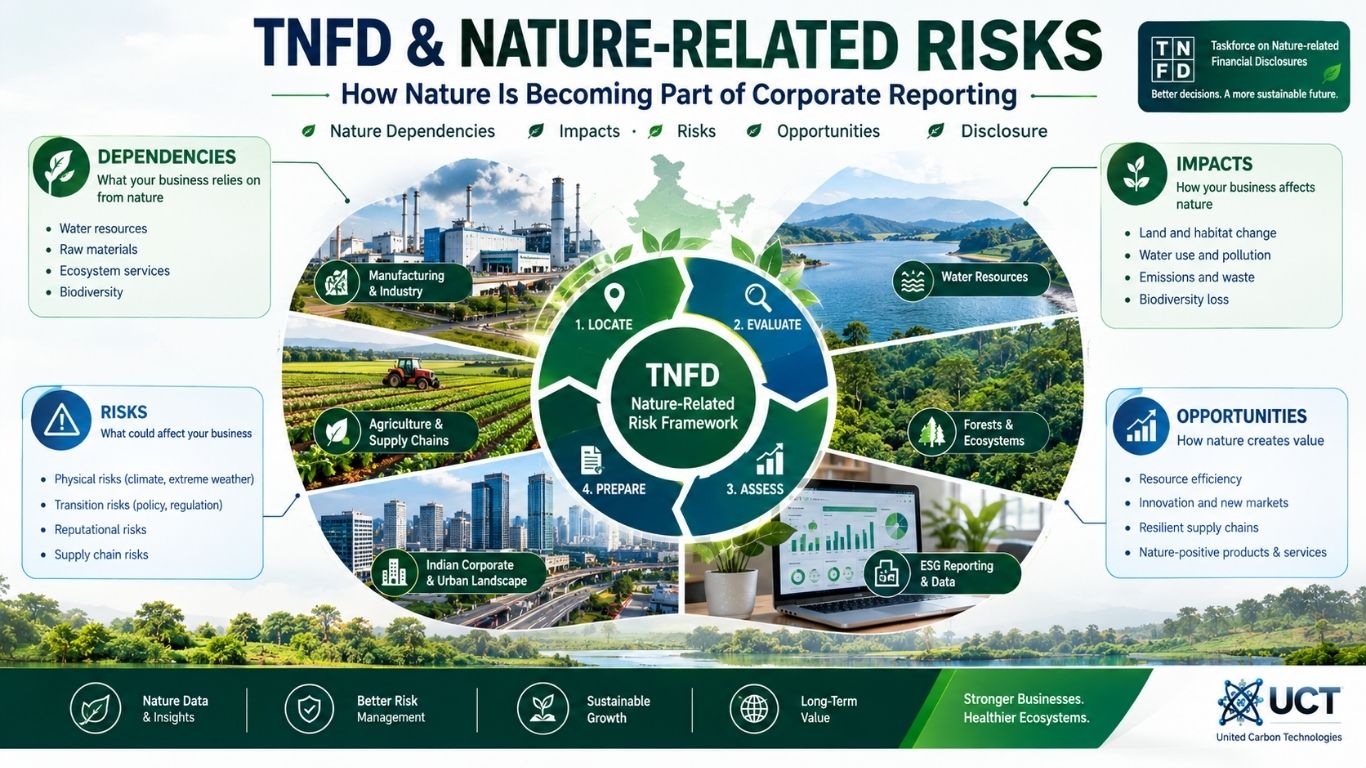
TNFD provides a framework that helps organizations identify, assess, manage, and disclose nature-related dependencies, impacts, risks, and opportunities. Its recommendations are designed to bring nature-related considerations into corporate strategy, risk management, governance, and reporting.
The Taskforce on Nature-related Financial Disclosures (TNFD) is a framework that provides recommendations for organizations to identify, assess, manage, and disclose material nature-related dependencies, impacts, risks, and opportunities across their operations and value chains.
```
Introduction: Why Is Nature Becoming a Corporate Reporting Issue?
Nature is often discussed as an environmental issue. For businesses, however, nature can also be connected to operational continuity, supply chains, resource availability, reputation, market opportunities, and financial risk.
Consider a company that depends heavily on agricultural commodities. Changes in soil quality, water availability, pollination, ecosystem health, or extreme weather can affect the availability and cost of inputs.
Similarly, a manufacturing facility may depend on reliable water supplies, while a construction or infrastructure project may interact with land, freshwater, forests, or sensitive ecosystems.
These relationships can create what TNFD describes as nature-related dependencies, impacts, risks, and opportunities.
As corporate sustainability reporting develops, companies are increasingly being asked to understand not only their carbon footprint but also how their business interacts with the natural systems on which economic activity depends.
Climate Intelligence Is Expanding into Nature Intelligence
```Understanding climate risk is increasingly connected with understanding ecosystems, resources, biodiversity, and nature-related dependencies across business operations and value chains.
Explore UCT Climate IntelligenceDid You Know?
TNFD's recommendations are structured around four pillars: Governance; Strategy; Risk and Impact Management; and Metrics and Targets. The framework contains 14 recommended disclosures and is designed to help organizations integrate nature-related issues into decision-making and corporate reporting.
1. What Does TNFD Stand For?
TNFD stands for the Taskforce on Nature-related Financial Disclosures.
It was established to develop recommendations and guidance that help businesses and financial institutions understand and communicate how nature-related issues can affect their organizations.
The framework focuses on four connected areas:
| TNFD Pillar | What It Covers |
|---|---|
| Governance | How the board and management oversee nature-related issues. |
| Strategy | How nature-related dependencies, impacts, risks, and opportunities affect strategy and financial planning. |
| Risk & Impact Management | How organizations identify, assess, prioritize, and monitor nature-related issues. |
| Metrics & Targets | How organizations measure and manage material nature-related dependencies, impacts, risks, opportunities, and targets. |
This structure makes TNFD particularly relevant to companies that want to move beyond general environmental statements toward a more systematic approach to nature-related risk management and disclosure.
2. What Are Nature-Related Risks?
Nature-related risks arise from the ways businesses depend on, interact with, and affect natural systems.
These risks can take different forms and may affect a company's operations, supply chain, financial performance, assets, or long-term strategy.
Physical Nature-Related Risks
Physical risks can arise when changes in ecosystems or natural resources affect the availability or quality of resources on which a business depends.
Examples may include:
- Water scarcity or declining water quality
- Soil degradation
- Loss of ecosystem services
- Declining pollination services
- Changes in fisheries or agricultural productivity
- Degradation of forests, wetlands, or other ecosystems
Transition-Related Nature Risks
Transition-related risks can emerge as governments, markets, investors, customers, and society respond to biodiversity loss and ecosystem degradation.
Businesses may therefore face changes in regulation, market expectations, financing conditions, consumer preferences, technology, or business practices.
3. What Is the Difference Between Nature Dependencies, Impacts, Risks, and Opportunities?
One of the most important concepts in TNFD is that these four terms are related but not identical.
| Term | Meaning in Business Context | Example |
|---|---|---|
| Dependency | A business relies on a natural resource, ecosystem service, or natural process. | A factory depends on freshwater. |
| Impact | Business activity affects nature positively or negatively. | Land use affects an ecosystem. |
| Risk | A nature-related issue could create financial, operational, strategic, or other business consequences. | Water scarcity disrupts production. |
| Opportunity | A nature-related development can create business value or strategic advantage. | Restoration or resource-efficiency solutions create new business opportunities. |
Understanding these relationships is important because a company's impact on nature can also influence the ecosystems and resources on which that company or its suppliers depend.
Is Your Business Mapping Its Nature Dependencies?
```Start by identifying where your operations and value chain interact with water, land, ecosystems, biodiversity, and other natural resources.
Talk to Our ESG Team4. What Are the Four TNFD Disclosure Pillars?
TNFD's recommended disclosures are organized into four pillars. This structure is designed to help organizations connect nature-related information with existing corporate governance, strategy, risk management, and performance processes.
Pillar 1: Governance
Governance focuses on how the board and management oversee nature-related dependencies, impacts, risks, and opportunities.
Businesses may need to consider who is responsible for nature-related matters, how oversight occurs, and how relevant responsibilities are integrated into existing governance structures.
Pillar 2: Strategy
Strategy examines how material nature-related issues can affect the organization's business model, value chain, strategy, and financial planning across different time horizons.
Pillar 3: Risk and Impact Management
This pillar focuses on the processes used to identify, assess, prioritize, and monitor nature-related dependencies, impacts, risks, and opportunities.
Pillar 4: Metrics and Targets
Metrics and targets help organizations measure and manage material nature-related issues. Depending on the company's activities, this can involve indicators related to dependencies, impacts, risks, opportunities, and progress toward defined objectives.
Preparing for the Next Stage of ESG Reporting?
```Nature-related information is becoming increasingly relevant to how businesses understand risk, resilience, value chains, and long-term sustainability.
Talk to Our ESG Team5. What Is the TNFD LEAP Approach?
One of the most useful elements of the TNFD framework is the LEAP approach. It provides a structured way for organizations to assess nature-related issues before deciding what is material and how those issues should be managed and disclosed.
LEAP stands for:
| LEAP Stage | Focus | Business Question |
|---|---|---|
| L — Locate | Locate interfaces with nature | Where does the business and its value chain interact with nature? |
| E — Evaluate | Evaluate dependencies and impacts | How does the business depend on or affect nature? |
| A — Assess | Assess risks and opportunities | What could these relationships mean for the business? |
| P — Prepare | Prepare to respond and disclose | What actions, governance, metrics, and disclosures are appropriate? |
The LEAP approach can help organizations move from a broad question such as "Does our company affect nature?" toward a more structured assessment of where nature-related issues could be relevant to business decision-making.
6. How Does the LEAP Approach Work in Practice?
Step 1: Locate
The first step is to understand where the organization and its value chain interact with nature. This can include facilities, production sites, farms, mines, warehouses, transportation routes, suppliers, and locations associated with raw-material sourcing.
Location matters because nature-related exposure can vary significantly between geographic areas. A facility operating in a water-stressed region may face a different risk profile from a similar facility operating in an area with abundant water resources.
Step 2: Evaluate
The business can then evaluate its major dependencies and impacts.
Questions may include:
- Which natural resources does the business depend upon?
- Which ecosystem services support operations?
- Which business activities have significant impacts on nature?
- Which suppliers have important nature-related dependencies?
- Which locations have particularly sensitive ecosystems or resource constraints?
Step 3: Assess
The next stage is to consider how identified dependencies and impacts could translate into business risks and opportunities.
For example, water dependency could become a production risk if availability declines. Agricultural supply-chain dependency could become a commercial risk if ecosystem degradation reduces crop productivity or increases input costs.
Step 4: Prepare
Finally, the organization can determine appropriate responses, governance arrangements, metrics, targets, risk-management processes, and disclosures.
The result should connect nature-related analysis with actual business decision-making rather than treating nature as a separate environmental topic.
7. What Nature-Related Data Do Businesses Need?
Nature-related reporting requires a different type of information from traditional carbon accounting. Greenhouse-gas accounting often begins with energy and activity data, while nature-related assessment can require information about location, ecosystems, resources, business activities, and value-chain relationships.
Depending on the sector, useful information may include:
- Facility and asset locations
- Water withdrawal and consumption
- Water quality indicators where relevant
- Land use and land-use change
- Raw-material sourcing locations
- Supplier locations and activities
- Waste and pollution information
- Resource consumption
- Interactions with ecosystems
- Biodiversity-sensitive locations
- Nature-related risks and dependencies
- Actions taken to prevent, reduce, restore, or manage impacts
Not every company needs every data point. The appropriate information depends on the company's sector, geography, business model, value chain, and material nature-related issues.
8. Why Is Location Important in Nature-Related Risk Assessment?
Location is particularly important because nature-related risks are often highly place-specific.
Carbon emissions have global climate implications, whereas many nature-related dependencies and impacts are closely connected to specific ecosystems, watersheds, landscapes, and geographic locations.
For example, two manufacturing plants may have similar production volumes but very different nature-related exposure if one depends on a stressed watershed or operates close to a biodiversity-sensitive area.
This makes geospatial information increasingly useful for corporate nature-risk assessment.
For nature-related risk, knowing what a business does is important, but knowing where it does it can be equally important.
9. Which Indian Industries May Need to Pay Particular Attention to Nature-Related Risks?
Nature-related issues can affect businesses across almost every sector, but the nature and intensity of exposure can differ significantly.
| Sector | Potential Nature Dependencies | Potential Issues |
|---|---|---|
| Agriculture & Food | Soil, water, pollination, ecosystems | Water stress, soil degradation, ecosystem changes |
| Manufacturing | Water, raw materials, land, ecosystem services | Resource availability, pollution, supply disruption |
| Mining & Metals | Land, water, geological resources | Land disturbance, water impacts, ecosystem sensitivity |
| Infrastructure | Land, water, ecosystem services | Land-use impacts and location-specific exposure |
| Textiles | Water, agricultural inputs, raw materials | Water consumption, pollution, raw-material dependency |
| Pharmaceuticals | Water, biological resources, raw materials | Resource availability, water and ecosystem impacts |
| Financial Services | Indirect exposure through financed activities | Portfolio and client exposure to nature-related risks |
This does not mean that every company in these sectors has the same level of nature-related exposure. A meaningful assessment should be based on the organization's actual operations, locations, dependencies, impacts, and value chain.
10. How Is TNFD Different from TCFD?
TNFD and TCFD are related in concept but focus on different environmental dimensions.
| Framework | Primary Focus | Typical Business Questions |
|---|---|---|
| TCFD | Climate-related financial risks and opportunities | How could climate change affect the company? |
| TNFD | Nature-related dependencies, impacts, risks, and opportunities | How does the company depend on and affect nature, and what business risks or opportunities follow? |
The two perspectives can complement one another. Climate change can affect ecosystems, while ecosystem degradation can also affect businesses and their ability to operate.
For companies building broader climate and sustainability strategies, nature-related assessment can therefore become an additional layer of enterprise risk and sustainability intelligence.
11. How Does TNFD Relate to ISSB and Corporate Sustainability Reporting?
The corporate reporting landscape is increasingly moving toward more structured sustainability information that can be useful to investors and other capital-market participants.
The International Sustainability Standards Board (ISSB) has developed sustainability disclosure standards focused on information relevant to investors and other providers of capital. TNFD, meanwhile, focuses specifically on nature-related issues.
TNFD's recommendations have been designed with interoperability in mind, which can help organizations consider nature alongside existing climate and sustainability reporting processes.
Businesses should nevertheless distinguish between a voluntary framework or recommendation and a specific legal reporting obligation. The reporting requirements applicable to an organization depend on its jurisdiction, regulatory status, listing status, reporting framework, and relevant reporting period.
12. Is TNFD Relevant to Indian Businesses?
TNFD can be relevant to Indian businesses even when a company is not currently preparing a standalone TNFD report.
Indian companies operate across sectors that can have significant relationships with water, land, agriculture, raw materials, forests, ecosystems, and natural resources. Nature-related dependencies can therefore influence operational resilience, supply chains, resource security, and long-term business strategy.
For businesses already developing ESG reporting capabilities, TNFD can provide a structured way to expand the analysis from greenhouse-gas emissions toward broader environmental dependencies and impacts.
TNFD and BRSR
India's sustainability reporting environment includes the Business Responsibility and Sustainability Report (BRSR) framework for applicable listed entities. TNFD should not be treated as a replacement for BRSR or as an automatic additional mandatory report for every Indian company.
Instead, businesses can examine where nature-related data, risk management, governance, resource-use information, and sustainability metrics may complement their existing ESG information systems.
Build an ESG Data Foundation That Can Grow
Climate, carbon, water, biodiversity, resource use, and nature-related risks increasingly require connected sustainability data rather than isolated reporting exercises.
Explore UCT Climate Intelligence13. How Can an Indian Business Start Preparing for TNFD?
Companies do not need to begin by producing a highly complex nature report. A practical starting point is to build an internal understanding of the organization's major nature-related dependencies, impacts, risks, and opportunities.
Step 1: Map Major Business Locations
Identify manufacturing sites, offices, warehouses, farms, mines, infrastructure assets, and other locations that are material to the business.
Step 2: Map Key Value-Chain Dependencies
Identify major raw materials, agricultural inputs, water dependencies, suppliers, logistics networks, and other activities that may have important relationships with nature.
Step 3: Identify Major Nature Interactions
Examine how the business depends on ecosystems and how its activities may affect land, water, biodiversity, pollution levels, resource availability, or ecosystem services.
Step 4: Assess Business Consequences
Translate nature-related dependencies and impacts into business questions. Could a nature issue affect production, procurement, operating costs, asset values, financing, market access, or customer relationships?
Step 5: Establish Governance
Determine who within the organization should monitor nature-related risks and how those issues should reach management and, where appropriate, board-level oversight.
Step 6: Develop Metrics and Action Plans
Once material issues are identified, establish suitable indicators, targets, mitigation measures, resource-efficiency initiatives, restoration or conservation actions where relevant, and monitoring processes.
14. What Could a TNFD Readiness Roadmap Look Like?
A business can approach nature-related reporting progressively. The following example is an illustrative roadmap rather than a universal reporting requirement.
| Phase | Focus | Illustrative Activities |
|---|---|---|
| 1. Understand | Awareness | Train teams and identify major nature-related concepts. |
| 2. Locate | Geographic exposure | Map assets, operations, suppliers, and nature-sensitive locations. |
| 3. Evaluate | Dependencies & impacts | Assess resource dependencies and business impacts on nature. |
| 4. Assess | Risks & opportunities | Prioritize material business risks and strategic opportunities. |
| 5. Prepare | Management & disclosure | Establish governance, metrics, actions, targets, and reporting processes. |
Is Your Business Ready for Nature-Related Risk Assessment?
Start with your locations, resource dependencies, value chain, environmental impacts, and the business consequences of nature-related change.
Talk to Our ESG Team15. How Are TNFD and Climate Reporting Connected?
Climate change and nature loss are closely connected, but they are not the same reporting issue. Businesses can face climate-related risks while also depending on, affecting, or creating risks for natural systems.
For example, a manufacturing company may experience climate risks from extreme heat or flooding while simultaneously depending on water resources and affecting local ecosystems through land use, wastewater, or resource consumption.
This means that climate and nature assessments can increasingly benefit from being considered together within broader sustainability and risk-management systems.
Climate reporting generally focuses on climate-related risks, opportunities and greenhouse-gas emissions, while TNFD focuses on nature-related dependencies, impacts, risks and opportunities.
Businesses should therefore avoid treating TNFD as simply another version of climate reporting. Instead, it can become an additional layer of environmental intelligence within an organization's broader ESG and sustainability framework.
16. Practical TNFD Readiness Checklist for Indian Businesses
A company does not need to immediately build a sophisticated nature-reporting system to begin preparing for TNFD-aligned assessment.
A practical starting point is to understand where the business interacts with nature and whether those interactions could create material business consequences.
| Readiness Area | Key Question |
|---|---|
| Locations | Where are our major facilities, operations and important suppliers located? |
| Dependencies | Which natural resources or ecosystem services does the business depend on? |
| Impacts | How could our operations or value chain affect nature? |
| Risks | Could nature-related changes affect revenue, costs, operations, assets or supply chains? |
| Opportunities | Could nature-positive products, efficiency or restoration create business opportunities? |
| Governance | Who is responsible for nature-related risks and opportunities? |
| Data | Do we have sufficient environmental, operational and location-level information? |
| Action | What management actions can reduce material risks and impacts? |
This checklist can help sustainability, risk, finance and operations teams establish an initial picture before moving toward a more detailed nature-related assessment.
17. Common Mistakes Businesses Should Avoid
Nature-related reporting is still developing. Companies can therefore benefit from avoiding several common approaches that may produce incomplete or disconnected assessments.
1. Treating TNFD as Only a Biodiversity Report
Nature-related issues extend beyond biodiversity. Water, land, soil, ecosystems, natural resources and ecosystem services can all be relevant to business dependencies and impacts.
2. Ignoring Location
Nature-related exposure is often highly location-specific. A resource dependency may have very different consequences depending on where an operation or supplier is located.
3. Looking Only at Direct Operations
A company's nature-related exposure may extend into agricultural inputs, raw materials, suppliers, logistics, financed activities and other parts of the value chain.
4. Treating Nature and Climate as Identical
Climate and nature are interconnected, but their risks, dependencies, impacts and measurement approaches are not identical.
5. Collecting Data Without Business Context
Simply collecting large quantities of environmental information does not automatically create useful risk intelligence. Businesses should connect relevant environmental information to operational, financial and strategic decisions.
6. Assuming a Framework Automatically Means Legal Compliance
A voluntary reporting framework and a regulatory reporting requirement are different things. Companies should separately determine which environmental and sustainability disclosures are legally applicable to them.
18. A Practical Three-Year TNFD Readiness Roadmap
For organizations that are beginning their nature-related reporting journey, implementation can be approached progressively rather than attempting to build a complete system immediately.
| Period | Primary Focus | Illustrative Activities |
|---|---|---|
| Year 1 | Understand & Locate | Map operations, locations, suppliers, natural-resource dependencies and major nature interactions. |
| Year 2 | Evaluate & Assess | Evaluate dependencies and impacts; identify material nature-related risks and opportunities. |
| Year 3 | Prepare & Integrate | Strengthen governance, metrics, targets, management actions and sustainability disclosures. |
The actual timeline will vary according to business size, sector, geographic footprint, value-chain complexity, available data and reporting objectives.
For a large organization with extensive operations, the process may require dedicated teams and specialized environmental and geospatial analysis. A smaller business may initially focus on its most material dependencies and operational locations.
19. What Does TNFD Mean for MSMEs and Large Corporates?
TNFD-related thinking can be relevant across different business sizes, but the depth of implementation does not have to be identical.
| Business Type | Possible Starting Point |
|---|---|
| MSMEs | Identify major natural-resource dependencies, key environmental impacts, important locations and supply-chain exposure. |
| Mid-sized Businesses | Build location-level assessments, establish governance and connect nature risks with operational and supply-chain management. |
| Large Corporates | Integrate nature-related dependencies, impacts, risks and opportunities into enterprise risk management, strategy, capital allocation and sustainability reporting. |
This makes TNFD-related preparation scalable. A company can begin with material issues rather than attempting to measure every possible interaction with nature at once.
20. How TNFD Can Become Part of a Broader ESG Data System
One of the practical benefits of TNFD-aligned thinking is that it can encourage businesses to connect environmental information that is often maintained in separate systems.
For example, a broader ESG data architecture could connect:
- Carbon emissions and energy consumption
- Water withdrawal and consumption
- Waste and pollution data
- Land and facility information
- Supplier and raw-material information
- Climate-related risks
- Nature-related dependencies and impacts
- Environmental targets and management actions
- ESG and sustainability reporting information
When these datasets are connected, sustainability teams can move from isolated environmental metrics toward a broader view of business exposure and environmental performance.
For Indian companies building ESG capabilities, this can also support the gradual integration of carbon accounting, climate-risk assessment, ESG reporting and nature-related assessment into a common climate-intelligence architecture.
Related Reads
Continue exploring related climate, carbon and ESG topics from the UCT Climate Knowledge Hub India:
- Climate Scenario Analysis: How Businesses Can Test Their Resilience Against Future Climate Risks
- What Is a Corporate Climate Transition Plan? A Practical Guide for Indian Businesses
- ESG Reporting Explained: What Indian Companies Need to Know
- Carbon Accounting Explained: How Businesses Measure Their Emissions
- What Is Scope 3 Emissions? A Practical Guide for Indian Businesses
Quick Summary: TNFD Explained
- TNFD stands for Taskforce on Nature-related Financial Disclosures.
- It provides recommendations for understanding and communicating nature-related dependencies, impacts, risks and opportunities.
- The framework is organized around four pillars: Governance, Strategy, Risk and Impact Management, and Metrics and Targets.
- The LEAP approach stands for Locate, Evaluate, Assess and Prepare.
- Location is particularly important because many nature-related risks are geographically specific.
- Businesses should consider both direct operations and relevant value-chain relationships.
- TNFD is related to ESG reporting but should not automatically be treated as a legal reporting requirement.
- Climate-related and nature-related risks can be interconnected but should not be treated as identical.
- Indian businesses can begin by mapping locations, dependencies, impacts and material risks.
- A phased approach can help organizations gradually integrate nature-related information into broader ESG and risk-management systems.
Frequently Asked Questions About TNFD
1. What is TNFD?
TNFD stands for Taskforce on Nature-related Financial Disclosures. It provides recommendations for organizations to identify, assess, manage and disclose nature-related dependencies, impacts, risks and opportunities.
2. What are the four pillars of TNFD?
The TNFD recommendations are organized around four pillars: Governance; Strategy; Risk and Impact Management; and Metrics and Targets.
3. What is the TNFD LEAP approach?
LEAP is an assessment approach consisting of four stages: Locate, Evaluate, Assess and Prepare. It helps organizations understand where they interact with nature, evaluate dependencies and impacts, assess risks and opportunities, and prepare appropriate responses and disclosures.
4. Is TNFD mandatory for Indian companies?
TNFD itself is a disclosure framework and recommendations should not automatically be treated as a legal reporting requirement for every Indian company. Businesses should separately determine which laws, regulations and reporting requirements apply to them.
5. How is TNFD different from climate reporting?
Climate reporting focuses on climate-related risks, opportunities and greenhouse-gas emissions, while TNFD focuses on nature-related dependencies, impacts, risks and opportunities. The two areas can be connected within broader sustainability management.
6. Which Indian industries may have significant nature-related dependencies?
Industries such as agriculture, food, textiles, manufacturing, mining, infrastructure and pharmaceuticals can have important relationships with water, land, ecosystems, biological resources or raw materials. Actual exposure depends on the company's operations and value chain.
7. How does TNFD relate to BRSR?
BRSR and TNFD serve different purposes. BRSR is an Indian business-responsibility reporting framework applicable to specified listed entities, while TNFD provides recommendations focused specifically on nature-related dependencies, impacts, risks and opportunities. They can be considered within a broader ESG reporting system.
8. Does TNFD require companies to report biodiversity?
TNFD covers nature-related issues more broadly than biodiversity alone. Depending on the company's activities and material issues, relevant areas can include ecosystems, water, land, biodiversity, natural resources and ecosystem services.
9. Can Indian MSMEs use the TNFD approach?
Yes. An MSME can use the underlying approach proportionately by identifying its major natural-resource dependencies, environmental impacts, important locations and potential business risks. It does not necessarily need the same level of assessment as a large multinational organization.
10. How should an Indian company start preparing for TNFD?
A practical starting point is to map important operational and value-chain locations, identify nature-related dependencies and impacts, assess potential business risks and opportunities, establish internal responsibility, and gradually develop relevant metrics and management actions.
Build Better Nature & ESG Intelligence
Nature-related risks are becoming an increasingly important part of how businesses understand environmental dependencies, operational resilience and long-term sustainability.
UCT is developing climate intelligence and sustainability solutions designed to help Indian businesses understand carbon, ESG and environmental data in a more structured way.
Explore UCT Climate IntelligenceAbout United Carbon Technologies
United Carbon Technologies is a climate-tech and sustainability initiative developing carbon intelligence, ESG reporting, climate education and sustainability solutions for Indian businesses.
Our work focuses on making climate and sustainability information more practical, measurable and accessible for organizations navigating India's evolving ESG and environmental landscape.
Built as part of ongoing climate-tech research and sustainability initiatives.