

ESG Assurance Explained: What Indian Companies Need to Know Before Their Reports Are Reviewed
By United Carbon Technologies | Climate Knowledge Hub India
Published: September 15, 2026 | Last Updated: September 15, 2026
ESG assurance is becoming an increasingly important part of corporate sustainability reporting. For Indian companies, understanding what ESG assurance means, what information may be reviewed, and how to prepare supporting evidence can improve reporting quality and strengthen confidence in sustainability disclosures.
What is ESG assurance?
ESG assurance is an independent process used to evaluate whether selected environmental, social, and governance information reported by a company is reliable, supported by appropriate evidence, and prepared according to the relevant reporting requirements or criteria.
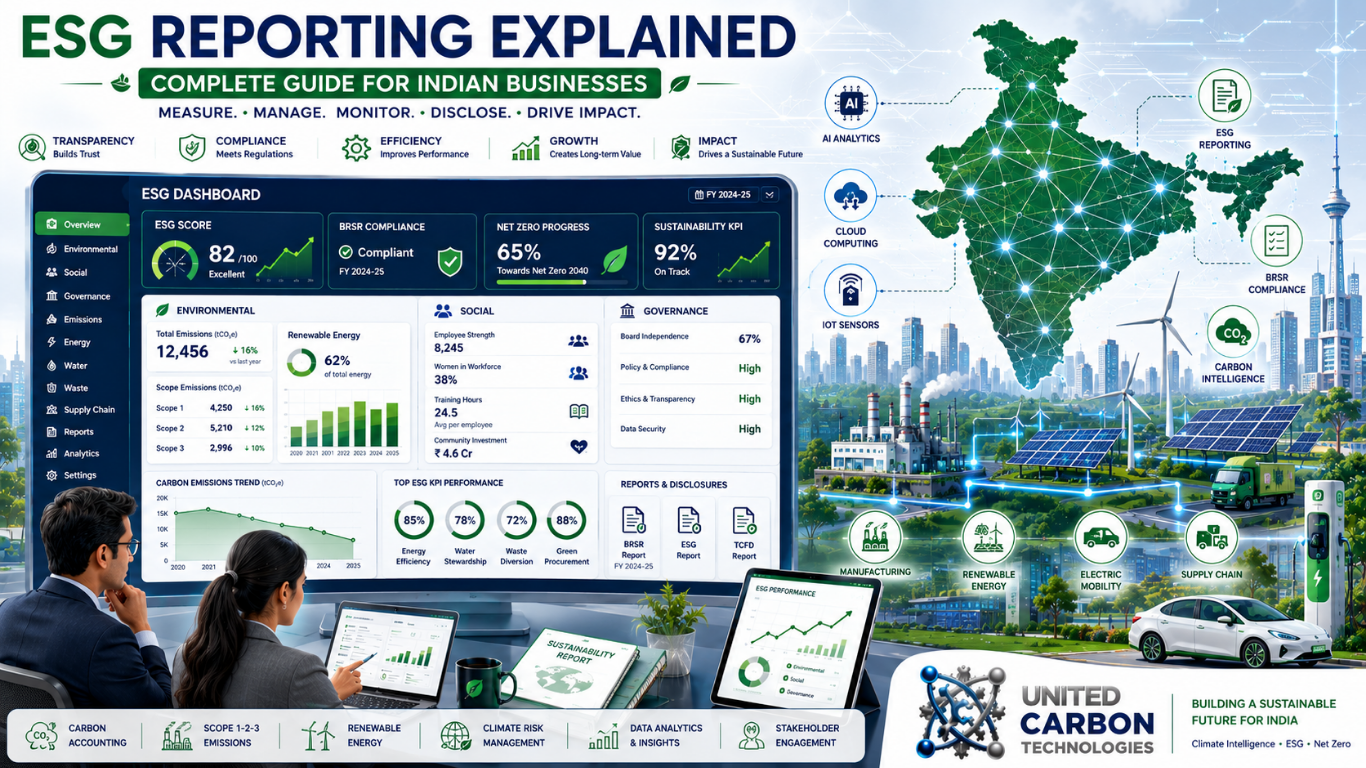
For many businesses, preparing an ESG report is no longer simply a matter of collecting sustainability information and publishing a document. As ESG reporting becomes more structured, companies increasingly need to demonstrate that the information they disclose is supported by reliable data, defined methodologies, documented processes, and appropriate evidence.
This is where ESG assurance becomes important. Assurance introduces an additional level of review around sustainability information and can help stakeholders gain greater confidence in the data presented by an organization.
For Indian companies, the subject is particularly relevant as sustainability disclosures become more closely connected with corporate reporting, investor expectations, regulatory developments, climate-related decision-making, and supply-chain requirements.
But ESG assurance should not be treated as something that begins when an external reviewer arrives. A well-prepared assurance process starts much earlier—with clearly defined ESG indicators, responsible data owners, consistent calculations, source documents, internal checks, and an evidence trail.
Climate intelligence connects ESG data, carbon measurement, sustainability performance, and reporting processes to help businesses make better-informed decisions.
Did you know?
ESG assurance does not simply ask whether a sustainability number appears in a report. A review can also involve examining the processes, methodologies, records, calculations, controls, and evidence supporting the reported information.
What Does ESG Assurance Actually Mean?
The word assurance can sound similar to verification, validation, auditing, or certification. Although these concepts can overlap in sustainability work, they are not automatically interchangeable.
In ESG reporting, assurance generally refers to an independent evaluation of selected sustainability information against defined criteria. The objective is to provide users of the report with a greater level of confidence that the information has been prepared appropriately.
The exact scope of an assurance engagement can vary. It may cover selected ESG indicators, particular environmental metrics, social indicators, governance information, or a defined set of disclosures.
For example, a company may report information relating to:
- Energy consumption
- Greenhouse gas emissions
- Water consumption
- Waste generation and disposal
- Employee-related indicators
- Health and safety performance
- Supply-chain sustainability information
- Other defined ESG performance indicators
The important point is that the reviewer needs to understand what has been reported, how it was calculated, where the underlying information came from, and whether appropriate evidence supports the disclosure.
Why Are Indian Companies Paying More Attention to ESG Assurance?
ESG reporting is increasingly being used by investors, lenders, customers, regulators, business partners, employees, and other stakeholders to understand how an organization manages sustainability-related risks and opportunities.
As sustainability information becomes more decision-useful, questions about the quality and reliability of that information naturally become more important.
For Indian businesses, this development is particularly significant because ESG disclosures are becoming more structured within the country's corporate reporting ecosystem. Companies therefore need to think beyond simply producing an attractive sustainability report.
A strong ESG reporting system should allow the organization to move from:
| Traditional Approach | Assurance-Ready Approach |
|---|---|
| Collecting numbers before reporting | Maintaining a defined ESG data process |
| Relying heavily on spreadsheets | Maintaining traceable data and supporting records |
| Estimating without clear documentation | Documenting methodologies and assumptions |
| Reviewing data at the end | Applying checks throughout the reporting cycle |
This shift is important because assurance readiness is fundamentally a data and process discipline, not just a final-stage reporting activity.
What Is the Difference Between ESG Reporting and ESG Assurance?
ESG reporting and ESG assurance are related but serve different purposes.
ESG reporting involves collecting, organizing, calculating, and communicating information about a company's environmental, social, and governance performance.
ESG assurance involves an independent review of specified information against defined criteria to provide confidence in the information within the agreed scope.
| Area | ESG Reporting | ESG Assurance |
|---|---|---|
| Primary purpose | Communicate ESG performance | Increase confidence in specified information |
| Main activity | Data collection and disclosure | Independent review against criteria |
| Evidence | Supports internal reporting | May be examined as part of the review |
| Timing | Throughout the reporting cycle | According to the assurance engagement |
A company therefore should not wait until the assurance process begins to discover whether its ESG information can be supported.
What Information Can Be Reviewed During ESG Assurance?
The scope depends on the engagement and the reporting framework involved. However, ESG assurance can require a company to demonstrate how important reported sustainability indicators were generated and supported.
For environmental information, this may include data relating to:
- Electricity and other energy consumption
- Fuel consumption
- Greenhouse gas emissions
- Scope 1 and Scope 2 emissions
- Selected Scope 3 categories where applicable
- Water withdrawal or consumption
- Waste generation and management
- Renewable energy use
For social information, the review may involve relevant employee, health and safety, diversity, training, or other workforce-related indicators depending on the reporting scope.
Governance-related disclosures may involve information concerning policies, oversight mechanisms, business conduct, risk management, or other defined governance indicators.
The key question is not simply “Do we have the number?” It is also:
“Can we demonstrate where the number came from and how it was produced?”
Why ESG Data Quality Is Critical Before a Report Is Reviewed
One of the biggest challenges in ESG reporting is that sustainability data often comes from multiple departments, facilities, systems, suppliers, invoices, meters, HR records, operational databases, and external sources.
Without a defined data-management process, the same metric can potentially be calculated differently across locations or reporting periods.
For example, a company's reported electricity consumption may depend on:
- Which facilities are included
- Which reporting period is used
- Whether purchased electricity and renewable electricity are separately identified
- Which bills, meters, or internal records support the data
- How missing information is treated
- Which emission factors are applied when emissions are calculated
An assurance-ready ESG system should therefore establish clear ownership and documentation for each important metric.
Before an ESG report reaches an external reviewer, businesses should understand their data sources, calculation methods, evidence requirements, responsibilities, and internal review controls.
What Does an ESG Reviewer Look for in the Data?
An ESG review is not necessarily limited to checking the final figures in a published report. Depending on the scope and criteria, the reviewer may need to understand the systems and processes used to generate the reported information.
This makes traceability particularly important.
A useful way to think about ESG data traceability is:
| Stage | Question |
|---|---|
| Source | Where did the original information come from? |
| Ownership | Who is responsible for the data? |
| Methodology | How was the information calculated? |
| Evidence | What records support the reported figure? |
| Review | What checks were performed before disclosure? |
The stronger this chain is, the easier it becomes for a company to explain and defend its ESG disclosures during a review.
Build stronger ESG reporting processes with structured data collection, carbon measurement, documentation, validation, and reporting workflows.
→ Talk to Our ESG Team
Understanding ESG assurance for Indian companies is becoming increasingly important for organizations that want their sustainability reporting to be reliable, transparent, traceable, and prepared for independent review. Assurance readiness begins with strong ESG data systems—not at the end of the reporting cycle.
What Is the Difference Between ESG Assurance, Verification, and Certification?
ESG assurance is sometimes used as a broad term for several types of sustainability-related review. However, businesses should understand that assurance, verification, and certification are not automatically the same thing.
The scope, criteria, level of confidence, subject matter, and conclusions can differ depending on the engagement. A company should therefore clearly understand what information is being reviewed and what type of conclusion the independent reviewer is expected to provide.
| Term | General Purpose | What Businesses Should Understand |
|---|---|---|
| ESG Assurance | Provides confidence over specified ESG information | Scope and criteria should be clearly defined |
| Verification | Checks specified information or claims against defined requirements | Often focused on particular data, inventories, or claims |
| Certification | Confirms conformity with a specified standard or system where certification is applicable | Depends on the relevant certification scheme and requirements |
The practical lesson for an Indian company is simple: do not assume that one sustainability review automatically covers every ESG disclosure. The company should understand the exact scope before preparing its evidence and reporting package.
How Does ESG Assurance Relate to BRSR and BRSR Core?
For Indian listed companies, ESG assurance needs to be understood alongside the country's evolving Business Responsibility and Sustainability Reporting (BRSR) framework.
BRSR provides a structured approach for companies to disclose information relating to environmental, social, and governance performance. BRSR Core goes further by identifying a set of key ESG indicators for which assessment or assurance requirements have been introduced in the regulatory framework.
This distinction is important because a company should not think of ESG assurance as simply reviewing the entire sustainability report in exactly the same way.
Instead, businesses need to understand:
- Which disclosures are within the applicable reporting requirements
- Which indicators fall within the relevant BRSR Core scope
- What assessment or assurance requirements apply
- What methodology is being used to calculate the reported indicators
- What evidence is available to support the information
- Who owns each ESG metric internally
Regulatory requirements can evolve, so companies should always confirm the latest applicable SEBI requirements for their reporting period rather than relying on an older reporting cycle.
What Is the Role of Evidence in ESG Assurance?
Evidence is one of the most important foundations of assurance-ready ESG reporting.
A sustainability figure may appear correct on a spreadsheet, but a reviewer may need to understand the underlying source and process used to produce that figure.
For example, electricity consumption may be supported by electricity bills, meter records, utility statements, internal energy-management systems, or other appropriate records depending on the company's circumstances.
Similarly, employee-related information may originate from HR systems, payroll records, attendance systems, safety registers, training records, or other documented sources.
A practical ESG evidence trail can therefore look like:
| ESG Metric | Possible Source | Supporting Evidence |
|---|---|---|
| Electricity consumption | Utility records / meters | Bills, meter data, internal records |
| Fuel consumption | Purchase and operational records | Invoices, fuel logs, consumption records |
| GHG emissions | Activity data + emission factors | Calculations, factors, source records |
| Employee data | HR systems | HR records and approved reports |
| Waste data | Waste-management records | Vendor records, manifests, internal logs |
The exact evidence required will depend on the metric, methodology, reporting framework, and assurance scope. The objective is to create a clear and defensible connection between the reported number and its underlying source.
Why Documentation Matters Before an ESG Review
Good ESG reporting is not only about collecting data. Companies should also document the decisions made while producing that data.
For example, if an organization excludes a facility from its reporting boundary, uses an estimation method because source data is unavailable, changes an emission factor, or applies a particular methodology, that decision should be documented appropriately.
Documentation can help answer questions such as:
- Why was this data source selected?
- Why is this facility included or excluded?
- Which emission factor was used?
- Who reviewed the calculation?
- How were missing values handled?
- Were previous-year figures restated?
- What assumptions were used?
Without documentation, a company may have the correct figure but struggle to explain how and why the figure was produced.
What Internal Controls Can Improve ESG Assurance Readiness?
ESG assurance readiness becomes much stronger when businesses introduce basic internal controls around sustainability information.
These controls do not necessarily have to be complicated. Even a structured process assigning responsibility for data collection, review, approval, and evidence retention can significantly improve consistency.
Useful ESG data controls can include:
- Defining a responsible owner for each ESG metric
- Maintaining standardized data-collection templates
- Recording data sources and reporting boundaries
- Documenting calculation methodologies
- Maintaining version-controlled calculation files
- Performing management review before final reporting
- Retaining supporting evidence
- Investigating unusual year-on-year changes
- Maintaining a record of assumptions and estimates
The goal is to make ESG information repeatable, reviewable, and traceable.
What Are the Most Common ESG Assurance Gaps?
Many assurance challenges are not caused by an organization's lack of sustainability initiatives. They arise because the underlying data and processes were not designed with reporting and review requirements in mind.
Common gaps can include:
| Common Gap | Why It Creates Difficulty |
|---|---|
| Missing source records | Reported information becomes difficult to substantiate |
| Unclear calculation methods | Reviewers may struggle to understand how figures were generated |
| Inconsistent data across locations | Can reduce comparability and reliability |
| Heavy dependence on manual spreadsheets | Increases the possibility of input or formula errors |
| Unclear ownership | Questions may move between departments without clear accountability |
| Late-stage data collection | Leaves little time to identify and resolve discrepancies |
A reliable ESG reporting system should connect every important disclosure with its source data, methodology, responsible owner, review process, and supporting documentation.
How Can Indian Companies Prepare for ESG Assurance?
Companies do not need to wait for an assurance engagement to begin preparing. A structured preparation process can start months before the sustainability report is finalized.
1. Define the ESG Reporting Boundary
First establish which entities, facilities, operations, employees, activities, and value-chain information are included within the relevant reporting scope.
2. Map Every Important ESG Metric
Create an ESG data register showing each reported metric, its definition, unit, source, responsible owner, calculation method, and reporting frequency.
3. Collect Source Evidence Throughout the Year
Do not wait until the end of the reporting period to search for supporting documents. Retain relevant evidence as part of the normal ESG data process.
4. Standardize Calculation Methodologies
Where calculations are required, document the methodology, assumptions, conversion factors, emission factors, formulas, and other relevant parameters.
5. Introduce Internal Review
Important ESG information should be reviewed before it becomes part of the final report. A second-level review can identify missing evidence, unusual values, inconsistent units, or calculation errors.
6. Perform an Assurance-Readiness Check
Before the external review begins, businesses can conduct an internal readiness exercise to identify gaps between the reported information and the evidence available to support it.
What Should an ESG Assurance Readiness Checklist Include?
A practical checklist can help sustainability, finance, operations, HR, procurement, and other teams work from the same reporting expectations.
| Readiness Area | Key Question |
|---|---|
| Reporting boundary | Is the reporting scope clearly defined? |
| Data ownership | Is a responsible person or team assigned to each key metric? |
| Source data | Can the original source of the information be identified? |
| Calculations | Are formulas and methodologies documented? |
| Evidence | Are supporting documents retained and accessible? |
| Internal review | Has the information been reviewed before reporting? |
| Changes | Are assumptions, methodology changes, and restatements documented? |
Why Should ESG Assurance Preparation Start Early?
One of the biggest mistakes a company can make is treating ESG assurance as a final reporting-stage exercise.
If evidence is collected only after the sustainability report has been drafted, the organization may discover that source documents are incomplete, calculations cannot easily be reproduced, different departments have used different definitions, or historical data is difficult to retrieve.
Early preparation creates an opportunity to correct these issues while the underlying information is still accessible.
It also encourages a useful change in organizational thinking:
Do not prepare ESG data only to publish a report. Prepare ESG data so that it can be understood, reproduced, reviewed, and trusted.
ESG Assurance in the Indian Business Context
India's sustainability reporting environment is evolving alongside increasing expectations around corporate transparency, responsible business practices, climate-related information, and ESG performance.
For large listed companies, this means ESG reporting teams increasingly need to coordinate with finance, internal audit, operations, human resources, procurement, risk management, and senior management.
For Indian MSMEs and unlisted businesses, the same principles can be valuable even when a particular assurance requirement does not directly apply. Strong ESG data management can support customer questionnaires, supply-chain requirements, investor discussions, sustainability programs, carbon accounting, and future reporting readiness.
This is particularly relevant for MSMEs that supply larger corporations. As large organizations increasingly examine their value chains, suppliers may increasingly be asked to provide reliable information about emissions, energy, water, waste, workforce practices, and other sustainability indicators.
What Does ESG Assurance Mean for Indian MSMEs?
An MSME may not currently be subject to the same ESG reporting requirements as a large listed company. However, that does not mean ESG data quality is irrelevant.
An MSME supplying a major corporate customer may increasingly encounter requests for:
- Carbon footprint information
- Energy consumption data
- GHG emissions information
- Environmental compliance information
- Workforce and health-and-safety data
- Supplier sustainability questionnaires
- Climate-risk information
Building an organized ESG data system early can therefore become a business advantage rather than simply a compliance exercise.
For smaller businesses, the most practical starting point is often simple: know your data, document your sources, standardize your calculations, and retain your evidence.
How Can Technology Improve ESG Assurance Readiness?
Technology can help organizations move away from fragmented ESG data collection and toward more structured sustainability information management.
A well-designed ESG data platform can help businesses organize:
- ESG metrics and indicators
- Data sources
- Reporting periods
- Calculation methodologies
- Emission factors
- Supporting documents
- Data owners
- Validation checks
- Approval workflows
- Reporting outputs
The objective is not simply to automate spreadsheets. The larger opportunity is to create a traceable ESG information system in which reported figures can be connected back to the underlying data and evidence.
This approach can also support carbon accounting, ESG reporting, climate-risk analysis, and sustainability performance management as companies mature their climate intelligence capabilities.
ESG assurance is closely connected with ESG, ESG reporting, carbon accounting, carbon footprint measurement, and climate intelligence.
UCT is developing climate intelligence and carbon measurement solutions for Indian businesses, helping organizations strengthen ESG data, carbon accounting, validation, and sustainability reporting processes.
→ Talk to Our ESG Team
ESG Assurance: Key Takeaways for Indian Companies
- ESG assurance provides greater confidence in specified sustainability information through an independent review against defined criteria.
- Assurance is different from simply preparing and publishing an ESG report.
- Evidence and traceability are critical because reported information needs to be supported by appropriate underlying records.
- Companies should document their reporting boundaries, methodologies, assumptions, calculations, and data sources.
- Internal controls can improve the consistency and reliability of ESG information.
- Indian listed companies should understand the applicable BRSR and BRSR Core requirements for their reporting period.
- MSMEs can also benefit from assurance-ready ESG data systems, particularly when responding to customer, supply-chain, or investor requirements.
- Technology can help connect ESG data, calculations, evidence, validation, and reporting into a more structured workflow.
Ultimately, ESG assurance should not be viewed as the final hurdle before publishing a sustainability report. It is an opportunity for companies to demonstrate that their sustainability information is supported by disciplined processes, reliable data, and appropriate evidence.
For Indian businesses preparing for increasingly structured ESG reporting, the best time to build assurance readiness is before the report is written—not after the reviewer arrives.
In Part 3, we will look at the practical questions companies should ask before an ESG assurance engagement, including common assurance questions, evidence preparation, data-quality checks, management responsibilities, and an ESG assurance readiness checklist.
What Questions Should Companies Ask Before ESG Assurance?
Before an ESG assurance engagement begins, companies should understand exactly what will be reviewed and what information will be required. Early clarification can prevent unnecessary confusion during the reporting process.
Management and sustainability teams should consider questions such as:
- What ESG information is included within the review scope?
- Which reporting criteria or requirements will be applied?
- Which ESG indicators require supporting evidence?
- Who owns each reported metric internally?
- Where is the underlying source data stored?
- Can reported figures be traced back to their original records?
- Are methodologies and assumptions documented?
- How are estimates and missing data handled?
- What internal review has already been performed?
- Are previous-year figures comparable with the current reporting period?
Answering these questions before the review begins can help the organization identify weaknesses while there is still time to address them.
What Should Management Do Before an ESG Report Is Reviewed?
ESG assurance is not only the responsibility of the sustainability team. Reliable ESG reporting usually requires coordination across multiple business functions.
Finance may provide financial and operational records. Operations may manage energy, fuel, water, production, and waste information. HR may manage workforce indicators. Procurement may hold supplier information. Risk and compliance teams may maintain relevant governance and regulatory records.
Senior management therefore has an important role in establishing accountability for the overall ESG reporting process.
A practical responsibility structure can look like this:
| Function | Possible ESG Responsibility |
|---|---|
| Sustainability / ESG Team | Coordinate reporting, methodologies, data collection, and disclosures |
| Finance | Support financial, operational, and control-related information |
| Operations | Provide facility-level activity and environmental data |
| Human Resources | Provide workforce and employee-related indicators |
| Procurement | Support supplier and value-chain information |
| Management | Provide oversight, accountability, and review |
How Can Companies Test Their ESG Data Before the Reviewer Does?
One useful preparation technique is to conduct an internal ESG data quality review before the formal assurance process.
Instead of asking only whether the final report looks complete, the company can select important ESG metrics and work backwards from the reported figure to the original source.
For example:
- Select a reported ESG indicator.
- Identify the calculation behind the reported figure.
- Check the underlying activity data.
- Locate the original supporting records.
- Confirm the reporting period and organizational boundary.
- Review the calculation methodology and assumptions.
- Check whether the information was reviewed internally.
- Document any gaps or corrections.
This simple exercise can reveal weaknesses in the ESG data trail before they become issues during an independent review.
What Should an ESG Assurance Evidence File Contain?
Companies can benefit from maintaining an organized evidence repository rather than searching for documents only when an assurance reviewer requests them.
Depending on the reporting scope, an evidence repository may contain:
- ESG reporting boundary documentation
- Data collection templates
- Source records and invoices
- Meter and utility records
- Fuel consumption records
- GHG emission calculations
- Emission-factor references
- Water and waste records
- HR and workforce records
- Safety and training records
- Supplier and value-chain information
- Methodology documents
- Assumptions and estimation records
- Internal review and approval records
The exact evidence will depend on the indicator and engagement scope. The important principle is to maintain a clear audit trail from source data to reported disclosure.
What Happens If ESG Data Has Errors?
Discovering an error in ESG data does not necessarily mean that the entire reporting process has failed. What matters is whether the organization identifies, investigates, documents, and appropriately addresses the issue.
A structured correction process can include:
- Identifying the incorrect information
- Determining the cause of the error
- Checking whether other reporting periods or locations are affected
- Correcting the underlying calculation or source data
- Documenting the correction
- Reviewing the effect on the reported disclosure
- Strengthening the relevant internal control
The lesson is important: ESG assurance readiness is not about pretending that data is perfect. It is about developing a process capable of identifying, explaining, and managing data-quality issues.
Can ESG Assurance Improve the Quality of Sustainability Reporting?
Yes. A well-designed assurance process can encourage organizations to improve the systems behind their sustainability disclosures.
When businesses know that important ESG information needs to be supported and explained, they are more likely to establish clearer definitions, better data ownership, stronger documentation, and more consistent calculation practices.
Over time, this can help transform ESG reporting from a periodic document-production exercise into a more structured management information system.
This is particularly valuable for carbon accounting. Emissions calculations depend on activity data, boundaries, methodologies, emission factors, and assumptions. When these components are systematically managed, carbon information becomes easier to review, compare, and use for decision-making.
ESG Assurance Should Be Built Into the Reporting Cycle
The strongest approach is to integrate assurance readiness into the entire ESG reporting cycle.
| Reporting Stage | Assurance-Ready Practice |
|---|---|
| Planning | Define scope, boundaries, metrics, owners, and methodologies |
| Data Collection | Capture source data and retain evidence |
| Calculation | Apply documented and consistent methodologies |
| Validation | Check completeness, consistency, and unusual changes |
| Reporting | Connect disclosures to supporting evidence |
| Review | Address questions and evidence requests systematically |
This approach can reduce last-minute pressure and help sustainability teams respond more confidently when information is requested.
ESG Assurance Readiness Checklist for Indian Companies
Before an ESG report is submitted for review, companies can use the following checklist as a practical starting point:
- ☐ Reporting boundary is clearly documented
- ☐ Key ESG indicators have defined owners
- ☐ Data sources are identified
- ☐ Reporting periods are consistent
- ☐ Units and definitions are standardized
- ☐ Calculation methodologies are documented
- ☐ Emission factors are recorded where applicable
- ☐ Estimates and assumptions are documented
- ☐ Supporting evidence is retained
- ☐ Important figures have been internally reviewed
- ☐ Unusual year-on-year movements have been investigated
- ☐ Changes to methodologies are documented
- ☐ Previous-period information can be traced where relevant
- ☐ Responsible teams understand their ESG data responsibilities
- ☐ The company understands the scope of the external review
Related Reads
- What Is a Carbon Audit?
- What Is a Carbon Audit for Businesses?
- How Companies Track Carbon Emissions
- How Businesses Measure Operational Carbon
- Operational Carbon Explained for Businesses and Buildings
- What Is a Carbon Baseline Assessment?
- How to Build a Carbon Inventory for Your Business
- What Are Emission Factors?
- How Companies Calculate Their Corporate Carbon Footprint
ESG reporting becomes stronger when businesses can connect every important disclosure with reliable data, documented methodologies, supporting evidence, and defined accountability.
UCT is developing climate intelligence and carbon measurement solutions for Indian businesses to support stronger ESG data, carbon accounting, sustainability analytics, and reporting workflows.
→ Talk to Our ESG Team
Frequently Asked Questions About ESG Assurance
1. What is ESG assurance?
ESG assurance is an independent review of specified environmental, social, and governance information against defined criteria. It is intended to increase confidence in the reliability of the information within the agreed scope.
2. Is ESG assurance the same as an ESG audit?
Not necessarily. ESG assurance, verification, and audit-related activities can have different scopes, objectives, criteria, and conclusions. Companies should understand the exact nature and scope of the engagement applicable to their reporting.
3. Why is ESG assurance important for Indian companies?
ESG assurance can strengthen confidence in sustainability disclosures and encourage better data management, documentation, internal controls, and reporting processes. It is particularly relevant as India's corporate sustainability reporting environment becomes more structured.
4. What ESG information may be reviewed?
Depending on the engagement, review may cover selected environmental, social, and governance indicators such as energy, greenhouse gas emissions, water, waste, workforce information, health and safety, and other specified disclosures.
5. What evidence is needed for ESG assurance?
Evidence depends on the metric and review scope. It may include utility records, invoices, meter data, HR records, waste documentation, calculations, emission factors, methodologies, assumptions, and other supporting records.
6. How can a company prepare for ESG assurance?
Companies can prepare by defining reporting boundaries, assigning data ownership, standardizing methodologies, maintaining source evidence, documenting assumptions, introducing internal reviews, and performing an assurance-readiness assessment before the external review.
7. Does ESG assurance apply only to large companies?
Specific regulatory requirements may apply differently depending on the type of company and reporting framework. However, assurance-ready ESG data practices can also benefit Indian MSMEs, especially businesses supplying larger corporations or responding to customer, investor, and supply-chain sustainability requirements.
8. Why is carbon accounting important for ESG assurance?
Carbon accounting depends on activity data, organizational boundaries, calculation methodologies, emission factors, and supporting evidence. Maintaining these elements systematically can make greenhouse gas information more traceable and easier to review.
9. What is the biggest ESG assurance mistake companies make?
One common mistake is treating assurance as a final-stage exercise. If data sources, calculations, evidence, and responsibilities are not managed throughout the reporting cycle, companies may face unnecessary difficulties when the information is reviewed.
10. Can technology help with ESG assurance readiness?
Yes. Structured ESG technology can help organizations manage data collection, source documentation, calculations, validation, approvals, evidence, carbon accounting, and reporting in a more traceable workflow.
Understand ESG, carbon accounting, climate risk, sustainability reporting, and climate intelligence through practical learning designed for India's changing business environment.
Join early learners building climate awareness across India.
ESG assurance is ultimately about more than having a sustainability report reviewed. It is about building confidence in the information that organizations use to communicate their environmental, social, and governance performance.
For Indian companies, the move toward stronger ESG data quality means that reporting teams should begin thinking about assurance well before the final report is prepared. Clear boundaries, reliable source data, documented calculations, strong evidence, internal controls, and defined accountability can make the entire reporting process more effective.
The future of ESG reporting will depend not only on what companies disclose, but also on how confidently they can demonstrate the information behind those disclosures.