

Methane Leak Detection in Industry: Practical Methods for Finding and Reducing Invisible Emissions
Published: 5 November 2026 | Updated: 5 November 2026
Follow the Climate Knowledge Hub India for practical insights on carbon emissions, climate technology, ESG and sustainable industrial operations.
+ Follow for ESG InsightsMethane emissions are an important climate challenge for industrial operations, particularly in sectors that extract, process, transport or use natural gas and other methane-containing materials. Unlike visible smoke or liquid spills, methane leaks are often difficult to identify through routine visual inspections. Small leaks from valves, pipelines, compressors, pumps, connectors and storage equipment can continue unnoticed unless facilities have appropriate monitoring and inspection procedures.
Methane leak detection is the process of identifying unintended methane releases from equipment, infrastructure and industrial processes. It combines inspection practices, gas-detection instruments, optical imaging, fixed monitoring systems and, in some applications, aerial or satellite-based observations. Detection is only the first step: effective methane management also requires locating the source, prioritising repairs, documenting corrective action and checking whether the emissions have actually stopped.
For Indian businesses operating in oil and gas, natural gas distribution, industrial processing, coal-related operations, wastewater treatment and biogas facilities, a structured leak detection and repair programme can help reduce avoidable emissions, improve operational control and identify losses of valuable gas.
Featured Snippet: What Is Methane Leak Detection?
Methane leak detection is the systematic identification of unintended methane releases from industrial equipment and infrastructure. It uses methods such as portable gas detectors, optical gas imaging cameras, fixed sensors, mobile monitoring and aerial surveys. A complete leak detection and repair programme identifies leaks, records their locations, prioritises corrective action, completes repairs and verifies that emissions have been reduced.
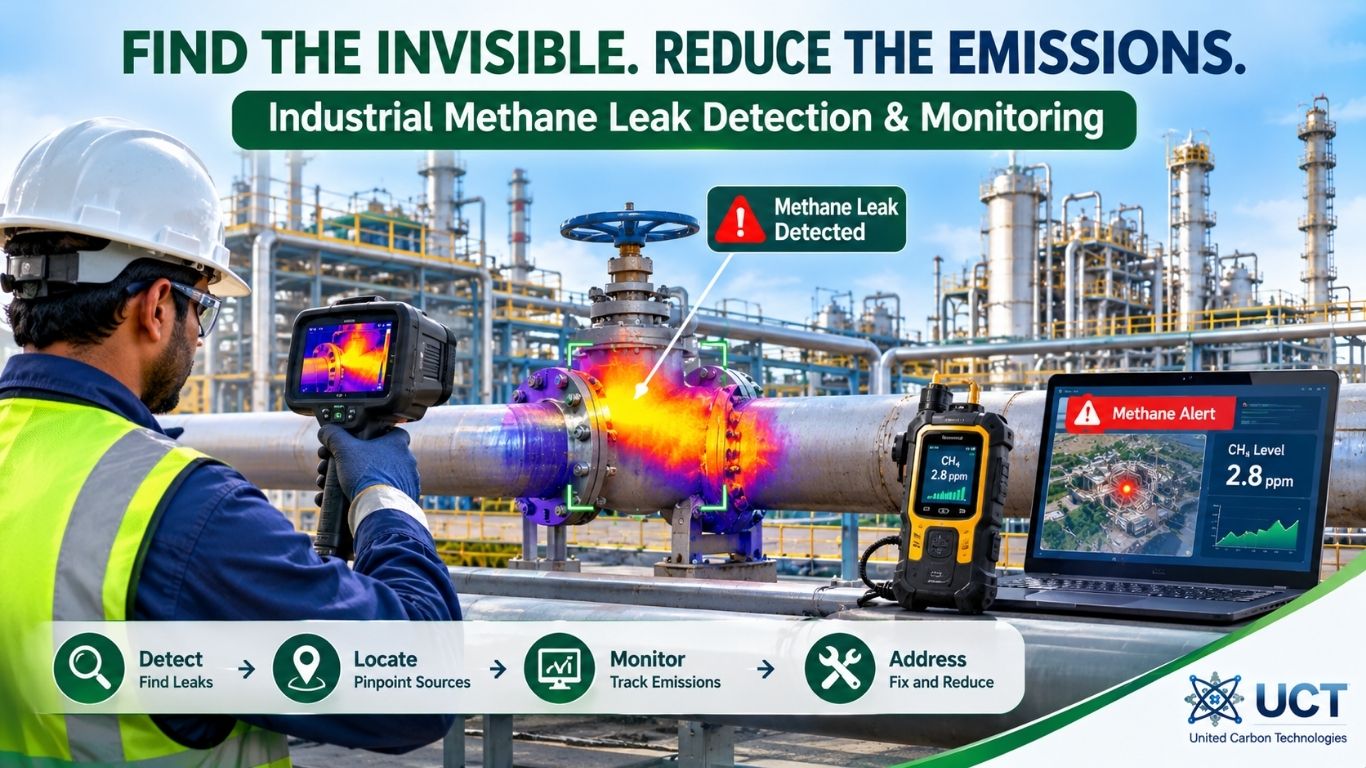
Introduction: Why Invisible Methane Leaks Need Industrial Attention
Industrial facilities depend on extensive networks of pipes, joints, valves, compressors, pumps, tanks and processing equipment. These systems may operate under pressure, experience temperature changes, undergo repeated mechanical movement or be exposed to corrosion and wear. Over time, equipment deterioration, loose connections, damaged seals and maintenance failures can create pathways through which methane escapes.
A methane leak may not produce a visible plume under ordinary conditions. It may also occur intermittently, making it difficult to identify during a single inspection. This creates a practical challenge for facility managers: the absence of an obvious warning sign does not necessarily mean that equipment is operating without emissions.
The International Energy Agency identifies leak detection and repair as one of the established measures available to reduce methane emissions from oil and gas operations. Its methane analysis also highlights the importance of combining improved measurement with practical mitigation measures.
For industrial businesses, this means methane management should not be treated as an occasional environmental exercise. It should be connected with equipment maintenance, process safety, environmental management and operational performance.
Build Better Visibility into Industrial Emissions
Understanding emissions begins with identifying where they originate, how they are measured and which operational improvements can reduce them. Explore how climate intelligence can support more informed sustainability decisions.
Explore UCT Climate IntelligenceDid You Know?
Methane monitoring is increasingly moving beyond occasional facility inspections. Satellite observations, aircraft, drones, fixed sensors and handheld instruments can provide information at different scales. However, these technologies serve different purposes: a satellite may identify a large emissions plume over a broad area, while a handheld detector or optical gas imaging camera can help an inspection team investigate a specific equipment component.
1. Understanding Where Methane Leaks Occur in Industrial Facilities
An effective methane detection programme begins with an understanding of the equipment and processes that may release methane. The sources vary according to the facility's activities, the gases handled and the operating conditions.
1.1 Valves, Flanges and Pipeline Connections
Valves, flanges, threaded joints, connectors and other pipeline components are common inspection points in facilities handling natural gas or methane-rich process streams. Seals and gaskets may deteriorate, connections may loosen, and mechanical damage can create leakage pathways.
Because industrial installations can contain hundreds or thousands of individual components, relying only on general visual inspections may leave small or intermittent leaks unidentified. A component inventory and a systematic inspection schedule help teams establish which locations require attention.
1.2 Compressors and Pumps
Compressors are used to move and pressurise gas through industrial systems. Their seals, connections and associated equipment require appropriate inspection and maintenance. Depending on the equipment design and process configuration, leakage may occur around seals, fittings or connected components.
Pumps and other equipment handling methane-containing fluids or gases may also require monitoring. Maintenance teams should understand the equipment-specific leakage pathways rather than applying the same inspection method to every asset.
1.3 Storage Tanks and Processing Equipment
Storage tanks, separators, processing vessels and related equipment can release methane through faulty fittings, pressure-control arrangements, damaged seals or unintended venting. Some releases may be associated with equipment malfunction, while others may result from process operations or maintenance activities.
Facilities should distinguish between unintended leaks and designed gas-release points. This distinction is important because a leak repair programme alone cannot address every source of methane emissions. Process modifications, vapour recovery, equipment replacement or improved operating procedures may be required for other sources.
1.4 Gas Distribution and Industrial Utility Networks
Industrial campuses and gas distribution systems may contain pipelines, regulators, metering stations, pressure-control equipment and numerous connection points. Leakage can occur across different sections of the network, including equipment located outside the main production building.
A useful monitoring plan therefore covers the complete operational boundary rather than focusing only on production machinery. Inspection priorities should consider equipment condition, operating pressure, historical maintenance records and the consequences of a potential release.
1.5 Wastewater, Biogas and Organic-Waste Facilities
Methane can also arise in facilities that manage organic waste under anaerobic conditions. Wastewater treatment plants, anaerobic digesters, biogas production systems and certain organic-waste processing operations may handle methane-containing gas.
Potential release points can include gas collection lines, digesters, gas holders, pipe connections, valves, pressure-relief arrangements and gas-treatment equipment. These facilities need monitoring approaches suited to their process design, gas composition and operating conditions.
A methane source inventory should identify equipment, process areas, gas-handling systems, inspection access and maintenance responsibilities. Without this baseline, a facility may conduct inspections without knowing whether its monitoring programme covers the most important potential emission sources.
2. Why Traditional Inspections Alone May Not Be Enough
Routine equipment inspections remain essential for industrial maintenance. Operators may check for damaged fittings, abnormal pressure readings, unusual sounds, visible equipment deterioration and other signs of malfunction. These checks can help identify operational problems, but they do not always provide sufficient evidence to detect or characterise methane emissions.
2.1 Methane Cannot Reliably Be Identified by Sight
Methane is colourless and odourless in its pure form. Natural gas supplied to consumers may contain an added odorant, but industrial gas streams and other methane-containing process gases should not be assumed to have a detectable smell. Smell-based checks are therefore not a reliable methane measurement method.
2.2 Small Leaks Can Remain Undetected
A small leak may not create an obvious operational disturbance. It may continue for an extended period if inspection teams do not use suitable gas-detection equipment or follow a defined survey procedure. Repeated inspections and appropriate instruments improve the likelihood of identifying these sources.
2.3 Intermittent Releases Can Be Difficult to Capture
Some emissions occur only under particular operating conditions, during equipment start-up or shutdown, or when pressure and temperature change. A one-time inspection may not capture these events. Monitoring frequency and timing should therefore reflect how the facility operates.
2.4 Finding a Leak Is Not the Same as Measuring Its Emissions
Detection and quantification are related but different activities. A detection instrument may indicate the presence of methane or help locate a leak without providing a reliable emission rate. Quantification requires suitable measurement methods and an understanding of the instrument's capabilities and limitations.
For example, optical gas imaging cameras can help operators visualise gas releases and locate potential leak points. However, a conventional optical gas imaging image is generally qualitative: it does not automatically provide the methane emission rate in kilograms per hour. Additional measurement methods may be needed when a facility must estimate the size of a release or demonstrate measured reductions.
This distinction is important for businesses preparing methane inventories, environmental disclosures or measurement-based reporting. A record that a leak was detected is useful, but it should not be presented as a quantified emissions result unless an appropriate measurement or estimation method supports it.
Make Industrial Emissions More Visible
Better climate performance depends on reliable information about emissions sources, operational activity and corrective action. Explore UCT's work in carbon intelligence, climate innovation and sustainability solutions.
Explore United Carbon TechnologiesStrengthening Emissions Management in Your Business?
Industrial organisations need more than an emissions estimate. They need clear data, defined responsibilities and practical processes that connect environmental performance with business operations.
Connect with United Carbon Technologies to explore ESG reporting, carbon measurement and climate intelligence solutions for Indian businesses.
Talk to Our ESG Team3. Practical Technologies Used for Methane Leak Detection
Industrial methane monitoring uses different technologies depending on the facility's size, equipment configuration, expected leak characteristics and monitoring objectives. Some instruments help workers identify methane near individual components, while others survey larger areas or continuously monitor selected locations.
No single technology is suitable for every situation. A facility may need a combination of portable instruments, optical imaging, fixed sensors and periodic aerial or mobile surveys to build an effective methane monitoring programme.
3.1 Portable Methane Gas Detectors
Portable gas detectors are handheld instruments used by inspection teams to identify methane concentrations near equipment, connections and other potential leak points. Depending on the instrument design, they may use catalytic, infrared, semiconductor or other sensing technologies.
These instruments are useful for routine inspections because technicians can carry them through production areas and examine individual components. Some detectors provide an audible or visual alarm when methane concentrations exceed a configured threshold, while others display measured gas concentrations.
Typical applications include:- Inspecting valves, flanges, connectors and pipeline joints.
- Checking compressor and pump areas.
- Investigating suspected gas releases identified during routine maintenance.
- Conducting follow-up checks after repairs.
Important limitation: Portable detectors differ in sensitivity, response time, calibration requirements and measurement units. A concentration reading near a component should not automatically be interpreted as the emission rate of that leak. Technicians must follow the instrument manufacturer's operating instructions and the facility's inspection procedure.
3.2 Optical Gas Imaging (OGI) Cameras
Optical Gas Imaging cameras are designed to visualise certain gases that are difficult or impossible to see with the naked eye. Specialised infrared cameras can detect the infrared absorption characteristics of gases such as methane and display gas movement as a visible image on the camera screen.
OGI technology can help inspection teams examine multiple components from a suitable viewing position. It is particularly useful in complex industrial installations where a large number of potential leak points need to be inspected efficiently.
Typical applications include:- Surveying gas processing equipment and pipeline installations.
- Inspecting valves, connectors, compressor seals and other components.
- Identifying potential gas releases from difficult-to-access locations.
- Documenting suspected leaks through inspection images or video.
Important limitation: OGI performance depends on factors such as camera specifications, distance, weather, background temperature, gas characteristics and operator experience. Conventional OGI images generally provide qualitative evidence of a gas release rather than a direct measurement of its emission rate. Additional quantification methods may be required.
3.3 Fixed Methane Gas Sensors
Fixed methane sensors are installed at selected locations within a facility to monitor gas concentrations continuously or at defined intervals. They can be connected to control systems, alarms or monitoring dashboards, allowing operators to respond when readings indicate an abnormal condition.
These systems are particularly useful in areas where gas accumulation or unexpected releases could create operational and safety concerns. Sensor placement should be based on the facility's process design, gas characteristics, ventilation, potential release locations and relevant safety engineering requirements.
Typical applications include:- Compressor rooms and enclosed gas-handling areas.
- Gas storage and processing installations.
- Biogas plants and anaerobic digestion facilities.
- Selected pipeline and utility equipment locations.
Important limitation: Fixed sensors monitor the locations where they are installed. They do not automatically detect every leak across an entire facility. Sensor coverage, alarm configuration, calibration, maintenance and response procedures are essential to system effectiveness.
3.4 Drone-Based Methane Monitoring
Drones equipped with suitable methane-detection instruments can survey selected industrial areas, pipeline corridors and locations that may be difficult or time-consuming for ground teams to inspect. They can provide useful information about potential releases from elevated equipment, remote infrastructure or large industrial sites.
Depending on the payload and monitoring approach, drone-based surveys may use gas sensors, laser-based instruments or other specialised measurement systems. The technology can support targeted inspections and help identify areas requiring closer investigation.
Typical applications include:- Surveying long pipeline corridors and remote installations.
- Inspecting elevated structures and hard-to-reach equipment.
- Screening selected industrial areas for potential methane releases.
- Supporting follow-up investigations after an initial detection.
Important limitation: Drone monitoring depends on payload capability, flight permissions, weather, operating conditions and the ability of the instrument to detect and locate the target gas. A drone survey should not be assumed to replace detailed component-level inspections.
3.5 Mobile Monitoring and Vehicle-Based Surveys
Mobile methane monitoring uses instruments installed on vehicles or carried by mobile inspection teams to identify methane concentrations across a wider area. These surveys can be useful for screening pipeline networks, industrial campuses and gas distribution infrastructure.
Mobile monitoring can help identify areas with elevated methane readings. Inspection teams can then conduct targeted investigations to locate the source and determine whether the release is associated with a particular component or section of infrastructure.
Typical applications include:- Screening extensive gas distribution networks.
- Surveying industrial campuses and utility corridors.
- Identifying areas that require detailed follow-up inspections.
- Supporting periodic monitoring across geographically dispersed assets.
Important limitation: Mobile measurements can be affected by wind, vehicle speed, background methane concentrations, instrument response and the distance between the sensor and the release. A detected concentration does not necessarily identify the exact leak component.
3.6 Satellite-Based Methane Monitoring
Satellite-based monitoring has expanded the ability to observe methane emissions over large geographical areas. Satellites equipped with suitable instruments can identify methane concentrations or emission plumes under favourable observation conditions.
This technology is particularly relevant for identifying significant methane emission events, observing patterns across regions and directing attention towards locations that may need further investigation.
Typical applications include:- Monitoring large industrial and energy-producing regions.
- Identifying substantial methane emission events.
- Supporting regional and national methane observation programmes.
- Providing information that can guide targeted ground-level investigations.
Important limitation: Satellite observations are affected by cloud cover, observation conditions, spatial resolution, detection thresholds and the characteristics of the instrument. They may not identify small individual equipment leaks. Satellite information should therefore complement, rather than replace, facility-level monitoring and repair programmes.
3.7 Comparing Methane Detection Technologies
| Technology | Main Application | Key Limitation |
|---|---|---|
| Portable gas detectors | Component-level inspection | Requires access and systematic inspection |
| Optical gas imaging | Visualising gas releases | Conventional images are generally qualitative |
| Fixed gas sensors | Continuous monitoring at selected points | Coverage depends on sensor placement |
| Drone monitoring | Remote and elevated-area surveys | Payload, weather and flight constraints |
| Mobile monitoring | Screening larger areas and networks | May require follow-up to locate the exact source |
| Satellite monitoring | Large-scale emission observation | Limited suitability for small component leaks |
The most appropriate technology depends on the monitoring objective. A facility investigating a suspected valve leak may need a portable detector or OGI camera, while an organisation screening a long pipeline network may benefit from mobile or aerial monitoring. Larger emission events may also be identified through satellite observations.
4. How to Select the Right Methane Detection Method
Technology selection should begin with the facility's monitoring requirements rather than the availability of a particular instrument. Businesses should first understand what they need to detect, where the potential sources are located and what action will follow a detection.
4.1 Identify the Monitoring Objective
A facility may have several different objectives:
- Leak identification: Finding the equipment or location from which methane is escaping.
- Continuous safety monitoring: Identifying abnormal gas concentrations in selected operational areas.
- Emission quantification: Estimating or measuring the amount of methane released over a defined period.
- Large-area screening: Identifying areas that may require detailed investigation.
- Repair verification: Confirming that a previously identified leak has been successfully addressed.
These objectives are not interchangeable. A technology suitable for detecting the presence of gas may not provide the measurement accuracy needed for emissions quantification.
4.2 Consider Facility Size and Equipment Layout
A small industrial facility with a limited number of gas-handling components may be able to conduct regular inspections using portable instruments. A large refinery, gas processing installation or pipeline network may require a combination of fixed sensors, mobile surveys, optical imaging and specialist inspection teams.
Equipment accessibility also matters. Components located at height, inside restricted areas or across remote pipeline corridors may require different monitoring arrangements.
4.3 Evaluate Detection Capability and Operating Conditions
Before selecting an instrument, businesses should evaluate its detection limits, response time, measurement range, calibration requirements and suitability for the expected gas composition and operating environment.
Temperature, wind, humidity, background gases, ventilation and physical obstructions may influence detection performance. Facilities should also consider whether the equipment is appropriate for the hazardous-area classification and safety requirements of the intended installation.
4.4 Assess the Need for Quantification
If the objective is simply to locate a leak for repair, a detection method may be sufficient to initiate corrective action. If the organisation needs to estimate emissions, compare performance across reporting periods or substantiate a methane reduction claim, it may need additional measurement or engineering-based estimation methods.
Businesses should document the measurement approach, assumptions, operating conditions and uncertainty associated with any reported emission estimate.
4.5 Consider Total Programme Cost
The cost of methane monitoring is not limited to purchasing an instrument. It may also include operator training, calibration, maintenance, software, data management, specialist surveys, repairs and periodic verification.
A practical approach is to compare the expected programme cost with the operational benefits, including reduced gas losses, improved maintenance planning, fewer uncontrolled releases and better emissions information.
5. Building an Effective Leak Detection and Repair (LDAR) Programme
A successful methane management system needs a repeatable process for identifying, recording, repairing and verifying leaks. This is commonly organised through a Leak Detection and Repair (LDAR) programme.
LDAR is not simply a periodic inspection activity. It is an operational system that connects equipment inventories, monitoring schedules, inspection results, maintenance responsibilities and follow-up verification.
5.1 Step One: Prepare an Equipment and Source Inventory
The first step is to identify the equipment and process areas that may release methane. The inventory should be sufficiently detailed to allow inspection teams to locate each component and maintain a history of inspection and repair.
A facility inventory may include:
- Equipment identification number and location.
- Component type, such as valve, flange, connector or compressor.
- Process gas or material handled.
- Operating conditions and relevant equipment information.
- Inspection history and previous leak records.
- Responsible department or maintenance team.
5.2 Step Two: Establish Inspection Procedures and Frequency
Inspection schedules should reflect the facility's equipment inventory, potential emission sources, historical leak performance, operating conditions and applicable regulatory or permit requirements.
Higher-risk equipment or locations with repeated leakage may require more frequent monitoring. Facilities should also define how inspections will be conducted during start-up, shutdown, maintenance and other relevant operating conditions.
The inspection procedure should specify the instrument to be used, measurement approach, inspection route, recording requirements and the process for escalating suspected leaks.
5.3 Step Three: Conduct Systematic Leak Surveys
Inspection teams should follow a defined survey route so that equipment is not repeatedly missed or inspected without proper records. Each inspection should be linked to the relevant equipment identification number.
When a potential leak is detected, the team should record the location, instrument used, date, time, operating conditions and available measurement information. Where appropriate, photographs, OGI images or inspection notes can support the record.
5.4 Step Four: Record and Prioritise Identified Leaks
Not every detected leak will have the same operational significance. A facility should use a defined prioritisation method that considers the measured or estimated release, equipment condition, safety implications, process criticality and the feasibility of repair.
Potentially significant or safety-critical releases should be escalated immediately through the facility's established safety and emergency procedures. Other leaks should be assigned to responsible maintenance teams with clear corrective-action deadlines.
The priority system should be documented and consistently applied. A leak register helps management understand outstanding issues, identify recurring failures and track repair performance.
5.5 Step Five: Repair the Source of the Leak
Repair activities should address the actual cause of the release rather than only the visible symptom. Depending on the problem, corrective action may involve tightening or replacing a connection, renewing a gasket or seal, repairing a valve, replacing damaged components or modifying an operating procedure.
Some repairs may require equipment isolation, depressurisation, a planned shutdown or specialist maintenance support. Work must follow the facility's approved safety procedures and applicable engineering requirements.
5.6 Step Six: Verify the Repair
Closing a maintenance work order does not automatically prove that a methane leak has been eliminated. The facility should conduct an appropriate follow-up inspection using a suitable detection method.
Verification should confirm whether the original leak has stopped, whether additional corrective work is needed and whether the equipment can return to normal operation. The result should be recorded against the original leak identification number.
5.7 Step Seven: Analyse Results and Improve the Programme
LDAR data becomes more valuable when it is reviewed over time. Management should examine repeated leaks, equipment types with high failure rates, repair delays and areas where inspections frequently identify new releases.
This analysis can help organisations identify underlying maintenance problems and prioritise equipment replacement, improved operating procedures or engineering modifications.
The Industrial Methane LDAR Cycle
- Identify: Prepare the equipment and methane source inventory.
- Inspect: Conduct scheduled surveys using suitable detection instruments.
- Record: Document leak locations, observations and measurement information.
- Prioritise: Assign corrective-action priorities and responsibilities.
- Repair: Correct the source of the methane release.
- Verify: Reinspect the equipment to confirm repair effectiveness.
- Improve: Analyse trends and strengthen the inspection and maintenance programme.
6. Using Methane Monitoring Data to Improve Industrial Performance
Methane monitoring should produce information that facility managers can use. If inspection findings remain scattered across notebooks, maintenance reports and disconnected spreadsheets, it becomes difficult to understand the facility's overall performance.
A structured methane leak register or digital monitoring dashboard can bring inspection, maintenance and verification information together. This makes it easier to identify recurring problems, track corrective actions and prepare evidence for internal environmental reviews.
6.1 Maintain a Centralised Leak Register
A leak register should provide a consistent record of every identified leak and its status. Depending on the facility's requirements, it may include:
- Unique leak or equipment reference number.
- Facility area and equipment identification.
- Date and method of detection.
- Observed concentration or estimated emission rate, where available.
- Leak severity or priority classification.
- Assigned maintenance responsibility.
- Repair date and corrective action taken.
- Verification result and closure status.
6.2 Track Useful Operational Indicators
Businesses can use programme indicators to understand whether their methane management process is working effectively. Examples include:
- Inspection coverage: The proportion of planned equipment inspections completed during the reporting period.
- Leaks identified: The number of new leaks detected during inspections.
- Repair completion rate: The proportion of identified leaks repaired within the facility's defined target period.
- Average repair time: The time taken between leak identification and completed corrective action.
- Repeat leak rate: The frequency with which previously repaired equipment develops another leak.
- Verification completion: The proportion of completed repairs that have undergone documented follow-up checks.
These indicators should be interpreted in context. For example, an increase in the number of detected leaks may reflect better inspection coverage rather than worsening facility performance. Management should review inspection activity alongside repair outcomes and measured emissions information.
6.3 Connect Methane Monitoring with Maintenance Management
Methane leak records should be linked with the facility's maintenance management process wherever practical. This can help teams connect inspection findings with work orders, equipment histories, replacement decisions and maintenance planning.
When repeated leaks occur in the same equipment category, management can investigate whether the underlying problem relates to component design, installation quality, operating pressure, vibration, corrosion or maintenance practices.
6.4 Maintain Evidence for Environmental Reporting
Methane monitoring records can support environmental management and emissions reporting when they are collected and maintained systematically. However, businesses should distinguish between the number of leaks identified, the number of leaks repaired and the quantity of methane emissions actually reduced.
A verified repair is evidence of corrective action. A quantified emissions reduction requires a defensible estimate or measurement of the methane released before and after the intervention, with appropriate assumptions and measurement limitations documented.
Related Reads from Climate Knowledge Hub India
Explore these related topics to understand how industrial emissions measurement, carbon management and climate technology connect with methane reduction.
-
Industrial Waste Heat Recovery: How Indian Factories Can Capture Energy That Is Currently Lost
Understand how industrial facilities can identify energy losses and improve operational efficiency. -
Carbon Accounting for Businesses: Measuring and Managing Organisational Emissions
Explore the principles of emissions measurement and the importance of reliable activity data. -
ESG Data Controls for Businesses: Building Reliable Evidence, Ownership and Audit Trails
Learn how organisations can maintain traceable environmental information and supporting records. -
Battery Energy Storage Systems in India: How Businesses Can Manage Renewable Power More Reliably
Explore another industrial climate-technology application and its role in business operations.
7. Practical Strategies to Reduce Methane Emissions in Industrial Operations
Detecting methane leaks is only the beginning of an effective methane management programme. Long-term reductions require facilities to address the causes of leakage, improve equipment reliability and minimise avoidable methane releases during routine operations.
The appropriate solution depends on the source of the emission. A leaking valve may require component repair or replacement, while methane escaping from a process vent may require process modification, gas recovery or improved operating controls.
7.1 Repair or Replace Faulty Equipment Components
Valves, seals, gaskets, connectors and other components should be repaired or replaced when inspections identify leakage or deterioration. Repeated failures may indicate that the existing component is unsuitable for the operating conditions.
Facilities should investigate recurring leaks rather than repeatedly applying temporary repairs. Component selection, installation quality, operating pressure, vibration, corrosion and maintenance practices may all influence equipment performance.
7.2 Improve Preventive and Predictive Maintenance
Preventive maintenance can reduce the likelihood of equipment deterioration developing into a methane leak. Inspection schedules should cover seals, connections, pressure-control equipment, compressors and other components identified in the facility's source inventory.
Where suitable operational data is available, predictive maintenance can help identify developing equipment problems before they result in a significant failure. Maintenance history, vibration trends, abnormal operating conditions and repeated leak records can support better maintenance planning.
7.3 Reduce Unnecessary Venting
Not all methane emissions originate from unintended equipment leaks. Some releases occur through designed venting arrangements, process operations, equipment blowdowns or maintenance activities.
Facilities should review these activities to identify opportunities for reducing unnecessary releases. Depending on the process and engineering requirements, possible measures may include:
- Recovering gas that would otherwise be released during selected operations.
- Improving process controls to minimise unnecessary gas discharge.
- Using appropriate vapour recovery or gas collection systems.
- Reviewing maintenance and depressurisation procedures.
- Reducing avoidable equipment purging and process losses.
These measures require process-specific engineering assessments. Gas recovery, reuse or routing to another system must be compatible with the gas composition, pressure conditions, equipment design and safety requirements.
7.4 Improve Gas Collection and Containment Systems
Facilities handling methane-rich gas should assess whether collection and containment systems are operating effectively. Damaged pipelines, poorly maintained connections and inadequate gas-handling arrangements can result in avoidable releases.
In biogas and anaerobic digestion facilities, for example, gas collection systems, digesters, storage arrangements and treatment equipment need appropriate inspection and maintenance. Improving containment can reduce losses while supporting more reliable utilisation of the produced gas.
7.5 Train Operators and Maintenance Teams
Workers who operate, inspect and maintain gas-handling equipment play an important role in methane reduction. Training should explain potential leakage points, instrument use, inspection procedures, reporting responsibilities and the facility's response arrangements.
Teams should also understand the difference between a suspected leak, a confirmed detection, an estimated emission rate and a verified repair. This helps prevent inaccurate records and improves communication between operations, maintenance, safety and environmental teams.
Leak repair programmes primarily address unintended releases. Broader methane reduction may also require changes to venting practices, gas recovery systems, process design and operating procedures. Businesses should assess these sources separately rather than assuming that component-level LDAR covers every methane emission.
8. Measuring and Verifying Methane Emission Reductions
An industrial facility may identify several leaks and successfully repair them, but management still needs a reliable method to understand the environmental benefit. This requires distinguishing between leak detection, emission quantification and reduction verification.
8.1 Understand the Difference Between Detection and Quantification
Detection establishes that methane is present or that a suspected release has been identified. Quantification estimates or measures how much methane is being emitted over a defined period.
Depending on the objective, quantification may use equipment-specific emission factors, component-level estimates, direct source measurements or site-level measurement approaches. Each method has different data requirements and uncertainty.
For example, a portable detector may identify a leak near a valve, while a suitable quantitative instrument or engineering method may be required to estimate its emission rate in kilograms per hour or standard volume per hour.
8.2 Establish a Baseline Before Implementing Improvements
A baseline provides a reference point against which future methane performance can be assessed. Businesses should document the sources included, measurement methods, equipment coverage, operating conditions and reporting period.
Where direct measurements are not available, an organisation may use appropriate estimation methods and emission factors. However, the method and its limitations should be clearly recorded. A baseline based on incomplete equipment information should not be presented as a comprehensive measurement of all facility emissions.
8.3 Verify Reductions After Repairs
Repair verification should first confirm that the original leak has been addressed. If the objective is to quantify the emissions benefit, the organisation should also use an appropriate method to estimate or measure the release before and after the intervention.
A reduction assessment should consider:
- The original leak source and its identification record.
- The measurement or estimation method used before repair.
- The corrective action completed.
- The follow-up inspection and verification result.
- The post-repair measurement or justified estimate.
- Any assumptions, uncertainty and changes in operating conditions.
8.4 Use Measurement, Reporting and Verification (MRV) Principles
Measurement, Reporting and Verification (MRV) provides a structured approach to collecting emissions information, documenting methods and reviewing the reliability of reported results.
For industrial methane management, an MRV process can connect source identification, emission estimation, corrective action, monitoring records and verification evidence. The level of measurement should be appropriate to the organisation's reporting objective and the applicable framework.
The United Nations Environment Programme's Oil and Gas Methane Partnership 2.0 (OGMP 2.0) provides a measurement-based reporting framework for companies in the oil and gas sector. Its technical guidance addresses different methane sources and quantification methods. It is a sector-specific framework, not a universal legal requirement for every Indian industrial facility.
8.5 Avoid Unsupported Methane Reduction Claims
Organisations should avoid claiming a specific percentage reduction simply because the number of detected leaks has decreased. Fewer recorded leaks may reflect changes in inspection coverage, monitoring frequency or detection capability rather than a real reduction in total methane emissions.
A credible reduction claim should explain the baseline, the measurement boundary, the method used, the reporting period and the treatment of uncertainty. Where only a repair has been verified, it is more accurate to report the completed corrective action than to claim an unmeasured quantity of avoided methane.
9. Methane Leak Detection in the Indian Industrial Context
Indian industrial facilities operate across a wide range of sectors, infrastructure types and operating conditions. Methane management requirements can therefore differ significantly between a natural gas processing installation, a city gas distribution network, a coal-related operation, a wastewater treatment plant and an industrial biogas facility.
Businesses should design monitoring programmes around their actual processes and applicable environmental, safety and operational requirements rather than adopting a generic inspection plan without considering the facility's risk profile.
9.1 Oil, Gas and Natural Gas Infrastructure
Facilities involved in gas production, processing, transmission, distribution and industrial consumption may have extensive methane-handling infrastructure. These operations can benefit from systematic equipment inventories, periodic leak surveys, suitable detection instruments and documented repair procedures.
Operators should also assess sources beyond equipment leaks, including venting, abnormal operating events and other process-related releases.
9.2 Coal Mining and Related Operations
Methane can occur in coal seams and may be released during mining and related operations. Underground coal mine methane management involves specialised monitoring, ventilation, gas drainage and safety procedures.
Methane detection in mining environments must be integrated with mine safety systems and the applicable statutory requirements. Instruments, monitoring arrangements and response procedures must be appropriate for the specific mining environment. General industrial leak inspection methods should not be treated as a substitute for specialised mine gas monitoring.
9.3 Biogas and Wastewater Treatment Facilities
India's expanding interest in organic-waste management, anaerobic digestion and biogas utilisation creates an important need for reliable gas containment and monitoring.
Biogas facilities should assess gas collection lines, digesters, storage systems, treatment equipment and associated connections. Methane detection and maintenance can help identify unintended releases and improve the reliability of gas utilisation systems.
9.4 Chemical, Fertiliser and Other Process Industries
Some process industries handle natural gas, methane-containing feedstocks or intermediate gases. Their methane monitoring programmes should focus on the actual process streams and equipment configurations present at the facility.
Not every industrial facility is a significant methane emitter. Businesses should first establish whether methane is present in their processes or equipment before investing in a methane-specific monitoring programme.
9.5 Regulatory and Standards Considerations
Indian businesses should identify the laws, environmental permissions, safety requirements, sector-specific directions and reporting obligations that apply to their particular operations. Requirements can vary according to the activity, location, facility classification and responsible regulator.
International technical frameworks and good-practice guidance can help organisations strengthen methane measurement and management. However, voluntary frameworks should not be confused with Indian statutory obligations, and foreign regulatory requirements should not automatically be assumed to apply in India.
Organisations operating in the oil and gas sector may also evaluate relevant international methane measurement and reporting initiatives, including OGMP 2.0, where participation and reporting expectations are appropriate to their business.
10. Common Challenges in Implementing Industrial Methane Monitoring
Even when suitable detection technologies are available, organisations may face practical challenges when introducing a methane monitoring programme. Understanding these barriers can help management plan a realistic implementation strategy.
10.1 Limited Awareness of Methane Sources
Some facilities may not have a complete inventory of methane-handling equipment or may not recognise all potential release points. Developing a source inventory and involving operations and maintenance teams can help close this information gap.
10.2 Initial Investment and Specialist Equipment Costs
Specialised cameras, gas analysers, fixed sensors and aerial monitoring services can require significant investment. Smaller businesses may find it more practical to begin with a risk-based inspection programme and suitable portable instruments before expanding to more advanced monitoring systems.
10.3 Shortage of Trained Inspection Personnel
Effective methane monitoring requires people who understand the instruments, inspection procedures, equipment layout and relevant safety requirements. Inadequate training can result in missed leaks, inconsistent measurements and unreliable records.
10.4 Poor Integration Between Departments
Methane detection findings may be collected by environmental teams, while repairs are managed by engineering or maintenance departments. If responsibilities are unclear, leaks can remain unresolved even after identification.
Assigning clear ownership, escalation procedures and repair deadlines helps connect inspection results with corrective action.
10.5 Inconsistent Measurement and Documentation
Different instruments, survey procedures and estimation methods can produce data that is difficult to compare. Organisations should document their measurement protocols, calibration practices, data quality checks and assumptions.
Consistent records are especially important when businesses want to compare performance over time or substantiate emissions reduction claims.
10.6 Managing Repairs Without Disrupting Operations
Certain repairs may require isolation, shutdowns, specialist contractors or additional safety controls. Facilities should plan corrective action with operations and maintenance teams while ensuring that urgent safety concerns are addressed through established procedures.
11. A Practical Methane Leak Detection Roadmap for Indian Businesses
Businesses do not necessarily need to install a sophisticated monitoring system across an entire facility at the beginning. A phased approach can help organisations understand their methane sources, establish inspection priorities and progressively improve measurement capability.
Phase 1: Assess Methane Exposure and Potential Sources
- Review the facility's processes and gas-handling activities.
- Identify methane-containing equipment and potential emission sources.
- Examine maintenance records and known leakage problems.
- Identify applicable safety and environmental requirements.
- Assign responsibility for methane management.
Phase 2: Develop the Monitoring Programme
- Prepare an equipment and source inventory.
- Classify potential leak locations according to risk and operational importance.
- Select suitable detection technologies.
- Define inspection procedures and schedules.
- Train the personnel responsible for surveys and maintenance coordination.
Phase 3: Conduct Initial Surveys and Establish Records
- Conduct the first systematic methane inspection.
- Record detected leaks and relevant equipment information.
- Investigate recurring or potentially significant releases.
- Determine where additional measurement or quantification is needed.
- Establish the baseline appropriate to the monitoring objective.
Phase 4: Implement Corrective Actions
- Prioritise leaks using the facility's documented procedure.
- Assign corrective actions to responsible teams.
- Repair or replace faulty equipment.
- Review opportunities to reduce unnecessary venting and gas losses.
- Verify completed repairs using suitable inspection methods.
Phase 5: Monitor, Review and Improve
- Maintain a centralised methane leak register.
- Track inspection coverage and repair performance.
- Investigate repeated equipment failures.
- Improve monitoring methods as the facility's needs evolve.
- Review emissions data and document verified improvements.
A Practical Starting Point for Industrial Facilities
A business beginning its methane management journey can start by identifying methane-containing processes, preparing an equipment inventory and conducting a documented initial inspection. The findings can then guide technology selection, repair priorities and future measurement requirements.
The objective should be a repeatable system that identifies emissions, drives corrective action and produces reliable evidence of improvement.
Quick Summary: Methane Leak Detection in Industry
- Methane leaks can occur in valves, pipelines, compressors, storage equipment, gas distribution systems and biogas infrastructure.
- Portable detectors, optical gas imaging cameras and fixed sensors support facility-level monitoring.
- Drones, mobile surveys and satellites can help screen larger or difficult-to-access areas.
- Detection and emission quantification are different activities and require different levels of evidence.
- A structured LDAR programme connects source inventories, inspections, leak records, repairs and verification.
- Preventive maintenance, equipment replacement, gas recovery and improved process controls can reduce methane releases.
- Monitoring data should be maintained in a centralised register and reviewed through operational performance indicators.
- Emission reduction claims should be supported by defensible measurement or estimation methods.
- Indian facilities should consider their specific industrial processes, safety requirements and applicable regulatory obligations.
- A phased implementation programme can help businesses strengthen methane management without unnecessary initial complexity.
Frequently Asked Questions (FAQs)
1. What is methane leak detection in industry?
Methane leak detection is the process of identifying unintended methane releases from industrial equipment, pipelines, storage systems and gas-handling infrastructure. It uses instruments such as portable gas detectors, optical gas imaging cameras and fixed monitoring sensors.
2. Why is methane leak detection important for industrial facilities?
Methane leak detection helps facilities identify avoidable gas releases, reduce operational losses, improve equipment maintenance and strengthen environmental management. Methane is also a powerful greenhouse gas, making its control important for climate mitigation.
3. Which industries should consider methane monitoring?
Methane monitoring is particularly relevant to oil and gas operations, natural gas distribution, coal mining, gas processing, selected chemical and fertiliser operations, wastewater treatment and biogas facilities. The need depends on whether methane is present in the facility's processes or equipment.
4. What is Optical Gas Imaging (OGI)?
Optical Gas Imaging is a specialised infrared imaging technique that can visualise certain gas releases, including methane, under suitable conditions. It helps inspectors locate potential leaks across industrial equipment. Conventional OGI images are generally qualitative and do not automatically provide an emission rate.
5. What does LDAR mean in methane management?
LDAR stands for Leak Detection and Repair. It is a systematic programme for identifying leaks, recording their locations, prioritising corrective actions, repairing faulty equipment and verifying that the leaks have been addressed.
6. Can drones and satellites detect methane leaks?
Yes. Suitable drone-mounted instruments can survey selected industrial areas and remote infrastructure, while satellite instruments can identify methane concentrations or significant emission plumes over larger areas. Their detection capabilities and limitations differ, and follow-up ground inspections may be necessary.
7. How often should industrial facilities inspect for methane leaks?
Inspection frequency should reflect the facility's equipment inventory, potential emission sources, operating conditions, historical leakage, safety risks and applicable requirements. Facilities should establish a documented monitoring schedule rather than relying on an identical frequency for every component.
8. How can a company verify that a methane leak has been repaired?
The facility should conduct a follow-up inspection using a suitable detection method and record the result against the original leak reference. If the organisation wants to quantify the emissions reduction, it should also use an appropriate measurement or estimation method to assess the emissions before and after the repair.
9. What is the difference between methane detection and methane measurement?
Detection identifies the presence or location of a suspected methane release. Measurement or quantification estimates or determines the amount of methane emitted over a defined period. A detection instrument may not provide enough information to calculate an emission rate.
10. How can Indian businesses begin a methane leak detection programme?
Businesses can begin by reviewing their processes, identifying methane-containing equipment, preparing a source inventory and conducting a systematic initial inspection. They can then select appropriate detection instruments, establish repair procedures, maintain a leak register and progressively strengthen measurement and verification.
Turn Methane Monitoring into Measurable Industrial Action
Identifying methane leaks is an important step towards stronger industrial emissions management. Businesses also need reliable information, effective corrective actions and a clear approach to measuring environmental performance.
United Carbon Technologies is developing climate intelligence and carbon measurement solutions for Indian businesses, supporting a more informed approach to emissions management, ESG reporting and sustainability performance.
Explore United Carbon TechnologiesFollow Climate Knowledge Hub India
Explore practical guides and insights on carbon emissions, climate intelligence, ESG reporting, renewable energy and industrial sustainability.
+ Follow for ESG InsightsThis article is part of the ongoing climate-tech research and sustainability initiatives of United Carbon Technologies. It is intended for educational and informational purposes. Technical decisions, methane measurements, equipment repairs and safety procedures should be undertaken by qualified personnel in accordance with applicable standards and site-specific requirements.
Technical References and Further Reading
- UNEP Oil and Gas Methane Partnership 2.0 (OGMP 2.0) – Reporting framework and technical guidance.
- International Association of Oil and Gas Producers (IOGP) – Methane emissions detection and quantification.
- Methane Guiding Principles – Identification, Detection, Measurement and Quantification.
- Methane Guiding Principles – Operational Repairs.
- United Nations Economic Commission for Europe (UNECE) – Best Practice Guidance for Effective Methane Management.
- International Energy Agency (IEA) – Methane monitoring and regulatory toolkit.