

Carbon Reporting Software: What Businesses Should Look For
United Carbon Technologies | Climate Knowledge Hub India
Join readers exploring carbon accounting, ESG reporting, sustainability technology, and climate intelligence.
As sustainability reporting becomes increasingly important, businesses are turning to carbon reporting software to improve emissions management, automate reporting processes, and support ESG initiatives.
Modern carbon reporting software can help organizations move beyond spreadsheets by centralizing emissions data, improving reporting accuracy, and enabling better sustainability decision-making.
What should businesses look for in carbon reporting software?
Businesses should look for carbon reporting software that supports emissions tracking, Scope 1, Scope 2, and Scope 3 reporting, ESG disclosures, automated data collection, analytics dashboards, regulatory reporting, and sustainability performance monitoring.
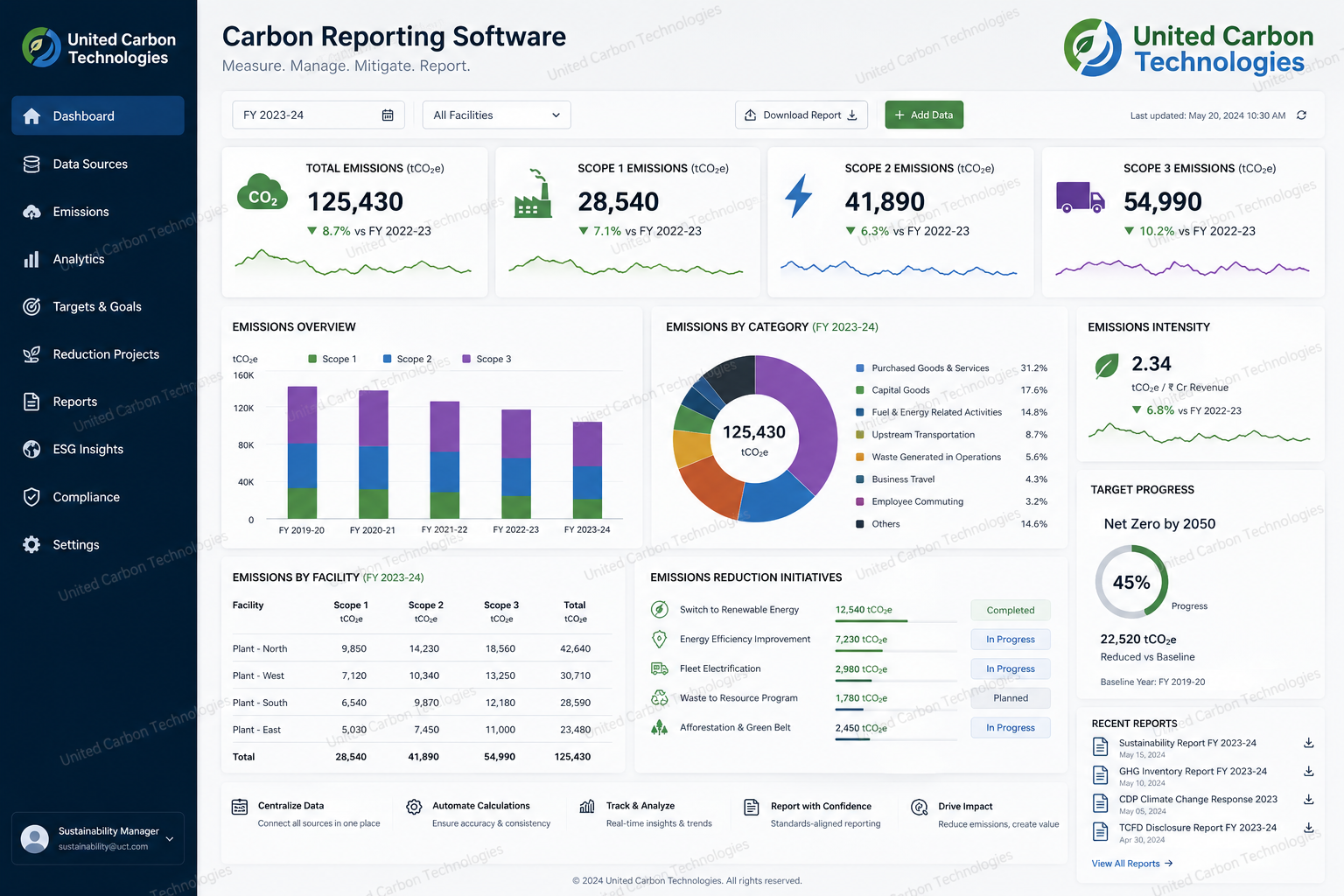
Managing sustainability data manually can become challenging as organizations grow. Carbon emissions information often comes from multiple departments, facilities, suppliers, and operational systems.
Carbon reporting software helps organizations collect, organize, analyze, and report emissions data more efficiently while supporting sustainability goals and ESG reporting requirements.
Did you know?
Many organizations begin carbon accounting with spreadsheets but later adopt specialized software as reporting requirements, stakeholder expectations, and emissions data complexity increase.
Why Businesses Use Carbon Reporting Software
- Centralizes emissions data
- Improves reporting accuracy
- Supports ESG disclosures
- Automates calculations
- Tracks sustainability performance
- Reduces manual reporting effort
- Supports climate-related decision-making
The right carbon reporting platform can transform emissions data into actionable business insights and measurable sustainability outcomes.
Build ESG readiness and climate intelligence capabilities with sustainability-focused support and environmental insights.
Essential Features to Look For
Carbon Reporting Software Feature Checklist
| Feature | Why It Matters |
|---|---|
| Scope 1, 2 & 3 Tracking | Provides complete emissions visibility |
| Automated Calculations | Reduces manual reporting effort |
| ESG Reporting Support | Supports sustainability disclosures |
| Analytics Dashboard | Improves decision-making |
| Supplier Data Collection | Helps manage Scope 3 emissions |
| Audit-Ready Reporting | Improves reporting credibility |
- Scope 1, Scope 2, and Scope 3 tracking
- Automated emissions calculations
- Carbon footprint dashboards
- Data management tools
- Supplier emissions reporting
- ESG reporting support
- Audit-ready reporting capabilities
These features help organizations maintain consistent and reliable sustainability reporting processes.
Data Collection and Integration Capabilities
Effective carbon reporting software should simplify data collection across multiple operational areas.
- Utility bill integration
- Procurement data imports
- Travel management systems
- Supply chain reporting tools
- Spreadsheet uploads
- ERP and business system integrations
Strong integration capabilities reduce manual data entry and improve reporting efficiency.
Analytics and Climate Intelligence Features
Modern sustainability platforms increasingly provide advanced analytics and climate intelligence capabilities.
- Emissions trend analysis
- Carbon hotspot identification
- Performance benchmarking
- Scenario modeling
- Sustainability KPI monitoring
- Executive reporting dashboards
These insights help organizations move beyond compliance toward strategic sustainability management.
Common Challenges Businesses Face Without Carbon Reporting Software
Many organizations initially manage emissions data using spreadsheets. As sustainability programs grow, manual approaches can create reporting challenges.
- Fragmented emissions data across departments
- Manual calculation errors
- Difficulty tracking Scope 3 emissions
- Limited visibility into sustainability performance
- Time-consuming ESG reporting processes
- Challenges maintaining audit-ready records
Dedicated carbon reporting software helps organizations centralize data, automate workflows, and improve reporting consistency.
Reporting and ESG Compliance Support
Reporting functionality is one of the most important aspects of carbon management software.
- ESG reporting support
- Sustainability disclosures
- Emissions inventories
- Stakeholder reporting
- Management reporting
- Environmental performance tracking
Scalability and Future Readiness
Organizations should consider whether a platform can support future sustainability requirements.
- Growing operational complexity
- Additional reporting frameworks
- Multi-location reporting
- Supplier engagement programs
- Climate-risk management initiatives
- Expanded ESG requirements
From Carbon Reporting to Climate Intelligence
Modern organizations increasingly require more than emissions reporting. Businesses are seeking platforms that combine carbon accounting, sustainability analytics, ESG reporting, climate intelligence, and decision-support capabilities within a single system.
The future of sustainability technology lies in transforming environmental data into actionable business insights that support operational efficiency, risk management, and long-term sustainability planning.
The Future of Carbon Reporting Technology
Carbon reporting platforms are evolving beyond simple emissions calculators. Businesses increasingly seek integrated solutions that combine carbon accounting, ESG reporting, sustainability analytics, climate intelligence, and environmental performance management.
Future platforms are expected to provide greater automation, improved data quality, enhanced analytics, and better decision-support capabilities for sustainability leaders.
UNITED CARBON TECHNOLOGIES
Climate & ESG Platform
Building India’s Carbon Intelligence Ecosystem
United Carbon Technologies is working toward climate-tech innovation, carbon management solutions, ESG capabilities, climate intelligence tools, and sustainability-focused digital platforms designed for the future of environmental decision-making.
Related Reads
- Carbon Accounting Process Step by Step
- How Businesses Collect Scope 3 Data
- Sustainability KPIs Every Company Should Track
- How Climate Data Helps Businesses Make Decisions
- What Is Climate Intelligence in Business?
- What Is Carbon Disclosure Reporting?
- Why Carbon Data Matters for ESG Reporting
- Guide to Start ESG Reporting for MSMEs
Related Sustainability & ESG Resources
- Carbon Accounting Process Step by Step
- How Businesses Collect Scope 3 Data
- Sustainability KPIs Every Company Should Track
- What Is a Carbon Baseline Assessment?
- What Is Climate Intelligence?
Carbon Reporting Technology in India
Indian organizations are increasingly investing in sustainability reporting capabilities as ESG expectations, stakeholder demands, and climate-related disclosures continue to evolve.
Technology platforms can help businesses improve reporting consistency, enhance transparency, and build stronger sustainability management programs.
- Carbon reporting software centralizes sustainability data.
- Automation improves reporting efficiency and accuracy.
- Analytics help identify emissions reduction opportunities.
- Strong integration capabilities improve data quality.
- Future-ready platforms support ESG and climate intelligence needs.
Frequently Asked Questions
What is carbon reporting software?
Carbon reporting software helps organizations collect, calculate, analyze, and report greenhouse gas emissions data.
Why do businesses use carbon reporting software?
It improves reporting accuracy, automates calculations, supports ESG initiatives, and simplifies sustainability management.
Can carbon reporting software track Scope 3 emissions?
Many platforms support Scope 3 reporting by helping organizations collect and manage supplier and value chain emissions data.
What features are most important?
Key features include emissions tracking, ESG reporting support, analytics dashboards, integrations, and automated calculations.
Can carbon reporting software help with ESG reporting?
Yes. Many platforms support ESG reporting by organizing emissions data, sustainability metrics, and environmental performance information into structured reports.
What is the difference between carbon accounting software and carbon reporting software?
Carbon accounting software focuses on calculating emissions, while carbon reporting software typically includes reporting, analytics, dashboards, disclosures, and sustainability performance tracking.
Can small businesses use carbon reporting software?
Yes. Many solutions are designed to help organizations of different sizes improve sustainability reporting and emissions management.
Does carbon reporting software support Scope 3 emissions?
Many modern platforms include supplier engagement and data collection tools that support Scope 3 emissions reporting.
Explore the Future of Climate Intelligence
Learn ESG, sustainability, carbon intelligence, and climate-tech concepts shaping the future of business and environmental strategy..
Join readers building climate intelligence knowledge for a sustainable future.