

Building an ESG Dashboard: Metrics Every Company Should Monitor (2026)
Learn the essential ESG metrics every company should monitor and how an ESG dashboard helps track sustainability performance, carbon emissions, and business impact.
By United Carbon Technologies | Climate Knowledge Hub India
Published: July 2026 | Last Updated: July 2026 | 14 min read
Join professionals learning about ESG Reporting, Carbon Accounting, Climate Intelligence, Sustainability Metrics, Net Zero, Corporate Governance, and digital ESG transformation.
As Environmental, Social, and Governance (ESG) reporting becomes an integral part of corporate strategy, businesses need more than spreadsheets and annual reports to manage sustainability performance. Leaders require real-time visibility into key ESG indicators so they can monitor progress, identify risks, and make informed decisions.
An ESG dashboard transforms sustainability data into meaningful insights by bringing together environmental, social, and governance metrics in a single, easy-to-understand platform. Instead of collecting information from multiple departments manually, organizations can monitor performance continuously through visual dashboards and automated reporting.
This beginner-friendly guide explains what an ESG dashboard is, why it matters, the most important ESG metrics every company should monitor, and how digital ESG platforms are changing sustainability management across industries.
Featured Snippet
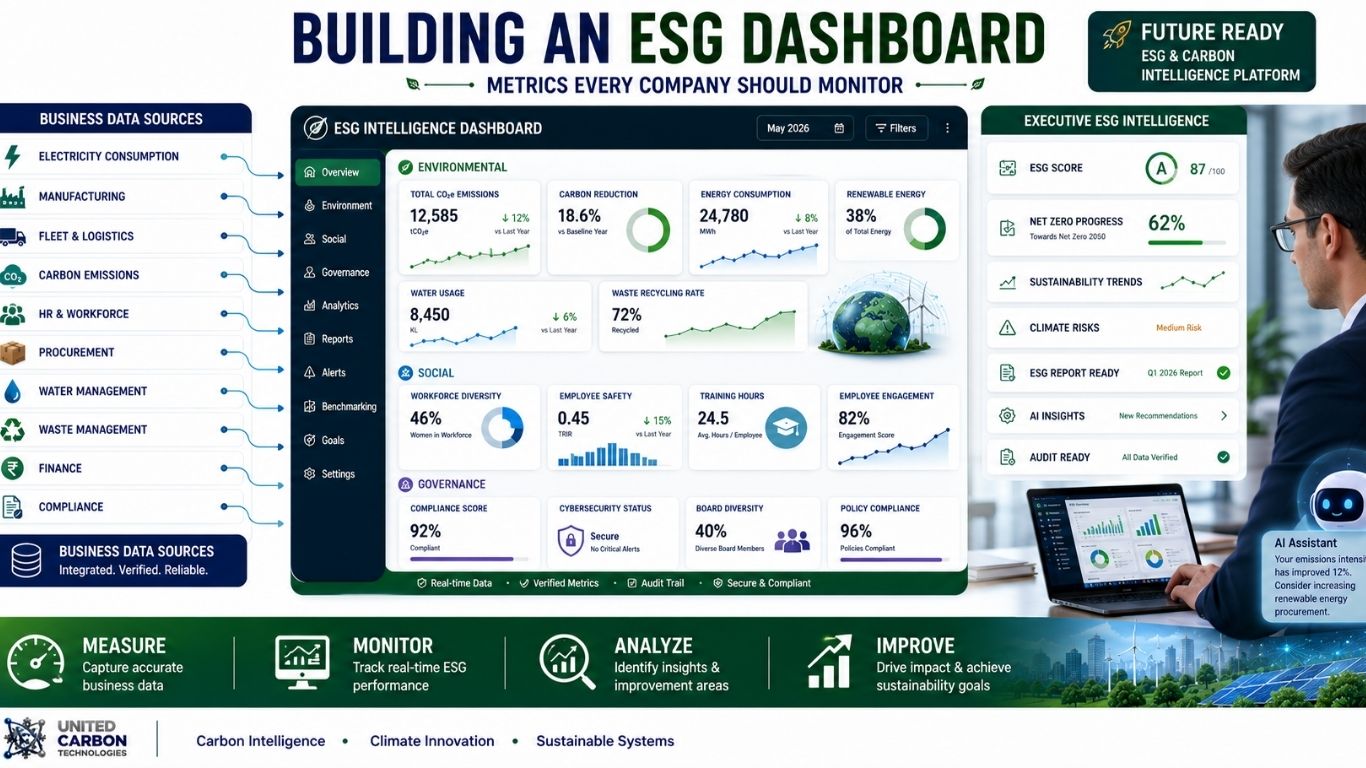
An ESG dashboard is a digital platform that tracks environmental, social, and governance performance using real-time metrics and visual analytics. It helps businesses monitor carbon emissions, energy use, workforce indicators, governance performance, ESG KPIs, and sustainability goals while improving reporting, compliance, and decision-making.
Introduction
Sustainability performance is no longer measured once a year. Investors, regulators, customers, and business leaders increasingly expect organizations to monitor ESG performance continuously using accurate, reliable, and transparent data.
An ESG dashboard provides a centralized view of sustainability performance by combining environmental, social, and governance metrics into one interactive platform. From greenhouse gas emissions and renewable energy consumption to employee diversity and governance indicators, dashboards help organizations understand how sustainability performance changes over time.
As reporting requirements continue to evolve, businesses that adopt digital ESG monitoring tools gain faster access to insights, improve reporting efficiency, and strengthen strategic decision-making.
Whether you are starting your first ESG program or enhancing an existing sustainability strategy, understanding which metrics belong on an ESG dashboard is the first step toward building an effective reporting system.
Carbon Intelligence • ESG Software • Better Sustainability Decisions
Building the Future of ESG Intelligence
United Carbon Technologies is developing an integrated ESG & Carbon Intelligence SaaS Platform designed to help organizations measure greenhouse gas emissions, monitor ESG KPIs, manage sustainability data, visualize performance through interactive dashboards, and simplify ESG reporting. Our pilot platform is currently under development to support businesses in making data-driven sustainability decisions.
💡 Did You Know?
- Leading organizations now monitor ESG performance throughout the year instead of waiting for annual sustainability reports.
- Interactive ESG dashboards help executives identify trends, monitor risks, and improve decision-making using real-time sustainability data.
- Many investors now expect companies to demonstrate measurable ESG performance supported by transparent metrics.
- Modern ESG platforms increasingly integrate Carbon Accounting, climate analytics, compliance monitoring, and sustainability reporting into a single dashboard.
1. What Is an ESG Dashboard?
An ESG dashboard is a digital reporting platform that collects, organizes, and visualizes Environmental, Social, and Governance performance indicators. It transforms raw sustainability data into charts, scorecards, and key performance indicators (KPIs), allowing organizations to track progress toward sustainability goals more efficiently.
Unlike static spreadsheets, ESG dashboards provide dynamic insights that help management monitor performance, identify emerging risks, and respond quickly to changing business conditions.
Most ESG dashboards integrate information from finance, operations, human resources, procurement, energy management, carbon accounting systems, and compliance functions into a single decision-support platform.
Typical ESG Dashboard Components
- Environmental KPIs
- Carbon Emissions Dashboard
- Energy & Resource Consumption
- Social Performance Indicators
- Governance Metrics
- Compliance Tracking
- Risk Monitoring
- Executive ESG Scorecards
2. Why Every Company Needs an ESG Dashboard
As ESG expectations continue to grow, organizations need reliable systems to manage increasing volumes of sustainability data. An ESG dashboard enables businesses to move beyond manual reporting by providing continuous visibility into performance across departments and business units.
By centralizing ESG information, dashboards support faster reporting, improve transparency, simplify regulatory compliance, and help leadership teams make informed sustainability decisions based on measurable data.
Key Business Benefits
- Centralizes ESG information.
- Tracks sustainability KPIs in real time.
- Improves decision-making.
- Strengthens ESG reporting.
- Supports Net Zero strategies.
- Enhances transparency and accountability.
- Simplifies management reporting.
An effective ESG dashboard transforms sustainability data into meaningful insights, helping organizations monitor progress, identify opportunities, and make better business decisions.
Join the Future of ESG Intelligence
United Carbon Technologies is building an integrated ESG & Carbon Intelligence SaaS platform that combines Carbon Accounting, ESG KPIs, sustainability analytics, executive dashboards, and automated reporting into one intelligent solution. Our pilot program is currently under development, and we look forward to collaborating with forward-thinking organizations seeking to modernize their sustainability reporting.
3. The Three Pillars of an ESG Dashboard
An effective ESG dashboard organizes sustainability performance into three core pillars—Environmental, Social, and Governance. Together, these pillars provide leadership with a comprehensive view of how sustainability initiatives are progressing across the organization.
Rather than monitoring isolated metrics, businesses should track interconnected indicators that reflect operational performance, regulatory compliance, stakeholder expectations, and long-term value creation.
The Three ESG Pillars
| Pillar | Examples of Metrics |
|---|---|
| Environmental | Carbon emissions, energy consumption, water usage, waste generation, renewable energy, recycling. |
| Social | Employee safety, diversity, training hours, engagement, turnover, community investment. |
| Governance | Board diversity, ethics training, compliance, cybersecurity, risk management, policy implementation. |
Monitoring these three dimensions together enables organizations to balance financial performance with sustainable business practices.
4. Environmental Metrics Every Company Should Monitor
Environmental indicators are often the foundation of ESG reporting because they measure how business activities affect natural resources and climate change. These metrics also help organizations identify operational efficiencies and prepare for evolving climate regulations.
Essential Environmental KPIs
- 🌍 Total Greenhouse Gas Emissions (CO₂e)
- 🏭 Scope 1 Emissions
- ⚡ Scope 2 Emissions
- 🚚 Scope 3 Emissions
- ⚡ Energy Consumption
- 🌞 Renewable Energy Usage (%)
- 💧 Water Withdrawal & Consumption
- ♻ Waste Generated & Recycled
- 📉 Carbon Intensity per Product or Revenue
- 🎯 Net Zero Progress
5. Social Metrics That Build a Sustainable Workforce
The social pillar evaluates how organizations manage relationships with employees, customers, suppliers, and communities. Strong social performance contributes to productivity, innovation, talent retention, and corporate reputation.
Important Social KPIs
- 👷 Lost Time Injury Frequency Rate (LTIFR)
- ❤️ Employee Health & Well-being
- 🤝 Diversity, Equity & Inclusion
- 🎓 Employee Training Hours
- 📈 Employee Retention Rate
- 😊 Employee Satisfaction Score
- 🌍 Community Investment
- 🎯 Gender Diversity
- 🧑💼 Leadership Diversity
- 📚 Learning & Development Participation
Many organizations also include supplier labor standards and human rights indicators to strengthen responsible supply chain management.
6. Governance Metrics That Strengthen Business Trust
Governance metrics measure how organizations are managed, how decisions are made, and whether ethical standards are consistently followed. Strong governance supports transparency, accountability, and long-term business resilience.
Key Governance KPIs
- 🏛 Board Independence
- 👩 Board Diversity
- ⚖ Ethics & Compliance Cases
- 🛡 Cybersecurity Incidents
- 📋 Policy Compliance Rate
- ⚠ Enterprise Risk Assessments
- 🔒 Data Privacy Compliance
- 📑 Internal Audit Findings
- 📈 ESG Policy Implementation
7. Executive ESG KPIs That Leaders Monitor
Senior management typically requires a concise executive dashboard that summarizes the organization's sustainability performance using high-level indicators rather than detailed operational data.
Executive Dashboard KPIs
- Overall ESG Performance Score
- Carbon Reduction Progress
- Net Zero Target Achievement
- Renewable Energy Percentage
- Major ESG Risks
- Compliance Status
- Supplier ESG Performance
- Sustainability Projects Progress
- Quarterly ESG Trends
- Board ESG Updates
Executive dashboards should emphasize trends, exceptions, and decision-support insights instead of overwhelming leaders with excessive operational details.
8. The Future of ESG Dashboards
ESG dashboards are rapidly evolving from static reporting tools into intelligent decision-support platforms. As businesses collect larger volumes of sustainability data, digital technologies such as artificial intelligence, automation, cloud computing, and predictive analytics are transforming how ESG information is monitored and managed.
The next generation of ESG platforms will not simply display historical performance—they will help organizations forecast risks, identify improvement opportunities, automate reporting workflows, and support strategic sustainability planning.
Future ESG Dashboard Capabilities
- 🤖 AI-powered sustainability insights
- 📊 Real-time Carbon Accounting
- 📈 Predictive ESG analytics
- 🏭 Automated Scope 1, 2 & 3 calculations
- 🚛 Supplier ESG monitoring
- ⚠ Climate risk dashboards
- 📑 Automated ESG reporting
- 🎯 Net Zero tracking
- 📡 Live KPI monitoring
- 🛡 Audit-ready sustainability data
Modern ESG dashboards are becoming intelligent business platforms that combine Carbon Accounting, ESG reporting, climate analytics, compliance management, supplier sustainability, and executive decision support into a single digital ecosystem.
9. ESG Dashboards in the Indian Business Context
Indian businesses are increasingly adopting digital ESG management systems as sustainability expectations continue to evolve. Companies preparing Business Responsibility and Sustainability Reports (BRSR), responding to investor requests, or participating in international supply chains require reliable ESG data that can be monitored throughout the year.
Industries such as manufacturing, pharmaceuticals, automotive, energy, logistics, infrastructure, financial services, and information technology are rapidly moving toward integrated ESG dashboards that simplify reporting and improve transparency.
10. Building an ESG Dashboard That Drives Better Decisions
An effective ESG dashboard should do more than display charts—it should help organizations make informed decisions. The most valuable dashboards combine high-quality data, meaningful KPIs, automation, and intuitive visualizations that enable executives and sustainability teams to understand performance at a glance.
As organizations progress toward Net Zero and stronger ESG governance, digital dashboards will become an essential management tool for measuring sustainability performance, identifying risks, and demonstrating accountability.
Experience the Next Generation of ESG Intelligence
United Carbon Technologies is developing an integrated ESG & Carbon Intelligence SaaS Platform that brings together Carbon Accounting, ESG KPIs, sustainability analytics, executive dashboards, AI-powered insights, and automated reporting into one intelligent solution. Our pilot program is currently under development, and we look forward to partnering with organizations seeking to modernize ESG management.
India Context
With growing adoption of BRSR, expanding ESG disclosure expectations, and increasing demand from investors and global customers, Indian organizations are moving beyond spreadsheets toward integrated ESG platforms. Businesses that invest in digital sustainability management today will be better prepared for future reporting requirements and competitive market expectations.
What's Next?
Building an ESG dashboard is only the beginning. The next step is understanding ESG Key Performance Indicators (KPIs)—how to select meaningful metrics, establish targets, and measure progress toward sustainability objectives using internationally recognized reporting frameworks.
Related Reads
- Materiality Assessment Explained for ESG Reporting
- How Businesses Improve Carbon Data Quality
- Operational Boundaries in Carbon Accounting Explained
- What Is ESG Reporting? A Beginner's Guide
- Carbon Accounting Explained
- Understanding Scope 3 Emissions
💡 Expert Insight
The future of ESG reporting is shifting from annual spreadsheets to real-time sustainability intelligence. Businesses will increasingly rely on integrated platforms that combine Carbon Accounting, ESG metrics, climate risk monitoring, supplier sustainability data, AI-powered analytics, and automated reporting into a single decision-support system. Organizations that embrace digital ESG platforms early will be better positioned to meet evolving regulatory requirements, strengthen stakeholder confidence, and achieve long-term sustainability goals.
Conclusion
An ESG dashboard is more than a reporting tool—it is a strategic management platform that helps organizations measure sustainability performance, monitor ESG risks, and make informed business decisions. By tracking the right environmental, social, and governance metrics, companies can improve transparency, strengthen compliance, and demonstrate measurable progress toward their sustainability commitments.
As digital transformation reshapes corporate sustainability, integrated ESG dashboards will become central to how organizations manage Carbon Accounting, ESG reporting, climate action, and long-term value creation.
Quick Summary
- An ESG dashboard centralizes sustainability data.
- Environmental, Social, and Governance metrics should all be monitored.
- Real-time dashboards improve reporting and decision-making.
- Executive KPIs support strategic sustainability management.
- AI and automation are transforming ESG dashboards.
- Integrated platforms simplify Carbon Accounting and ESG reporting.
- Digital ESG systems prepare businesses for future sustainability requirements.
Frequently Asked Questions (FAQs)
1. What is an ESG dashboard?
An ESG dashboard is a digital platform that tracks environmental, social, and governance performance using visual KPIs and sustainability analytics.
2. Why do companies need an ESG dashboard?
It centralizes ESG data, improves reporting, supports decision-making, and helps organizations monitor sustainability performance.
3. What environmental metrics should an ESG dashboard include?
Common metrics include greenhouse gas emissions, energy use, renewable energy, water consumption, waste generation, and carbon intensity.
4. What social KPIs are important?
Employee safety, diversity, training, engagement, retention, and community investment are widely monitored social indicators.
5. Which governance metrics should be tracked?
Board diversity, ethics, compliance, cybersecurity, policy implementation, and enterprise risk management are common governance KPIs.
6. Can ESG dashboards automate reporting?
Yes. Modern ESG platforms automate data collection, KPI tracking, and sustainability reporting workflows.
7. How do ESG dashboards support Net Zero goals?
They monitor emissions, track reduction targets, and visualize progress toward climate commitments.
8. Are ESG dashboards useful for small and medium-sized businesses?
Yes. Businesses of all sizes benefit from centralized sustainability monitoring and improved reporting efficiency.
9. How often should ESG dashboards be updated?
Organizations should update dashboards regularly, with many platforms supporting monthly, weekly, or real-time data updates.
10. What is the future of ESG dashboards?
Future ESG dashboards will incorporate AI, predictive analytics, automated Carbon Accounting, climate risk intelligence, and real-time sustainability decision support.
Key Takeaways
- ESG dashboards transform sustainability data into actionable business insights.
- Tracking the right KPIs improves ESG performance and reporting quality.
- Digital platforms simplify Carbon Accounting and sustainability management.
- Real-time monitoring enables proactive decision-making.
- AI-powered ESG dashboards represent the future of corporate sustainability.
The Future of ESG Management Starts with Better Data
Explore more expert guides from United Carbon Technologies to deepen your understanding of ESG reporting, Carbon Accounting, Climate Intelligence, and digital sustainability solutions. If you're interested in shaping the future of ESG technology, register your interest in our upcoming ESG & Carbon Intelligence Dashboard pilot.