

How to Conduct a Supplier ESG Assessment: A Step-by-Step Business Guide (2026)
Learn how to conduct a Supplier ESG Assessment, evaluate supplier sustainability performance, reduce supply chain risks, and strengthen ESG reporting.
By United Carbon Technologies | Climate Knowledge Hub India
Published: July 2026 | Last Updated: July 2026 | 15 min read
Join professionals learning about ESG Reporting, Sustainable Procurement, Supplier Sustainability, Carbon Accounting, Climate Intelligence, and Net Zero.
As sustainability expectations continue to grow, organizations are increasingly expected to understand not only their own environmental performance but also the ESG practices of their suppliers. A structured Supplier ESG Assessment helps businesses identify risks, improve supply chain transparency, strengthen responsible sourcing, and support long-term sustainability goals.
Rather than evaluating suppliers only on cost, quality, and delivery, modern procurement teams also consider environmental performance, labour practices, governance standards, ethical conduct, and climate commitments. These assessments help businesses build resilient supply chains while preparing for evolving ESG disclosure requirements.
This step-by-step guide explains how to conduct a Supplier ESG Assessment, the key evaluation criteria, common challenges, recommended KPIs, and best practices for building stronger supplier relationships.
Featured Snippet
A Supplier ESG Assessment is a structured evaluation of a supplier's environmental, social, and governance performance. It helps organizations identify sustainability risks, improve responsible sourcing, reduce Scope 3 emissions, strengthen ESG reporting, and build more resilient supply chains.
Introduction
For many organizations, the majority of environmental and social impacts occur across the supply chain rather than within their own operations. This makes supplier sustainability an essential part of modern ESG management.
Supplier ESG Assessments provide organizations with a structured framework for evaluating suppliers based on sustainability performance, governance practices, ethical conduct, and operational resilience. These assessments help procurement teams identify improvement opportunities while reducing climate-related and supply chain risks.
Whether your organization works with a few suppliers or thousands, implementing a consistent ESG assessment process supports better procurement decisions, stronger supplier engagement, and long-term business value.
💡 Did You Know?
- Supply chain emissions (Scope 3) often represent the largest portion of a company's total carbon footprint.
- Many multinational organizations require suppliers to complete ESG assessments before awarding contracts.
- Supplier sustainability performance increasingly influences investment decisions, procurement strategies, and customer expectations.
- Digital ESG platforms make supplier assessments faster, more consistent, and easier to monitor over time.
1. What Is a Supplier ESG Assessment?
A Supplier ESG Assessment is a structured evaluation process that measures how well suppliers manage environmental, social, and governance (ESG) issues. The assessment helps organizations identify sustainability strengths, potential risks, and opportunities for improvement across their value chain.
Rather than relying solely on financial or operational performance, businesses evaluate suppliers using ESG criteria that support responsible sourcing and long-term sustainability objectives.
Assessment Objectives
- Improve supplier transparency.
- Reduce sustainability risks.
- Strengthen responsible sourcing.
- Support ESG reporting.
- Reduce Scope 3 emissions.
- Enhance supplier engagement.
- Improve regulatory readiness.
- Build resilient supply chains.
2. Why Supplier ESG Assessments Matter
Organizations increasingly depend on suppliers to achieve sustainability targets. Poor supplier practices can expose businesses to environmental, operational, legal, and reputational risks. ESG assessments help organizations identify these risks early while encouraging suppliers to continuously improve their sustainability performance.
A consistent assessment process also strengthens procurement decisions, supports climate strategies, and improves stakeholder confidence.
Business Benefits
- Better supplier selection.
- Reduced ESG risks.
- Improved supply chain transparency.
- Enhanced ESG reporting.
- Stronger customer confidence.
- Improved supplier collaboration.
- Support for Net Zero strategies.
- Long-term supply chain resilience.
Evaluating supplier sustainability today helps organizations reduce future risks, strengthen ESG performance, and build resilient value chains.
Build Smarter Supplier Sustainability Programs
United Carbon Technologies is developing an ESG & Carbon Intelligence Platform designed to help organizations assess supplier ESG performance, monitor Scope 3 emissions, centralize procurement sustainability data, and strengthen ESG reporting through intelligent dashboards. Planned capabilities include supplier scorecards, ESG questionnaires, risk monitoring, and value-chain analytics.
3. Key ESG Criteria for Supplier Assessments
A comprehensive Supplier ESG Assessment evaluates suppliers across environmental, social, and governance (ESG) dimensions. The goal is not only to identify risks but also to encourage continuous improvement and stronger long-term partnerships.
Environmental Criteria
- Greenhouse gas emissions
- Energy efficiency
- Renewable energy usage
- Water management
- Waste reduction and recycling
- Pollution prevention
- Environmental certifications
- Climate action initiatives
Social Criteria
- Employee health & safety
- Labour rights
- Fair wages
- Diversity & inclusion
- Human rights practices
- Training & development
- Community engagement
- Employee wellbeing
Governance Criteria
- Business ethics
- Anti-corruption policies
- Regulatory compliance
- Board oversight
- Data privacy
- Cybersecurity
- Risk management
- Transparency & reporting
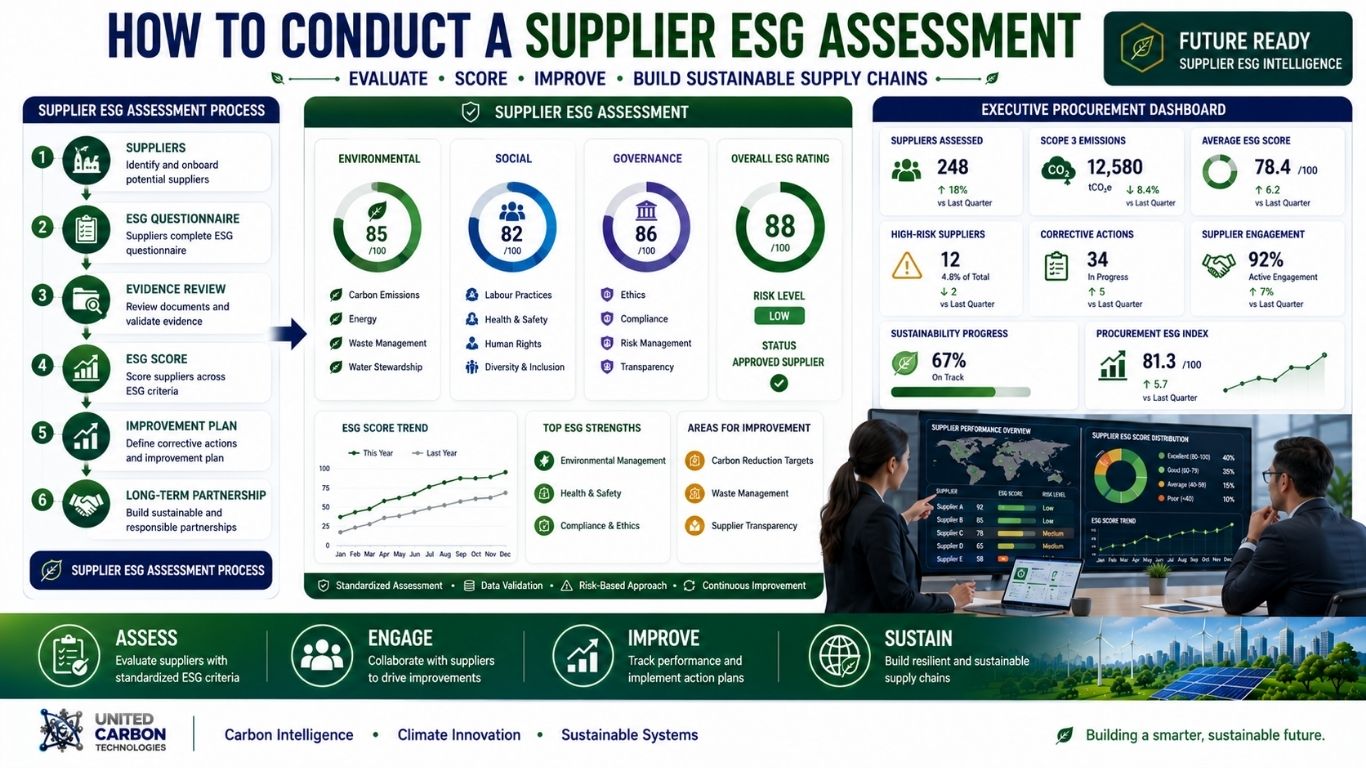
4. Step-by-Step Supplier ESG Assessment Process
A structured assessment process improves consistency, reduces bias, and enables organizations to monitor supplier sustainability performance over time.
Recommended Process
- Identify priority suppliers.
- Define ESG assessment criteria.
- Develop supplier questionnaires.
- Collect supporting documentation.
- Review ESG evidence.
- Assign ESG scores.
- Identify improvement opportunities.
- Monitor supplier progress annually.
Organizations often begin with strategic or high-risk suppliers before expanding ESG assessments across the wider supply chain.
5. Creating a Supplier ESG Scorecard
Supplier scorecards convert ESG information into measurable performance indicators. A standardized scorecard allows procurement teams to compare suppliers objectively and prioritize improvement initiatives.
Typical Scorecard Categories
- Environmental Performance
- Carbon Emissions
- Labour Practices
- Health & Safety
- Business Ethics
- Governance
- Regulatory Compliance
- Innovation & Improvement
- Documentation Quality
- Overall ESG Rating
Many organizations assign weighted scores based on supplier risk, industry, geographic location, and procurement category.
6. Key Supplier ESG KPIs
Measuring supplier sustainability enables organizations to track progress and demonstrate continuous improvement. Well-defined KPIs also strengthen ESG reporting and procurement governance.
Recommended KPIs
- Suppliers assessed annually (%)
- Average ESG score
- Scope 3 emissions reported
- Suppliers with climate targets
- Supplier corrective actions completed
- Supplier audit completion rate
- Environmental certification coverage
- High-risk supplier reduction
- Supplier training participation
- Annual supplier improvement rate
7. Common Challenges and Best Practices
Supplier ESG Assessments require collaboration, reliable information, and continuous engagement. Rather than treating assessments as compliance exercises, organizations should view them as opportunities to strengthen supplier relationships.
Common Challenges
- Incomplete supplier data
- Different reporting standards
- Limited supplier resources
- Inconsistent assessment methods
- Manual data collection
- Changing ESG regulations
Best Practices
- Use standardized questionnaires.
- Provide supplier guidance.
- Focus on continuous improvement.
- Review assessments annually.
- Integrate ESG into procurement.
- Use digital monitoring tools.
8. Digital Supplier ESG Management
Managing supplier ESG assessments manually becomes increasingly difficult as supplier networks expand. Digital ESG platforms centralize supplier information, automate questionnaires, monitor ESG scores, and provide executive dashboards that improve procurement decisions.
Technology also enables organizations to identify supplier risks more quickly, monitor improvement plans, and generate sustainability reports using consistent and reliable data.
United Carbon Technologies is developing an integrated ESG & Carbon Intelligence Platform designed to simplify supplier sustainability management through centralized supplier profiles, ESG questionnaires, Scope 3 emissions tracking, procurement dashboards, and executive reporting. Planned capabilities aim to help organizations monitor supplier performance using reliable sustainability data.
9. Supplier ESG Assessments in India
Indian businesses are increasingly adopting supplier ESG assessments as global customers, investors, and multinational buyers seek greater transparency across supply chains. Companies that export internationally or supply large enterprises are more frequently asked to demonstrate responsible sourcing, climate action, and governance practices.
Industries including manufacturing, pharmaceuticals, automotive, engineering, textiles, chemicals, FMCG, logistics, and information technology are strengthening supplier sustainability programs to improve competitiveness and prepare for evolving ESG requirements.
10. Building Stronger Supplier Partnerships
Supplier ESG Assessments should not be viewed solely as compliance tools. When implemented effectively, they encourage collaboration, innovation, and continuous improvement across the supply chain. Organizations that work closely with suppliers can reduce risks while creating shared sustainability value.
Combining structured assessments, meaningful KPIs, supplier engagement, and digital ESG technologies enables businesses to build more resilient, transparent, and future-ready supply chains.
Strengthen Supplier Sustainability with Better Data
United Carbon Technologies is developing an ESG & Carbon Intelligence Platform that will help organizations centralize supplier ESG information, monitor Scope 3 emissions, manage supplier scorecards, and visualize procurement performance through executive dashboards. Our vision is to simplify supplier sustainability using intelligent, data-driven insights.
India Context
As Indian businesses integrate more deeply into global supply chains, supplier ESG assessments are becoming an important competitive advantage. Organizations that evaluate supplier sustainability today are better prepared for evolving ESG disclosure requirements, customer expectations, and international procurement standards.
What's Next?
Once supplier ESG assessments are established, organizations should focus on supplier decarbonization programs, Scope 3 emissions measurement, procurement analytics, and continuous supplier improvement to build resilient and sustainable value chains.
Related Reads
- Green Procurement Policy: A Step-by-Step Guide
- Step-by-Step Guide to Supplier Decarbonization Programs
- What Are Scope 3 Emissions?
- Building an ESG Dashboard: Metrics Every Company Should Monitor
- Materiality Assessment Explained for ESG Reporting
- What Is Sustainability Governance?
💡 Expert Insight
The future of supply chain sustainability depends on collaboration rather than compliance alone. Organizations that combine standardized ESG assessments, transparent supplier engagement, and digital sustainability platforms are better positioned to reduce risks, improve Scope 3 emissions management, and create long-term value across their supplier ecosystem.
Conclusion
Supplier ESG Assessments help organizations make more informed procurement decisions by evaluating suppliers beyond traditional commercial factors. A structured assessment process improves transparency, strengthens responsible sourcing, supports ESG reporting, and builds resilient supply chains.
As sustainability expectations continue to evolve, businesses that invest in supplier engagement, measurable ESG performance, and digital assessment tools will be better prepared to create long-term environmental, social, and business value.
Quick Summary
- Supplier ESG Assessments evaluate environmental, social, and governance performance.
- Standardized scorecards improve supplier comparisons.
- KPIs strengthen procurement governance.
- Supplier engagement supports continuous improvement.
- Digital ESG platforms simplify supplier monitoring.
- Assessments reduce supply chain risks.
- Supplier sustainability strengthens long-term resilience.
Frequently Asked Questions (FAQs)
1. What is a Supplier ESG Assessment?
A structured evaluation of a supplier's environmental, social, and governance performance.
2. Why are Supplier ESG Assessments important?
They reduce risks, improve responsible sourcing, and strengthen ESG reporting.
3. What information should suppliers provide?
Environmental policies, emissions data, certifications, labour practices, governance information, and compliance records.
4. How often should suppliers be assessed?
Most organizations conduct annual assessments or more frequently for high-risk suppliers.
5. What is a Supplier ESG Scorecard?
A scoring framework used to compare supplier sustainability performance consistently.
6. Which suppliers should be assessed first?
Strategic, high-spend, high-risk, or environmentally significant suppliers.
7. How do Supplier ESG Assessments support Scope 3 reporting?
They improve supplier data quality and help organizations understand value chain emissions.
8. Can SMEs perform Supplier ESG Assessments?
Yes. SMEs can adopt simplified assessment frameworks based on business size and supplier risk.
9. How does technology improve supplier assessments?
Digital ESG platforms automate questionnaires, scoring, dashboards, and reporting.
10. What is the biggest success factor?
Continuous supplier engagement and improvement rather than one-time compliance assessments.
Key Takeaways
- Supplier ESG Assessments improve responsible sourcing.
- Consistent scoring creates objective supplier evaluations.
- Reliable supplier data supports ESG reporting.
- Digital tools simplify supplier sustainability management.
- Strong supplier partnerships create resilient supply chains.
Build Stronger Supplier Partnerships Through ESG
Explore more expert resources from United Carbon Technologies on supplier sustainability, Scope 3 emissions, Carbon Accounting, ESG reporting, and Climate Intelligence. Stay connected for updates on our upcoming ESG & Carbon Intelligence Platform and discover how digital tools can strengthen supplier sustainability management.