

What Is Sustainability Governance? A Complete Business Guide (2026)
Learn what sustainability governance is, why it matters, and how businesses build effective governance frameworks to support ESG reporting and long-term sustainability.
By United Carbon Technologies | Climate Knowledge Hub India
Published: July 2026 | Last Updated: July 2026 | 13 min read
Join professionals learning about ESG Reporting, Corporate Sustainability, Carbon Accounting, Climate Intelligence, Governance, and Net Zero strategies.
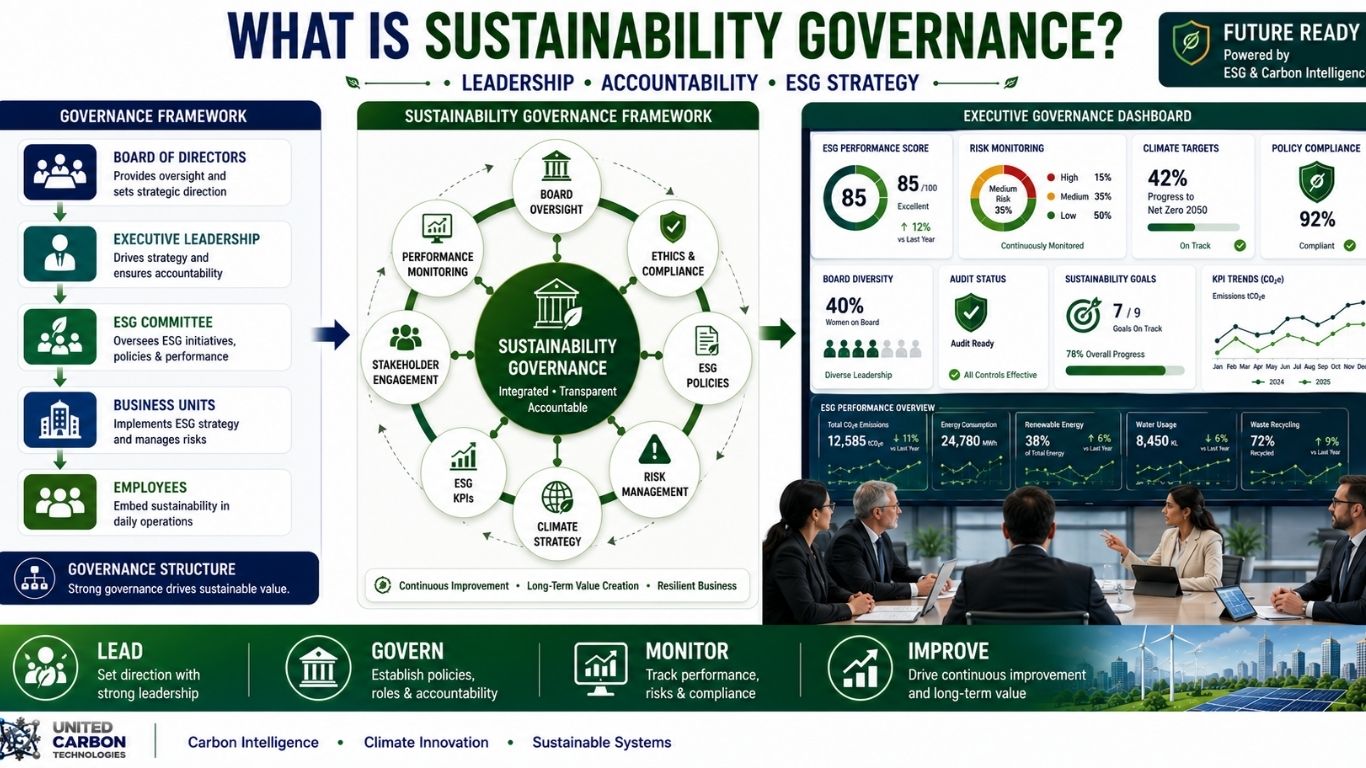
Successful sustainability programs do not happen by chance—they require strong leadership, clear accountability, and effective decision-making. This is where sustainability governance becomes essential. It provides the structure that enables organizations to integrate sustainability into business strategy, risk management, and everyday operations.
As investors, regulators, customers, and employees place greater emphasis on Environmental, Social, and Governance (ESG) performance, organizations need governance systems that ensure sustainability commitments are measurable, transparent, and consistently managed.
This beginner-friendly guide explains what sustainability governance is, why it matters, its key components, and how businesses can build governance frameworks that support long-term ESG success.
Featured Snippet
Sustainability governance is the system of leadership, policies, responsibilities, and decision-making processes that guide how an organization manages Environmental, Social, and Governance (ESG) issues. Strong governance helps businesses improve accountability, manage sustainability risks, comply with regulations, and achieve long-term business goals.
Introduction
Many organizations begin their sustainability journey by measuring carbon emissions or publishing ESG reports. However, meaningful progress depends on having a governance system that defines responsibilities, monitors performance, and ensures sustainability objectives are integrated into business decisions.
Sustainability governance connects leadership with execution. It establishes who makes decisions, how sustainability risks are managed, how ESG performance is monitored, and how organizations remain accountable to stakeholders.
Whether an organization is just starting its ESG journey or strengthening an existing sustainability strategy, effective governance provides the foundation for long-term resilience and responsible business growth.
💡 Did You Know?
- Strong governance is considered the foundation that supports effective environmental and social initiatives.
- Many investors evaluate board oversight of sustainability before making investment decisions.
- Organizations with clear sustainability governance often make ESG reporting more consistent and transparent.
- Governance frameworks help businesses manage climate risks, compliance obligations, and long-term sustainability goals.
1. What Is Sustainability Governance?
Sustainability governance refers to the policies, leadership structures, responsibilities, and decision-making processes that guide how an organization manages sustainability and ESG issues. It ensures that sustainability is embedded into corporate strategy rather than treated as a standalone initiative.
An effective governance framework establishes accountability at every level—from the board of directors and executive leadership to operational teams—helping organizations monitor ESG performance, manage risks, and drive continuous improvement.
Core Elements of Sustainability Governance
- Board oversight
- Executive leadership
- ESG committees
- Policies and codes of conduct
- Risk management processes
- Performance monitoring
- Stakeholder engagement
- Transparent reporting
2. Why Sustainability Governance Matters
Without strong governance, sustainability initiatives often become fragmented, making it difficult to measure progress or achieve meaningful outcomes. Governance aligns sustainability with business objectives and creates clear accountability for ESG performance.
It also strengthens stakeholder confidence by demonstrating that sustainability commitments are supported by robust leadership, measurable goals, and transparent reporting.
Business Benefits
- Improves strategic decision-making.
- Strengthens ESG reporting.
- Enhances regulatory compliance.
- Builds investor confidence.
- Improves risk management.
- Supports long-term business resilience.
- Promotes accountability across the organization.
Organizations that define clear leadership responsibilities and measurable ESG objectives are better positioned to manage risks, build trust, and achieve long-term sustainability success.
Strengthen Your ESG Governance Framework
United Carbon Technologies is developing Carbon Intelligence and ESG solutions that help organizations monitor sustainability performance, manage ESG data, and support informed governance through centralized reporting and executive dashboards. Our upcoming ESG & Carbon Intelligence Platform is designed to make sustainability management more transparent, measurable, and actionable.
3. Key Components of Sustainability Governance
A strong sustainability governance framework consists of several interconnected elements that ensure ESG initiatives are effectively planned, implemented, monitored, and continuously improved. Rather than relying on a single department, governance integrates sustainability across the entire organization.
Each component contributes to building transparency, accountability, and long-term business resilience.
Essential Components
- Board oversight and accountability
- Executive leadership commitment
- Clearly defined ESG policies
- Roles and responsibilities
- Risk management framework
- Performance monitoring and KPIs
- Stakeholder engagement
- Transparent ESG reporting
4. The Role of the Board of Directors
The Board of Directors plays a critical role in sustainability governance by providing strategic oversight and ensuring ESG considerations are integrated into long-term business planning. Increasingly, boards are expected to evaluate climate-related risks, monitor sustainability performance, and hold management accountable for achieving ESG objectives.
Board Responsibilities
- Approve sustainability strategy
- Review ESG risks
- Monitor climate-related performance
- Set governance expectations
- Evaluate sustainability targets
- Review ESG disclosures
- Promote ethical leadership
- Ensure long-term accountability
Board engagement signals that sustainability is a strategic priority rather than simply a compliance exercise.
5. Executive Leadership and ESG Committees
While the board provides oversight, executive leadership is responsible for translating sustainability strategy into action. Many organizations establish ESG committees or sustainability steering groups that coordinate initiatives across departments.
Typical Participants
- Chief Executive Officer (CEO)
- Chief Financial Officer (CFO)
- Chief Sustainability Officer (CSO)
- Operations Leadership
- Human Resources
- Legal & Compliance Teams
- Risk Management
- Information Technology
Cross-functional collaboration helps ensure sustainability objectives are embedded into everyday business operations.
6. Sustainability Policies and Decision-Making
Governance frameworks rely on formal policies that establish consistent expectations across the organization. These policies provide guidance for employees, suppliers, leadership, and business partners while supporting regulatory compliance and ethical business practices.
Common Sustainability Policies
- Environmental Policy
- Climate Change Policy
- Code of Business Ethics
- Human Rights Policy
- Supplier Code of Conduct
- Diversity & Inclusion Policy
- Anti-Corruption Policy
- Data Privacy Policy
Well-designed policies enable organizations to make sustainability decisions consistently across all business functions.
7. Measuring Governance Performance
Governance should be measurable. Organizations increasingly monitor governance performance using Key Performance Indicators (KPIs) that demonstrate leadership effectiveness, compliance, transparency, and accountability.
Governance KPIs
- Board meeting attendance
- Board diversity
- ESG policy implementation
- Ethics training completion
- Compliance incidents
- Internal audit findings
- Cybersecurity readiness
- Risk assessment completion
- Whistleblower case resolution
- Supplier compliance rates
8. Digital Governance and ESG Technology
As sustainability reporting becomes more data-intensive, organizations are increasingly adopting digital platforms to strengthen governance. Modern ESG technology enables leaders to monitor KPIs, review compliance, visualize sustainability performance, and improve decision-making through centralized dashboards.
Digital governance reduces reliance on spreadsheets, improves collaboration across departments, and enhances confidence in reported ESG data.
Technology Supporting Governance
- Interactive ESG dashboards
- Carbon Accounting software
- Automated KPI monitoring
- Document management
- Compliance tracking
- Audit trails
- Risk management systems
- Executive reporting dashboards
United Carbon Technologies is developing an integrated ESG & Carbon Intelligence Platform designed to support governance through centralized ESG data management, executive dashboards, Carbon Accounting, sustainability analytics, and intelligent reporting workflows. Our goal is to help organizations transform sustainability governance into measurable business intelligence.
9. Sustainability Governance in India
Indian businesses are strengthening sustainability governance as ESG expectations continue to evolve. Organizations preparing Business Responsibility and Sustainability Reports (BRSR), engaging with international investors, or participating in global supply chains increasingly require governance systems that promote accountability and transparency.
Sectors including manufacturing, pharmaceuticals, energy, infrastructure, IT, logistics, and financial services are integrating sustainability governance into enterprise risk management and long-term corporate strategy.
10. Building a Governance Framework for Long-Term Success
Sustainability governance is not a one-time initiative—it is an ongoing management system that evolves alongside business strategy, stakeholder expectations, and regulatory requirements. Organizations with strong governance frameworks are better positioned to manage ESG risks, improve transparency, and create sustainable long-term value.
As sustainability becomes central to corporate success, governance will continue to serve as the foundation that connects leadership, accountability, data, and measurable business outcomes.
Build Stronger Sustainability Governance with Better Data
United Carbon Technologies is developing an ESG & Carbon Intelligence Platform that helps organizations strengthen governance through executive dashboards, sustainability analytics, Carbon Accounting, ESG KPI monitoring, and centralized reporting. Our pilot platform is being designed to support informed leadership and data-driven sustainability decisions.
India Context
India's sustainability landscape is evolving rapidly through initiatives such as BRSR, climate commitments, and increasing investor focus on ESG performance. Companies that establish strong governance frameworks today will be better prepared to respond to future disclosure requirements, improve stakeholder confidence, and compete in global markets.
What's Next?
Once sustainability governance is established, organizations should focus on defining meaningful ESG Key Performance Indicators (KPIs), implementing digital dashboards, and using reliable sustainability data to support continuous improvement and informed decision-making.
Related Reads
- Building an ESG Dashboard: Metrics Every Company Should Monitor
- Materiality Assessment Explained for ESG Reporting
- Operational Boundaries in Carbon Accounting Explained
- How Businesses Improve Carbon Data Quality
- Carbon Accounting Explained
- What Is ESG Reporting? A Beginner's Guide
💡 Expert Insight
Organizations with mature sustainability governance do more than publish ESG reports—they integrate sustainability into board discussions, investment decisions, enterprise risk management, operational planning, and performance evaluation. As digital ESG platforms continue to evolve, governance will increasingly rely on real-time data, executive dashboards, and intelligent analytics to support faster and more informed decision-making.
Conclusion
Sustainability governance provides the leadership, accountability, and structure needed to turn ESG commitments into measurable business outcomes. By establishing clear responsibilities, effective oversight, strong policies, and transparent reporting processes, organizations can strengthen resilience, build stakeholder trust, and support long-term sustainable growth.
As sustainability expectations continue to rise, businesses that invest in robust governance frameworks will be better positioned to navigate emerging risks, seize new opportunities, and create lasting value.
Quick Summary
- Sustainability governance aligns ESG with business strategy.
- Board oversight is essential for effective governance.
- Executive leadership drives implementation.
- Policies create consistency and accountability.
- Governance KPIs measure organizational performance.
- Digital ESG platforms strengthen governance.
- Good governance supports long-term sustainability success.
Frequently Asked Questions (FAQs)
1. What is sustainability governance?
Sustainability governance is the framework of leadership, policies, responsibilities, and decision-making that guides ESG management within an organization.
2. Why is sustainability governance important?
It improves accountability, supports ESG reporting, strengthens risk management, and aligns sustainability with business strategy.
3. Who is responsible for sustainability governance?
Responsibility is shared across the board of directors, executive leadership, ESG committees, and operational teams.
4. What is the role of the board in ESG governance?
The board provides strategic oversight, approves sustainability objectives, monitors ESG risks, and reviews performance.
5. What policies support sustainability governance?
Environmental, ethics, human rights, supplier, climate, diversity, and compliance policies are commonly included.
6. How is governance performance measured?
Organizations monitor governance using KPIs such as board diversity, compliance rates, ethics training, audit findings, and risk assessments.
7. How does technology improve governance?
Digital ESG platforms centralize sustainability data, automate reporting, improve transparency, and support executive decision-making.
8. Is sustainability governance only for large companies?
No. Organizations of all sizes benefit from clear governance structures and defined ESG responsibilities.
9. How does governance support ESG reporting?
Governance ensures ESG information is accurate, consistent, transparent, and aligned with organizational objectives.
10. What is the future of sustainability governance?
Future governance will increasingly rely on AI, ESG dashboards, Carbon Intelligence, and real-time sustainability analytics.
Key Takeaways
- Governance is the foundation of successful ESG programs.
- Leadership accountability drives sustainability performance.
- Policies and KPIs strengthen organizational transparency.
- Digital ESG tools improve governance efficiency.
- Strong governance creates long-term business resilience.
Build Better Governance. Build a More Sustainable Business.
Explore more expert resources from United Carbon Technologies on ESG reporting, Carbon Accounting, Climate Intelligence, and digital sustainability management. Stay connected to learn more about our upcoming ESG & Carbon Intelligence Platform and how it can support your sustainability governance journey.