

Internal Carbon Pricing Explained: A Complete Business Guide (2026)
Learn what internal carbon pricing is, how it works, its business benefits, and why companies use it to drive climate action and smarter investment decisions.
By United Carbon Technologies | Climate Knowledge Hub India
Published: July 2026 | Last Updated: July 2026 | 14 min read
Join professionals learning about Carbon Accounting, ESG Reporting, Climate Finance, Net Zero, Carbon Intelligence, and Sustainability Strategy.
As businesses strengthen their climate strategies, many are introducing internal carbon pricing to better understand the financial impact of greenhouse gas emissions. Rather than waiting for government carbon taxes or emissions trading systems, organizations voluntarily assign a monetary value to carbon emissions and use it to guide investment, operational, and sustainability decisions.
Internal carbon pricing helps companies evaluate climate-related risks, encourage low-carbon innovation, improve capital allocation, and support long-term Net Zero commitments. It transforms carbon emissions from an environmental metric into a business decision factor.
This beginner-friendly guide explains what internal carbon pricing is, how it works, its different approaches, benefits, challenges, and how businesses can begin integrating carbon pricing into their sustainability strategies.
Featured Snippet
Internal carbon pricing is a voluntary business practice where an organization assigns a financial value to greenhouse gas emissions. It helps businesses evaluate investments, manage climate-related risks, improve carbon reduction strategies, and support long-term sustainability and Net Zero goals.
Introduction
Climate change is increasingly influencing business strategy, investment decisions, and financial planning. Organizations are recognizing that carbon emissions carry potential financial risks—from future regulations and market expectations to investor scrutiny and operational costs.
Internal carbon pricing provides a practical way to incorporate these risks into everyday decision-making. By assigning an internal cost to greenhouse gas emissions, businesses can compare projects more effectively, prioritize cleaner technologies, and encourage emission reductions before external regulations require them.
Many multinational corporations already use internal carbon pricing as part of their sustainability strategy, while an increasing number of businesses are exploring it to strengthen climate resilience and improve long-term competitiveness.
💡 Did You Know?
- Many global companies voluntarily use internal carbon pricing even in countries where no mandatory carbon tax exists.
- Internal carbon pricing helps organizations evaluate future climate-related financial risks before regulations change.
- Carbon pricing supports better investment decisions by considering both financial returns and environmental impact.
- It is increasingly used alongside Carbon Accounting, ESG reporting, and Net Zero strategies.
1. What Is Internal Carbon Pricing?
Internal carbon pricing is a voluntary management tool that assigns a monetary value to greenhouse gas emissions generated by an organization's operations, products, or projects. Rather than paying this amount to a government, businesses use the price internally to evaluate investment decisions, compare alternatives, and encourage lower-carbon choices.
The assigned carbon price acts as an additional cost within financial models, helping organizations understand how emissions affect long-term business performance and climate strategy.
Why Businesses Use Internal Carbon Pricing
- Improve investment decisions
- Reduce greenhouse gas emissions
- Support Net Zero planning
- Prepare for future carbon regulations
- Manage climate-related financial risks
- Encourage operational efficiency
- Promote low-carbon innovation
- Strengthen ESG performance
2. Why Internal Carbon Pricing Matters
Businesses are increasingly expected to demonstrate how climate risks influence strategic decision-making. Internal carbon pricing helps organizations integrate environmental considerations into financial planning rather than treating sustainability as a separate function.
It also supports long-term resilience by encouraging investments that remain economically viable in a future where carbon regulations, customer expectations, and investor requirements may become more stringent.
Key Business Benefits
- Improves capital allocation.
- Supports climate risk management.
- Strengthens ESG reporting.
- Encourages emission reductions.
- Supports sustainable innovation.
- Improves long-term competitiveness.
- Enhances investor confidence.
Internal carbon pricing encourages organizations to consider environmental impacts alongside financial performance, supporting more resilient and future-ready investment choices.
Turn Carbon Data into Better Business Decisions
United Carbon Technologies is developing an integrated ESG & Carbon Intelligence Platform to help organizations measure greenhouse gas emissions, analyze Carbon Accounting data, monitor ESG KPIs, and generate decision-ready sustainability insights. Future capabilities are intended to support advanced climate analytics that can help organizations evaluate carbon-related business decisions more effectively.
3. Types of Internal Carbon Pricing
Organizations adopt different internal carbon pricing approaches depending on their sustainability maturity, business objectives, and decision-making processes. While every company implements the concept differently, most internal carbon pricing systems fall into three primary categories.
A. Shadow Carbon Price
A shadow price assigns a hypothetical cost to carbon emissions during investment analysis. No money changes hands, but the price influences financial evaluations of projects.
For example, when comparing two manufacturing technologies, the one with lower emissions may become financially attractive once the carbon cost is included.
B. Internal Carbon Fee
An internal carbon fee charges business units based on the emissions they generate. The collected funds are often reinvested into sustainability initiatives such as renewable energy projects, energy efficiency improvements, or carbon reduction programs.
C. Implicit Carbon Pricing
Some organizations estimate carbon costs through investments already made in sustainability projects, compliance activities, or operational improvements without assigning a formal carbon price.
4. How Internal Carbon Pricing Works
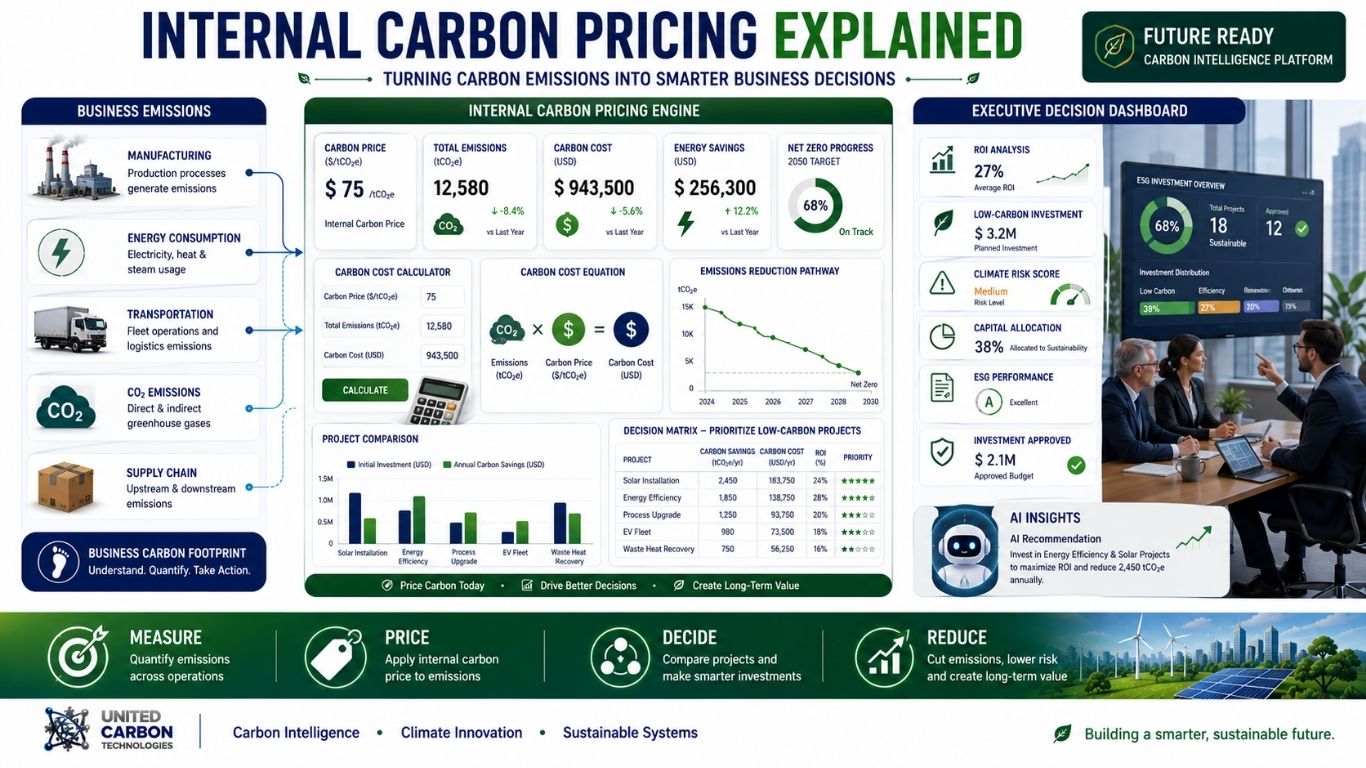
Implementing internal carbon pricing follows a structured process that combines carbon accounting with financial planning. Organizations first measure emissions, assign a carbon value, and then use that value to evaluate investments and operational decisions.
Typical Process
- Measure greenhouse gas emissions.
- Define organizational boundaries.
- Select an internal carbon price.
- Apply the price during project evaluation.
- Compare investment alternatives.
- Monitor financial and environmental outcomes.
- Review and update pricing periodically.
This process encourages decision-makers to consider both financial returns and long-term climate impacts before approving major investments.
5. Business Benefits of Internal Carbon Pricing
Internal carbon pricing creates measurable business value beyond emissions reduction. By incorporating climate considerations into financial planning, organizations can improve strategic decision-making while preparing for a low-carbon economy.
Key Advantages
- Supports smarter capital investments.
- Encourages energy efficiency.
- Accelerates carbon reduction initiatives.
- Strengthens climate risk management.
- Improves ESG reporting.
- Enhances investor confidence.
- Supports long-term Net Zero strategies.
- Promotes innovation.
Many organizations find that internal carbon pricing encourages departments to consider sustainability as part of everyday business planning rather than treating it as a separate initiative.
6. Challenges Businesses Should Consider
Although internal carbon pricing offers significant benefits, successful implementation requires reliable carbon data, leadership commitment, and regular review. Businesses should recognize that internal pricing is a management tool rather than a substitute for regulatory compliance.
Common Challenges
- Selecting an appropriate carbon price.
- Obtaining accurate emissions data.
- Integrating sustainability into finance.
- Building internal stakeholder support.
- Maintaining consistent methodologies.
- Adapting to evolving regulations.
7. Internal Carbon Pricing and ESG Reporting
Internal carbon pricing complements ESG reporting by demonstrating how climate-related risks influence strategic decisions. Investors increasingly value organizations that integrate sustainability into governance and financial planning rather than reporting emissions alone.
Organizations can also use internal carbon pricing to support climate disclosures, transition planning, and long-term emissions reduction strategies.
Supports ESG Through
- Improved climate governance.
- Better investment transparency.
- Enhanced sustainability reporting.
- Risk-informed decision-making.
- Climate scenario planning.
- Performance measurement.
8. Digital Carbon Intelligence and Internal Carbon Pricing
Managing internal carbon pricing manually can become challenging as organizations grow. Digital Carbon Intelligence platforms help centralize emissions data, calculate carbon impacts, visualize trends, and support executive decision-making through interactive dashboards.
Instead of relying on disconnected spreadsheets, organizations can monitor emissions, evaluate carbon costs, and generate sustainability insights from a single platform.
United Carbon Technologies is developing an integrated ESG & Carbon Intelligence Platform designed to simplify Carbon Accounting, ESG reporting, sustainability analytics, executive dashboards, and future-ready climate decision support. As the platform evolves, it aims to help organizations transform carbon data into actionable business intelligence.
9. Internal Carbon Pricing in India
While internal carbon pricing is still emerging in India, interest is growing as businesses expand internationally, strengthen ESG reporting, and prepare for evolving climate regulations. Organizations participating in global supply chains are increasingly expected to understand climate-related financial risks and demonstrate structured carbon management practices.
Industries such as manufacturing, energy, cement, steel, chemicals, logistics, aviation, and infrastructure are particularly well positioned to benefit from internal carbon pricing as part of broader sustainability strategies.
10. Preparing for a Low-Carbon Future
Internal carbon pricing is more than a financial calculation—it is a strategic management tool that helps organizations prepare for a future where climate considerations increasingly influence business success. Companies that integrate carbon costs into investment decisions today are better positioned to manage risks, identify opportunities, and remain competitive in a changing economy.
Combined with Carbon Accounting, ESG reporting, and intelligent sustainability analytics, internal carbon pricing enables organizations to build stronger, more resilient business strategies.
Make Carbon Data Work for Your Business
United Carbon Technologies is developing an ESG & Carbon Intelligence Platform that helps organizations measure emissions, monitor sustainability KPIs, improve Carbon Accounting, and generate executive insights through intelligent dashboards. Our vision is to empower businesses with data-driven tools for smarter climate decisions.
India Context
India's transition toward a low-carbon economy presents new opportunities for businesses to integrate climate considerations into financial planning. As sustainability disclosures, investor expectations, and global market requirements evolve, internal carbon pricing can help Indian organizations proactively manage climate-related risks and strengthen long-term competitiveness.
What's Next?
After understanding internal carbon pricing, businesses should learn how to establish meaningful carbon reduction targets, monitor climate KPIs, and use Carbon Intelligence platforms to transform emissions data into strategic business decisions.
Related Reads
- Carbon Accounting Explained
- Operational Boundaries in Carbon Accounting Explained
- How Businesses Improve Carbon Data Quality
- Building an ESG Dashboard: Metrics Every Company Should Monitor
- What Is Sustainability Governance?
- Materiality Assessment Explained for ESG Reporting
💡 Expert Insight
Internal carbon pricing is increasingly becoming a strategic planning tool rather than simply an environmental initiative. Organizations that combine accurate Carbon Accounting, reliable ESG data, executive oversight, and digital analytics can make more informed investment decisions while preparing for future climate regulations and market expectations. As Carbon Intelligence platforms mature, businesses will be able to model carbon-related financial scenarios with greater confidence and precision.
Conclusion
Internal carbon pricing helps organizations bring climate considerations into everyday business decisions. By assigning a financial value to greenhouse gas emissions, businesses can strengthen investment planning, encourage innovation, improve risk management, and support long-term sustainability goals.
As the global economy continues its transition toward lower emissions, organizations that proactively integrate carbon pricing into their strategies will be better positioned to create resilient, competitive, and future-ready businesses.
Quick Summary
- Internal carbon pricing assigns a financial value to emissions.
- It supports smarter investment decisions.
- Businesses can use shadow prices, internal fees, or implicit pricing.
- It strengthens Carbon Accounting and ESG reporting.
- Carbon pricing improves climate risk management.
- Digital Carbon Intelligence simplifies implementation.
- It supports long-term Net Zero planning.
Frequently Asked Questions (FAQs)
1. What is internal carbon pricing?
It is a voluntary business practice that assigns a financial value to greenhouse gas emissions for internal decision-making.
2. Is internal carbon pricing mandatory?
No. Most organizations adopt it voluntarily as part of their sustainability strategy.
3. What is a shadow carbon price?
A hypothetical carbon cost used to evaluate projects without actual financial transactions.
4. What is an internal carbon fee?
An internal charge applied to business units based on their emissions, often funding sustainability initiatives.
5. Why do companies use internal carbon pricing?
To improve investment decisions, manage climate risks, and support emissions reduction.
6. Does internal carbon pricing replace Carbon Accounting?
No. Carbon Accounting measures emissions, while internal carbon pricing assigns financial value to those emissions.
7. How does internal carbon pricing support ESG reporting?
It demonstrates how climate risks influence financial and strategic business decisions.
8. Which industries benefit most?
Manufacturing, energy, logistics, infrastructure, aviation, chemicals, and heavy industries commonly benefit.
9. Can SMEs use internal carbon pricing?
Yes. Small and medium-sized businesses can adopt simplified approaches based on their sustainability goals.
10. How can technology support internal carbon pricing?
Carbon Intelligence platforms automate emissions tracking, analytics, dashboards, and decision support.
Key Takeaways
- Internal carbon pricing links climate action with financial planning.
- It supports smarter investments and sustainability decisions.
- Reliable carbon data is essential for effective pricing.
- Digital Carbon Intelligence improves implementation.
- Early adoption strengthens long-term business resilience.
Prepare Your Business for the Low-Carbon Economy
Explore more expert resources from United Carbon Technologies on Carbon Accounting, ESG Reporting, Climate Intelligence, and sustainability strategy. Stay connected for updates on our upcoming ESG & Carbon Intelligence Platform and discover how data-driven insights can support better climate decisions.