

ISSB Standards Explained for Indian Businesses: A Complete Guide (2026)
Learn what the ISSB Standards are, why they matter for Indian businesses, and how they support ESG reporting, climate disclosures, investor confidence, and long-term sustainability.
By United Carbon Technologies | Climate Knowledge Hub India
Published: July 2026 | Last Updated: July 2026 | 15 min read
Join professionals learning about ESG Reporting, Climate Disclosure, Carbon Accounting, Climate Intelligence, Sustainability Governance, and Net Zero.
Sustainability reporting is rapidly evolving from voluntary disclosures to globally comparable reporting standards. One of the biggest developments in recent years is the introduction of the International Sustainability Standards Board (ISSB) Standards, which provide organizations with a consistent framework for reporting sustainability-related and climate-related financial information.
For Indian businesses, understanding ISSB Standards is becoming increasingly important as investors, multinational customers, financial institutions, and regulators seek transparent, decision-useful sustainability information. Companies that align with globally recognized reporting frameworks are better positioned to build investor confidence and compete in international markets.
This guide explains what ISSB Standards are, why they matter, how they relate to Indian ESG reporting requirements, and practical steps organizations can take to prepare for future sustainability disclosure expectations.
Featured Snippet
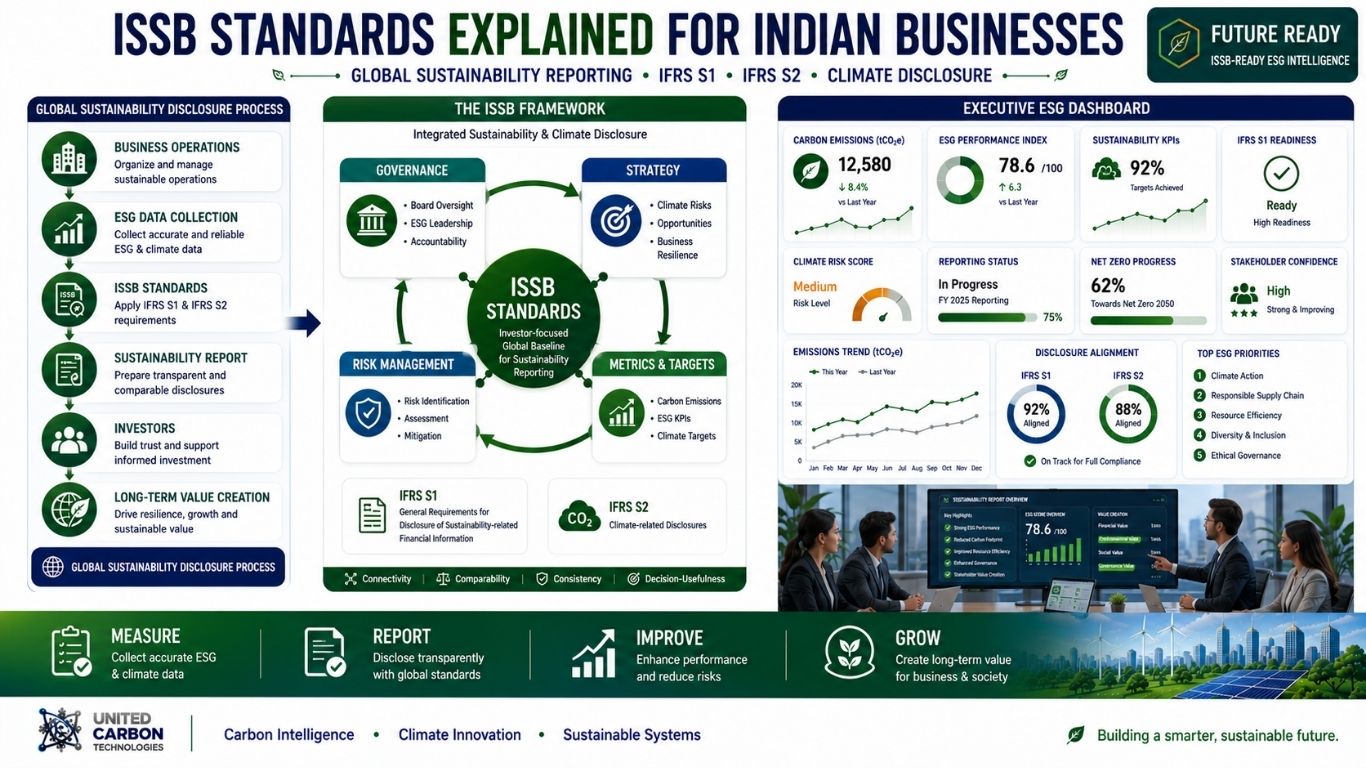
The ISSB (International Sustainability Standards Board) develops global sustainability disclosure standards that help businesses report climate-related and sustainability-related risks and opportunities in a consistent, investor-focused manner. The standards improve transparency, comparability, and confidence in corporate sustainability reporting.
Introduction
Environmental, Social, and Governance (ESG) reporting is increasingly becoming a strategic business requirement rather than simply a compliance exercise. Investors now expect organizations to disclose how sustainability-related risks and opportunities may affect long-term business performance.
The ISSB Standards were created to establish a globally consistent sustainability reporting framework that enables investors to compare sustainability information across organizations and industries. Rather than replacing financial reporting, these standards complement financial disclosures by integrating sustainability into business decision-making.
For Indian businesses, understanding ISSB Standards today can help improve ESG readiness, strengthen governance, and prepare for evolving sustainability reporting expectations across domestic and international markets.
💡 Did You Know?
- ISSB Standards were developed to create a global baseline for sustainability-related financial disclosures.
- The first two standards—IFRS S1 and IFRS S2—focus on sustainability-related disclosures and climate-related disclosures.
- Many multinational companies and investors are increasingly aligning sustainability reporting with ISSB principles.
- Indian businesses with international operations or global customers may benefit from understanding ISSB reporting expectations early.
1. What Are ISSB Standards?
The International Sustainability Standards Board (ISSB) develops globally recognized sustainability disclosure standards that help organizations communicate sustainability-related risks and opportunities that may affect enterprise value.
The standards are designed to improve consistency, transparency, and comparability across sustainability reports while supporting investor decision-making.
Primary Objectives
- Improve sustainability transparency.
- Strengthen investor confidence.
- Create globally comparable reporting.
- Support climate-related disclosures.
- Integrate sustainability with financial reporting.
- Improve corporate governance.
- Enhance risk management.
- Support long-term value creation.
2. Why ISSB Standards Matter for Indian Businesses
Indian companies increasingly participate in global supply chains, attract international investors, and work with multinational customers. As sustainability reporting expectations evolve, organizations that understand ISSB Standards can improve reporting quality and strengthen stakeholder confidence.
Although reporting obligations depend on applicable regulations and business circumstances, aligning internal sustainability practices with globally recognized frameworks can improve organizational readiness and reporting consistency.
Business Benefits
- Improve investor confidence.
- Enhance ESG reporting quality.
- Support global business expansion.
- Improve sustainability governance.
- Strengthen climate risk management.
- Increase reporting consistency.
- Improve strategic decision-making.
- Build long-term business resilience.
Understanding global reporting standards today helps organizations prepare for tomorrow's investor and regulatory expectations.
Prepare for the Future of ESG Reporting
United Carbon Technologies is developing an ESG & Carbon Intelligence Platform designed to help organizations centralize sustainability data, strengthen Carbon Accounting, monitor ESG metrics, and simplify sustainability reporting through intelligent dashboards. Planned capabilities are intended to support organizations preparing for globally recognized sustainability disclosure frameworks, including ISSB-aligned reporting workflows.
3. Understanding IFRS S1 and IFRS S2
The ISSB has issued two foundational sustainability disclosure standards that together create a global baseline for sustainability-related financial reporting. These standards are designed to help organizations provide consistent, decision-useful information to investors and other capital market participants.
IFRS S1 — General Requirements
IFRS S1 establishes the general framework for reporting sustainability-related risks and opportunities that could reasonably affect an organization's enterprise value over the short, medium, or long term.
- Governance of sustainability issues
- Business strategy and sustainability risks
- Risk management processes
- Relevant sustainability metrics
- Targets and progress monitoring
IFRS S2 — Climate-related Disclosures
IFRS S2 focuses specifically on climate-related risks and opportunities. It builds upon the recommendations of the Task Force on Climate-related Financial Disclosures (TCFD) and emphasizes governance, strategy, risk management, and climate-related metrics and targets.
- Climate governance
- Physical climate risks
- Transition risks
- Climate opportunities
- GHG emissions reporting
- Climate targets
- Scenario analysis
- Climate resilience
4. ISSB Standards and ESG Reporting
ISSB Standards do not replace ESG reporting; rather, they provide a globally recognized framework for reporting sustainability-related financial information in a consistent and investor-focused manner.
Organizations already measuring ESG performance can use ISSB principles to improve governance, reporting quality, data consistency, and disclosure processes.
ISSB Supports
- Higher-quality ESG reporting
- Better governance disclosures
- Climate risk transparency
- Comparable sustainability information
- Improved investor communication
- Decision-useful reporting
- Integrated sustainability management
- Long-term value creation
5. Preparing Your Business for ISSB Reporting
Preparing for ISSB reporting is not simply about publishing another sustainability report. Organizations should first establish reliable sustainability data, governance processes, and reporting systems that support consistent disclosures.
Practical Preparation Steps
- Establish ESG governance responsibilities.
- Identify material sustainability topics.
- Strengthen Carbon Accounting processes.
- Measure greenhouse gas emissions.
- Assess climate-related risks.
- Improve sustainability data quality.
- Develop internal reporting controls.
- Review disclosures regularly.
Businesses that build strong sustainability data foundations today will find it easier to adapt to evolving reporting expectations in the future.
6. Common Challenges for Businesses
Organizations beginning their sustainability reporting journey often encounter practical challenges when preparing for ISSB-aligned disclosures.
Common Challenges
- Limited ESG data availability.
- Inconsistent reporting processes.
- Poor carbon data quality.
- Limited internal expertise.
- Disconnected business systems.
- Supplier sustainability data gaps.
- Changing reporting expectations.
- Resource constraints.
Addressing these challenges requires cross-functional collaboration between finance, sustainability, operations, procurement, and leadership teams.
7. Technology and ISSB Reporting
As sustainability disclosures become more comprehensive, organizations increasingly rely on digital platforms to collect, validate, analyze, and report ESG information. Manual spreadsheets become difficult to maintain as reporting requirements expand.
Digital ESG platforms help organizations centralize sustainability information, improve data accuracy, automate reporting workflows, and support executive decision-making.
United Carbon Technologies is developing an integrated ESG & Carbon Intelligence Platform designed to centralize Carbon Accounting, sustainability metrics, ESG reporting, executive dashboards, and climate analytics. Planned capabilities are intended to help organizations organize sustainability data that can support reporting aligned with globally recognized disclosure frameworks such as the ISSB Standards.
8. ISSB Standards in the Indian Context
India's sustainability reporting landscape continues to evolve. Many organizations already prepare disclosures under frameworks such as Business Responsibility and Sustainability Reporting (BRSR). Companies with international investors, export markets, or multinational customers may also monitor global sustainability reporting developments, including ISSB Standards, to improve reporting readiness and comparability.
Understanding ISSB concepts today can help organizations strengthen governance, improve sustainability data quality, and prepare for changing stakeholder expectations.
9. Best Practices for Successful Implementation
- Integrate sustainability into business strategy.
- Improve board-level oversight.
- Strengthen Carbon Accounting.
- Improve ESG data governance.
- Standardize reporting processes.
- Use measurable KPIs.
- Review sustainability performance regularly.
- Invest in digital reporting systems.
10. Building a Future-Ready Sustainability Reporting System
ISSB Standards represent an important step toward globally consistent sustainability reporting. Organizations that invest in governance, reliable sustainability data, climate risk management, and integrated reporting systems today will be better positioned to respond to future stakeholder expectations.
Rather than viewing sustainability reporting as a compliance activity, businesses can use ISSB principles to strengthen transparency, improve strategic decision-making, and create long-term enterprise value.
Simplify Sustainability Reporting with Better Data
United Carbon Technologies is developing an ESG & Carbon Intelligence Platform to help organizations centralize ESG information, improve Carbon Accounting, monitor sustainability KPIs, and visualize reporting through executive dashboards. Our vision is to simplify ESG data management and support organizations preparing for globally recognized sustainability reporting frameworks.
India Context
Indian companies are increasingly expected to demonstrate high-quality sustainability disclosures by investors, lenders, multinational customers, and supply chain partners. While reporting requirements vary depending on company size, listing status, and applicable regulations, understanding ISSB Standards can help businesses strengthen ESG maturity and improve global competitiveness.
What's Next?
After understanding ISSB Standards, organizations should focus on materiality assessments, Carbon Accounting, climate risk assessments, sustainability governance, and ESG dashboards to build a robust sustainability reporting system.
Related Reads
- Materiality Assessment Explained for ESG Reporting
- Building an ESG Dashboard: Metrics Every Company Should Monitor
- What Is Sustainability Governance?
- Internal Carbon Pricing Explained
- How Businesses Improve Carbon Data Quality
- Carbon Accounting Explained
💡 Expert Insight
Organizations that build reliable sustainability data systems before reporting becomes mandatory are typically better positioned to respond to investor requests, regulatory developments, and customer expectations. Strong governance, accurate carbon data, and integrated ESG management provide the foundation for credible sustainability disclosures under frameworks such as the ISSB Standards.
Conclusion
ISSB Standards provide businesses with a globally recognized framework for communicating sustainability-related and climate-related information. For Indian organizations, understanding these standards today can improve reporting quality, strengthen governance, and enhance long-term business resilience.
By investing in reliable sustainability data, Carbon Accounting, and effective ESG governance, organizations can prepare for future reporting expectations while creating greater transparency and stakeholder confidence.
Quick Summary
- ISSB creates global sustainability disclosure standards.
- IFRS S1 covers general sustainability disclosures.
- IFRS S2 focuses on climate-related disclosures.
- ISSB improves investor-focused reporting.
- Reliable ESG data is essential for effective reporting.
- Digital platforms simplify sustainability reporting.
- Indian businesses can improve reporting readiness by understanding ISSB principles.
Frequently Asked Questions (FAQs)
1. What is the ISSB?
The International Sustainability Standards Board develops global sustainability disclosure standards.
2. What is IFRS S1?
IFRS S1 provides the general requirements for sustainability-related financial disclosures.
3. What is IFRS S2?
IFRS S2 focuses on climate-related financial disclosures.
4. Are ISSB Standards mandatory in India?
Applicability depends on evolving regulations and organizational circumstances. Businesses should monitor guidance from relevant authorities.
5. How do ISSB Standards relate to ESG reporting?
They provide a globally consistent framework for sustainability-related financial disclosures.
6. Why are investors interested in ISSB reporting?
It improves comparability, transparency, and decision-useful sustainability information.
7. Do SMEs need to understand ISSB Standards?
Yes. SMEs working with multinational customers or investors may benefit from understanding these frameworks.
8. How can organizations prepare for ISSB reporting?
Strengthen governance, Carbon Accounting, ESG data quality, and reporting processes.
9. How does technology support ISSB reporting?
Digital ESG platforms centralize sustainability data and simplify reporting workflows.
10. Why are ISSB Standards important for the future?
They promote globally comparable sustainability disclosures and support better long-term decision-making.
Key Takeaways
- ISSB promotes globally consistent sustainability reporting.
- IFRS S1 and IFRS S2 are the foundational ISSB standards.
- Strong ESG data improves reporting quality.
- Carbon Accounting supports credible climate disclosures.
- Technology simplifies sustainability reporting.
Build Better ESG Reporting with Confidence
Explore more expert resources from United Carbon Technologies on Carbon Accounting, ESG reporting, climate disclosures, sustainability governance, and Climate Intelligence. Stay connected for updates on our upcoming ESG & Carbon Intelligence Platform designed to simplify sustainability data management and reporting.