

How Businesses Define Organizational Boundaries for Carbon Accounting (2026)
Learn what organizational boundaries are in carbon accounting, the GHG Protocol approaches, and how businesses choose the right reporting boundary for accurate greenhouse gas emissions reporting.
By United Carbon Technologies | Climate Knowledge Hub India
Published: July 2026 | Last Updated: July 2026 | 11 min read
Join readers exploring practical insights on Carbon Accounting, ESG Reporting, Climate Intelligence, Scope 1, Scope 2, Scope 3 Emissions, Sustainability Strategy, and India's transition toward a low-carbon economy.
Before a business can calculate its carbon footprint, it must first answer a fundamental question: Which operations should be included? The answer lies in defining organizational boundaries—one of the most important yet often overlooked steps in greenhouse gas accounting.
Organizational boundaries determine which facilities, subsidiaries, joint ventures, leased assets, and business operations are included in a company's carbon inventory. Without clearly defined boundaries, greenhouse gas reporting can become inconsistent, incomplete, and difficult to compare over time.
This beginner-friendly guide explains what organizational boundaries are, why they matter, the three reporting approaches recommended by the GHG Protocol, and how businesses can establish a reliable foundation for accurate carbon accounting and ESG reporting.
Featured Snippet
Organizational boundaries define which business operations, subsidiaries, facilities, and assets are included in a company's greenhouse gas inventory. The GHG Protocol recommends three approaches—Equity Share, Financial Control, and Operational Control—to ensure consistent, transparent, and accurate carbon accounting.
Introduction
Accurate carbon accounting begins long before greenhouse gas emissions are calculated. Businesses must first determine the scope of their reporting by identifying which parts of the organization will be included in the carbon inventory. This process is known as defining organizational boundaries.
For businesses operating multiple facilities, subsidiaries, manufacturing plants, franchises, joint ventures, or international offices, establishing organizational boundaries ensures that emissions are reported consistently and transparently. It prevents both double counting and unintentional exclusion of significant emission sources.
The Greenhouse Gas (GHG) Protocol, the world's most widely used carbon accounting framework, provides three recognized approaches for defining organizational boundaries. Selecting the most appropriate approach depends on how a business owns, manages, and controls its operations.
Understanding organizational boundaries is essential for preparing reliable Scope 1, Scope 2, and Scope 3 inventories, meeting ESG reporting requirements, and building credible Net Zero strategies.
Carbon Intelligence • Better Boundaries • Better Reporting
Building Reliable Carbon Accounting from the Ground Up
United Carbon Technologies is developing digital Carbon Intelligence solutions that help businesses establish reporting boundaries, calculate greenhouse gas emissions, manage ESG data, and build transparent sustainability reporting systems.
💡 Did You Know?
- The GHG Protocol identifies organizational boundaries as one of the first steps in preparing a corporate greenhouse gas inventory.
- Choosing different organizational boundary approaches can result in different reported emissions for the same business.
- Many multinational companies use the Operational Control approach because it aligns with day-to-day business management.
- Clearly defined organizational boundaries improve transparency, audit readiness, and investor confidence in ESG reporting.
1. What Are Organizational Boundaries?
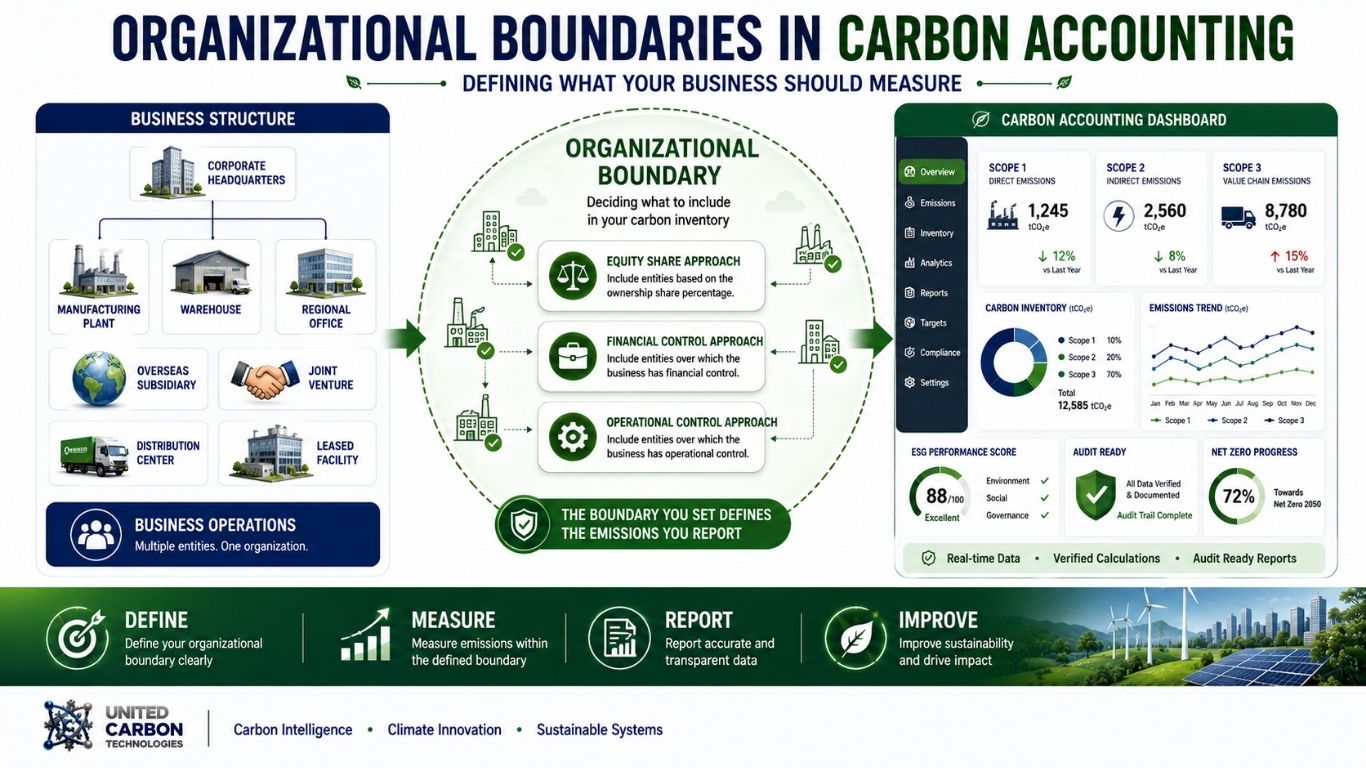
Organizational boundaries define which parts of a business are included in its greenhouse gas inventory. They establish the limits of carbon accounting by determining whether emissions from subsidiaries, manufacturing plants, leased facilities, joint ventures, business units, and other operational entities should be reported.
Instead of measuring emissions from every organization connected to a company, businesses report emissions only from operations that fall within their chosen organizational boundary approach. This creates consistency and ensures emissions are reported using a recognized methodology.
Without clearly defined organizational boundaries, carbon accounting can become inconsistent, making year-to-year comparisons and ESG reporting less reliable.
Examples of Organizational Entities
- Corporate headquarters
- Manufacturing plants
- Warehouses
- Regional offices
- Subsidiaries
- Joint ventures
- Leased facilities
- Distribution centers
2. Why Organizational Boundaries Matter
Organizational boundaries provide the foundation for every greenhouse gas inventory. Before businesses classify emissions into Scope 1, Scope 2, and Scope 3, they must first determine which operations belong within the reporting boundary.
Well-defined organizational boundaries improve reporting consistency, simplify audits, strengthen ESG disclosures, and help stakeholders understand exactly what the reported emissions represent.
Benefits of Defining Organizational Boundaries
- Improves reporting consistency.
- Reduces the risk of double counting emissions.
- Supports transparent ESG reporting.
- Aligns reporting with the GHG Protocol.
- Creates a reliable baseline for Net Zero planning.
- Builds confidence among investors, customers, and regulators.
Before calculating emissions, ensure your organization has defined which facilities, subsidiaries, and operations are included in your greenhouse gas inventory.
United Carbon Technologies is developing Carbon Intelligence solutions to help businesses define reporting boundaries, calculate emissions, manage ESG data, and simplify carbon accounting with intelligent digital tools.
3. The Three GHG Protocol Approaches to Organizational Boundaries
The Greenhouse Gas (GHG) Protocol Corporate Standard provides three internationally recognized approaches for defining organizational boundaries. Businesses should choose one approach and apply it consistently across all reporting periods to ensure transparent and comparable greenhouse gas inventories.
The three approaches are based on how an organization owns, finances, or operates different parts of its business. Selecting the appropriate method depends on the company's legal structure, management responsibilities, and reporting objectives.
The Three Approaches
- Equity Share Approach
- Financial Control Approach
- Operational Control Approach
4. Equity Share Approach Explained
Under the Equity Share Approach, businesses account for greenhouse gas emissions according to their percentage of ownership in an operation. The reported emissions correspond to the organization's economic interest rather than its management responsibilities.
For example, if a company owns 40% of a manufacturing joint venture, it reports 40% of that facility's greenhouse gas emissions in its corporate carbon inventory.
Best Suited For
- Joint ventures
- Shared ownership structures
- Investment partnerships
- Infrastructure projects
- International collaborations
Advantages
- Reflects true ownership interest.
- Works well for investment-focused organizations.
- Reduces overlap between shareholders.
5. Financial Control Approach Explained
The Financial Control Approach requires businesses to report 100% of emissions from operations they financially control, regardless of their ownership percentage. Financial control generally means the organization has the authority to direct financial and operating policies to obtain economic benefits.
Even if a company owns less than half of a business entity, it may still report all emissions if it exercises financial control over that operation.
Typical Examples
- Wholly owned subsidiaries
- Financially controlled joint ventures
- Controlled manufacturing facilities
- Business entities managed through financial agreements
Advantages
- Aligns with financial reporting.
- Supports corporate governance practices.
- Provides consistent organizational reporting.
6. Operational Control Approach Explained
The Operational Control Approach is the most widely adopted method for corporate greenhouse gas accounting. Businesses report 100% of emissions from operations where they have the authority to introduce and implement operating policies, regardless of ownership percentage.
In simple terms, if a business controls how a facility operates on a day-to-day basis, it generally reports all associated emissions.
Examples
- Manufacturing plants operated by the company.
- Corporate offices under direct management.
- Distribution centres managed by the organization.
- Leased facilities operated by company employees.
- Company-managed logistics operations.
Why It's Popular
- Easy to implement.
- Aligns with operational decision-making.
- Supports emission reduction initiatives.
- Commonly used in ESG reporting.
- Recommended by many sustainability practitioners.
7. How Businesses Choose the Right Organizational Boundary
There is no universally "best" approach. The appropriate organizational boundary depends on business structure, ownership arrangements, reporting objectives, stakeholder expectations, and governance practices.
| Business Situation | Common Approach |
|---|---|
| Investment-based ownership | Equity Share |
| Financial reporting alignment | Financial Control |
| Operational management | Operational Control |
Regardless of the approach selected, organizations should apply it consistently and clearly document the methodology within their ESG and sustainability reports.
8. Common Mistakes Businesses Make
Incorrectly defining organizational boundaries can reduce the credibility of greenhouse gas inventories and make emissions difficult to compare across reporting years.
Common Mistakes
- Changing reporting approaches every year.
- Excluding subsidiaries without justification.
- Double counting emissions from joint ventures.
- Ignoring leased assets.
- Not documenting reporting assumptions.
- Confusing organizational boundaries with operational boundaries.
- Failing to review business acquisitions and divestments.
9. Organizational Boundaries in the Indian Business Context
Many Indian organizations operate through subsidiaries, manufacturing plants, franchise models, contract manufacturing arrangements, and joint ventures. As sustainability reporting becomes increasingly important for exports, ESG disclosures, and investor communication, defining organizational boundaries has become a critical first step in preparing reliable greenhouse gas inventories.
Companies participating in global supply chains should establish transparent reporting boundaries that align with internationally recognized frameworks to improve consistency and stakeholder confidence.
10. Best Practices for Defining Organizational Boundaries
- Select one GHG Protocol approach and apply it consistently.
- Document ownership and management structures.
- Review reporting boundaries annually.
- Include newly acquired operations promptly.
- Maintain records supporting reporting decisions.
- Communicate the chosen methodology within ESG reports.
- Use digital Carbon Intelligence platforms to manage organizational structures efficiently.
Build Reliable Carbon Inventories from Day One
United Carbon Technologies is developing Carbon Intelligence solutions that help organizations establish reporting boundaries, calculate greenhouse gas emissions, manage ESG data, and simplify corporate sustainability reporting through intelligent digital systems.
India Context
As Indian businesses expand through acquisitions, subsidiaries, contract manufacturing, and overseas operations, organizational boundaries are becoming increasingly important for ESG reporting and global supply chain participation. Clearly defining reporting boundaries helps companies comply with international sustainability expectations while improving transparency for investors, customers, and regulators.
What's Next?
After establishing organizational boundaries, businesses should define operational boundaries by classifying emissions into Scope 1, Scope 2, and Scope 3. Together, these two concepts create the foundation of every corporate greenhouse gas inventory.
Related Reads
- What Are Emission Factors? A Beginner-Friendly Business Guide
- Spend-Based vs Activity-Based Carbon Accounting Explained
- How to Collect Supplier Carbon Data
- Understanding Scope 3 Emissions
- Carbon Accounting Explained
💡 Expert Insight
Many organizations focus immediately on collecting emissions data, but experienced sustainability teams begin by defining reporting boundaries first. A well-documented organizational boundary reduces confusion, improves audit readiness, prevents double counting, and ensures carbon inventories remain consistent even as businesses grow through acquisitions or new partnerships.
Conclusion
Organizational boundaries are the starting point of credible carbon accounting. Before businesses measure emissions or set Net Zero targets, they must clearly define which operations, facilities, and subsidiaries are included in their greenhouse gas inventory.
Whether using the Equity Share, Financial Control, or Operational Control approach, consistency and transparency are essential. Organizations that establish clear reporting boundaries build stronger ESG reports, improve stakeholder confidence, and create a reliable foundation for long-term climate action.
Quick Summary
- Organizational boundaries define what is included in a carbon inventory.
- The GHG Protocol recommends three reporting approaches.
- Operational Control is widely used by businesses.
- Consistent reporting improves ESG credibility.
- Clear boundaries reduce double counting.
- Documentation supports audit readiness.
- Strong boundaries create better carbon accounting.
Frequently Asked Questions (FAQs)
1. What are organizational boundaries in carbon accounting?
They define which business operations, facilities, subsidiaries, and assets are included in a company's greenhouse gas inventory.
2. Why are organizational boundaries important?
They ensure emissions are reported consistently, transparently, and without double counting.
3. What are the three GHG Protocol approaches?
Equity Share, Financial Control, and Operational Control.
4. Which approach is most commonly used?
The Operational Control approach is widely adopted because it aligns with day-to-day business management.
5. Can businesses change their reporting approach?
They can, but changes should be justified, documented, and applied carefully to maintain consistency.
6. Do leased facilities need to be included?
It depends on the reporting approach and the level of operational or financial control.
7. How do organizational boundaries affect Scope 1, 2, and 3 reporting?
They determine which operations are included before emissions are classified into the three scopes.
8. Are organizational and operational boundaries the same?
No. Organizational boundaries define which entities are included, while operational boundaries classify emissions into Scopes 1, 2, and 3.
9. Should subsidiaries always be included?
Inclusion depends on the selected reporting approach and the company's ownership or control.
10. How do digital ESG platforms help?
They simplify organizational mapping, emissions calculations, reporting consistency, and audit preparation.
Key Takeaways
- Define reporting boundaries before calculating emissions.
- Apply one GHG Protocol approach consistently.
- Document reporting assumptions.
- Review boundaries whenever the business structure changes.
- Use digital Carbon Intelligence tools to improve reporting efficiency.
Strengthen Your Carbon Accounting Foundation
Clear organizational boundaries are the first step toward credible greenhouse gas reporting. Explore more practical Carbon Accounting guides from United Carbon Technologies and build a stronger foundation for ESG reporting, Net Zero planning, and Climate Intelligence.