

Spend-Based vs Activity-Based Carbon Accounting Explained (2026)
Learn the difference between spend-based and activity-based carbon accounting, their advantages, limitations, and when businesses should use each approach for accurate Scope 3 emissions reporting.
By United Carbon Technologies | Climate Knowledge Hub India
Published: July 2026 | Last Updated: July 2026 | 10 min read
Join readers exploring practical insights on Carbon Accounting, ESG Reporting, Climate Intelligence, Scope 3 Emissions, Sustainability Strategy, and India's transition toward a low-carbon economy.
One of the biggest challenges in carbon accounting is estimating emissions when detailed supplier data is unavailable. Businesses often need practical methods to calculate greenhouse gas emissions while gradually improving data quality. This is where spend-based and activity-based carbon accounting become essential.
Both approaches are widely used in Scope 3 emissions reporting, but they serve different purposes. Choosing the right method can significantly influence the accuracy of carbon inventories, ESG reporting, sustainability strategies, and climate-related decision-making.
In this guide, you'll learn how spend-based and activity-based carbon accounting work, their strengths and limitations, when each method should be applied, and why many organizations ultimately combine both approaches for more reliable emissions reporting.
Featured Snippet
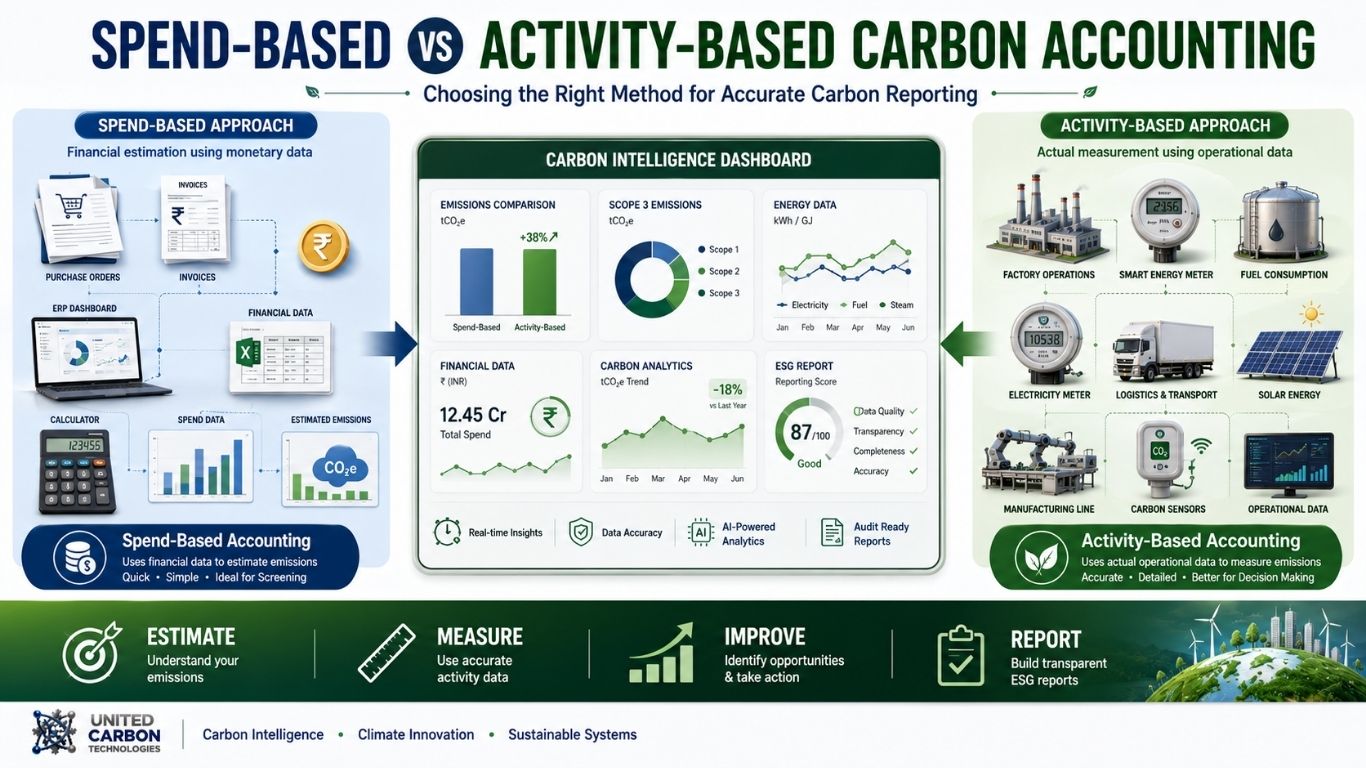
Spend-based carbon accounting estimates emissions using the amount of money spent on goods or services combined with emission factors. Activity-based carbon accounting uses actual operational data, such as fuel consumption, electricity usage, distance travelled, or material quantities, making it more accurate for greenhouse gas reporting and Scope 3 emissions calculations.
Introduction
As businesses around the world strengthen their sustainability commitments, measuring greenhouse gas emissions has become an essential part of corporate decision-making. However, many organizations struggle to obtain detailed emissions data from suppliers, logistics partners, or service providers. Without reliable operational information, estimating emissions accurately becomes a significant challenge.
To address this issue, organizations use different carbon accounting methodologies depending on the information available. Two of the most common approaches are spend-based carbon accounting and activity-based carbon accounting. Both methods help businesses estimate emissions, but they differ considerably in terms of data requirements, calculation methods, and reporting accuracy.
Understanding these two approaches is particularly important for organizations preparing Scope 3 greenhouse gas inventories, ESG disclosures, sustainability reports, or Net Zero strategies. Selecting the appropriate methodology enables companies to improve reporting credibility while identifying meaningful opportunities for emission reductions across their value chain.
This practical guide explains how each approach works, where it is most effective, and how businesses can progressively move toward higher-quality carbon accounting.
Carbon Intelligence • Better Data • Better Decisions
Supporting Smarter Carbon Accounting for Businesses
United Carbon Technologies is developing digital Carbon Intelligence solutions that simplify emissions measurement, Scope 3 reporting, ESG analytics, supplier engagement, and sustainability data management for organizations of all sizes.
💡 Did You Know?
- Many organizations initially calculate more than half of their Scope 3 emissions using spend-based estimation methods.
- Activity-based accounting generally provides higher accuracy because it relies on actual operational data rather than financial expenditure.
- As supplier reporting improves, businesses often transition from spend-based estimates to activity-based calculations.
- Many organizations use a hybrid approach that combines both methods for comprehensive carbon reporting.
1. What Is Spend-Based Carbon Accounting?
Spend-based carbon accounting estimates greenhouse gas emissions by multiplying the amount of money spent on a product or service by an emission factor assigned to that spending category. Instead of measuring actual resource consumption, this method uses financial expenditure as a proxy for environmental impact.
For example, if a company spends ₹50 lakh annually on office equipment or consulting services, emission factors associated with those expenditure categories can be used to estimate the resulting greenhouse gas emissions. This approach is particularly useful when supplier-specific emissions data is unavailable.
Spend-based accounting is commonly applied during the early stages of carbon footprint assessments because financial purchasing data is generally easier to obtain than detailed operational information.
Typical Data Sources
- Purchase orders
- Invoices
- ERP and accounting systems
- Procurement records
- Financial expenditure reports
- Industry emission factor databases
2. What Is Activity-Based Carbon Accounting?
Activity-based carbon accounting calculates greenhouse gas emissions using actual operational data rather than financial expenditure. It measures physical activities that directly generate emissions, making it one of the most accurate approaches available for carbon accounting.
Examples of activity data include electricity consumption (kWh), fuel usage (litres), transportation distance (kilometres), material quantities (kilograms), waste generated (tonnes), or water consumption. These activity values are multiplied by scientifically established emission factors to estimate greenhouse gas emissions.
Because activity-based accounting reflects real-world operations, it provides businesses with more reliable information for emissions reduction planning, supplier engagement, ESG reporting, and climate strategy development.
Common Activity Data Examples
- Electricity consumption
- Natural gas usage
- Diesel and petrol consumption
- Transportation distances
- Raw material quantities
- Waste generation
- Business travel records
- Manufacturing production volumes
Businesses that progressively transition from spend-based estimates to activity-based measurements build more reliable carbon inventories and stronger ESG reporting systems.
United Carbon Technologies is developing Carbon Intelligence solutions to help businesses calculate emissions, improve Scope 3 reporting, manage sustainability data, and build future-ready ESG reporting systems.
3. Key Differences Between Spend-Based and Activity-Based Carbon Accounting
Although both approaches estimate greenhouse gas emissions, they differ significantly in the type of data used, calculation accuracy, implementation effort, and business applications. Understanding these differences helps organizations choose the most suitable methodology for their sustainability journey.
| Comparison | Spend-Based | Activity-Based |
|---|---|---|
| Primary Data Source | Financial expenditure | Operational activity data |
| Accuracy | Moderate | High |
| Ease of Implementation | Easy | Moderate to Advanced |
| Supplier Data Required | Usually No | Usually Yes |
| Best Use Case | Initial carbon inventories | Detailed emissions reporting |
4. Advantages of Spend-Based Carbon Accounting
Spend-based accounting allows businesses to begin measuring emissions even when supplier-specific environmental data is unavailable. It provides a practical starting point for organizations beginning their carbon accounting journey.
Benefits
- Easy to implement using existing financial records.
- Requires minimal supplier engagement.
- Suitable for first-time carbon footprint assessments.
- Provides broad coverage across purchased goods and services.
- Supports early ESG reporting initiatives.
- Helps identify high-spending emission categories.
5. Advantages of Activity-Based Carbon Accounting
Activity-based accounting uses real operational information, making it the preferred approach for organizations seeking accurate emissions reporting and measurable carbon reduction opportunities.
Benefits
- Higher reporting accuracy.
- Better identification of emission hotspots.
- Supports supplier engagement.
- Improves reduction planning.
- Strengthens ESG disclosures.
- Provides greater confidence for investors and customers.
6. Limitations of Both Methods
No carbon accounting methodology is perfect. Each approach has advantages as well as practical limitations that businesses should understand before implementation.
| Method | Common Limitations |
|---|---|
| Spend-Based | Less accurate, depends on industry averages, limited visibility into operational improvements. |
| Activity-Based | Requires detailed supplier data, higher implementation effort, greater data management requirements. |
7. When Should Businesses Use Each Method?
Selecting the right methodology depends on data availability, reporting maturity, business objectives, and available resources.
Use Spend-Based When:
- Starting carbon accounting.
- Supplier data is unavailable.
- Conducting a preliminary Scope 3 assessment.
- Time and resources are limited.
Use Activity-Based When:
- Supplier operational data is available.
- Preparing detailed ESG reports.
- Tracking emission reduction initiatives.
- Supporting Net Zero strategies.
- Meeting customer disclosure requirements.
8. Why Many Organizations Use a Hybrid Approach
In practice, many businesses combine both methodologies. High-impact suppliers are assessed using activity-based calculations, while lower-priority suppliers are estimated using spend-based emission factors.
This hybrid approach balances reporting accuracy with practical implementation, enabling organizations to improve carbon inventories gradually without delaying sustainability reporting.
9. Digital Carbon Intelligence Is Transforming Carbon Accounting
Modern Carbon Intelligence platforms reduce manual calculations by integrating procurement systems, supplier questionnaires, ERP software, utility data, and ESG reporting tools into a single digital workflow.
Organizations can automatically calculate emissions, monitor supplier performance, visualize carbon hotspots, and generate reporting dashboards for management and stakeholders.
10. Preparing for the Future of Carbon Accounting
As sustainability reporting standards continue to evolve, businesses will increasingly rely on high-quality operational data rather than estimated financial proxies. Improving supplier engagement, investing in digital reporting systems, and strengthening data governance today will make future reporting more accurate and efficient.
Organizations that continuously improve their carbon accounting methodologies will be better positioned to meet investor expectations, customer requirements, and emerging climate disclosure regulations.
Build Better Carbon Accounting with Climate Intelligence
United Carbon Technologies is developing digital Carbon Intelligence solutions to help businesses measure emissions, improve Scope 3 reporting, manage supplier sustainability data, and simplify ESG reporting through intelligent automation.
Whether your organization is beginning its carbon accounting journey or transitioning toward more advanced emissions reporting, digital tools can improve data quality and support better climate decisions.
India Context
Indian businesses are increasingly participating in global supply chains where customers, investors, and multinational companies expect transparent greenhouse gas reporting. Export-oriented manufacturers, automotive companies, pharmaceutical firms, technology providers, infrastructure businesses, and large MSMEs are beginning to measure Scope 3 emissions to remain competitive.
Organizations that strengthen carbon accounting capabilities today will be better prepared for future sustainability regulations and international reporting expectations.
What's Next?
Understanding carbon accounting methodologies is only one step in building a comprehensive emissions management system. Businesses should next focus on improving emission factors, supplier engagement, carbon data quality, and digital ESG reporting capabilities to achieve more accurate climate intelligence.
Related Reads
- How to Collect Supplier Carbon Data
- Understanding Scope 3 Emissions
- Carbon Accounting Explained
- Carbon Reporting Software: What Businesses Should Look For
- ESG Reporting Checklist for Businesses
- How Climate Data Helps Businesses Make Better Decisions
💡 Expert Insight
Many organizations delay carbon accounting because they believe they need perfect supplier data before they can begin. In reality, the best approach is to start with spend-based estimates to establish a baseline and progressively replace those estimates with activity-based data as supplier engagement improves. This phased strategy enables continuous improvement while supporting credible ESG reporting and informed climate action.
Conclusion
Spend-based and activity-based carbon accounting are not competing methodologies—they are complementary tools that support different stages of an organization's sustainability journey. Spend-based calculations provide a practical starting point, while activity-based methods deliver the accuracy needed for mature ESG reporting and long-term emissions reduction planning.
Businesses that gradually improve data quality, strengthen supplier engagement, and adopt digital Carbon Intelligence platforms can build more reliable greenhouse gas inventories and make better sustainability decisions over time.
Quick Summary
- Spend-based accounting estimates emissions using financial expenditure.
- Activity-based accounting uses actual operational data.
- Activity-based reporting offers higher accuracy.
- Spend-based accounting is useful for initial Scope 3 inventories.
- Many organizations combine both approaches.
- Digital platforms improve carbon accounting efficiency.
- Better data leads to better climate decisions.
Frequently Asked Questions (FAQs)
1. What is spend-based carbon accounting?
Spend-based carbon accounting estimates emissions using financial expenditure and industry emission factors.
2. What is activity-based carbon accounting?
It calculates emissions using actual operational data such as fuel, electricity, materials, transportation, and production volumes.
3. Which method is more accurate?
Activity-based carbon accounting is generally more accurate because it relies on real operational information.
4. Why do companies still use spend-based accounting?
It provides a practical solution when supplier-specific operational data is unavailable.
5. Can both methods be used together?
Yes. Many organizations use a hybrid approach to balance reporting accuracy with practical implementation.
6. Which approach is recommended for Scope 3 emissions?
Organizations often begin with spend-based estimates and gradually transition toward activity-based calculations.
7. Does activity-based accounting require supplier cooperation?
Yes. Suppliers usually need to provide operational information such as energy consumption or production data.
8. Which industries benefit most from activity-based accounting?
Manufacturing, logistics, construction, pharmaceuticals, automotive, food processing, and other resource-intensive industries.
9. How do digital ESG platforms help?
They automate calculations, centralize data, improve reporting accuracy, and simplify carbon accounting workflows.
10. Which method supports Net Zero strategies?
Both methods contribute to Net Zero planning, but activity-based accounting provides better insights for identifying emission reduction opportunities.
Key Takeaways
- Choose the methodology based on available data.
- Improve reporting accuracy over time.
- Engage suppliers to obtain operational emissions data.
- Use digital Carbon Intelligence tools to streamline reporting.
- Treat carbon accounting as a continuous improvement process rather than a one-time exercise.
Start Building Smarter Carbon Intelligence
Understanding carbon accounting is the foundation of effective climate action. Continue exploring practical guides from United Carbon Technologies to strengthen your ESG reporting, improve Scope 3 emissions management, and prepare your business for a low-carbon future.