

What Are Emission Factors? A Beginner-Friendly Business Guide (2026)
Learn what emission factors are, how they work in carbon accounting, where they come from, and how businesses use them to calculate greenhouse gas emissions and improve ESG reporting.
By United Carbon Technologies | Climate Knowledge Hub India
Published: July 2026 | Last Updated: July 2026 | 10 min read
Join readers exploring practical insights on Carbon Accounting, ESG Reporting, Climate Intelligence, Scope 3 Emissions, Sustainability Strategy, and India's transition toward a low-carbon economy.
Every carbon footprint calculation starts with one essential component: an emission factor. Whether a business is measuring electricity consumption, fuel use, employee travel, logistics, waste generation, or purchased materials, emission factors are used to convert everyday activities into greenhouse gas emissions.
Despite their importance, emission factors are often misunderstood. Many businesses know they need to calculate emissions but are unsure where emission factors come from, how they are selected, or why different databases sometimes produce different results.
This beginner-friendly guide explains what emission factors are, how they work in carbon accounting, where they originate, and how organizations can use them correctly to improve Scope 1, Scope 2, and Scope 3 emissions reporting while strengthening ESG performance.
Featured Snippet
Emission factors are scientifically developed values that convert an activity, such as using electricity, burning fuel, or transporting goods, into greenhouse gas emissions. Businesses use emission factors in carbon accounting to estimate Scope 1, Scope 2, and Scope 3 emissions accurately and consistently.
Introduction
Accurate carbon accounting depends on more than simply collecting data—it also requires reliable methods for converting that data into greenhouse gas emissions. Emission factors make this possible by providing standardized values that estimate the amount of carbon dioxide equivalent (CO₂e) released from specific activities.
For example, recording electricity consumption in kilowatt-hours or diesel usage in litres does not directly indicate climate impact. Emission factors bridge this gap by translating operational data into measurable emissions using established scientific methodologies.
Emission factors are used across virtually every industry, including manufacturing, logistics, construction, healthcare, agriculture, retail, information technology, and financial services. They are fundamental to corporate carbon inventories, sustainability reporting, climate risk assessments, and Net Zero planning.
Understanding how emission factors are selected and applied helps organizations improve reporting accuracy, compare emissions consistently over time, and make better-informed sustainability decisions.
Carbon Intelligence • Better Calculations • Better Climate Decisions
Helping Businesses Measure Emissions with Confidence
United Carbon Technologies is developing digital Carbon Intelligence solutions that simplify greenhouse gas accounting, automate emissions calculations, improve ESG reporting, and help organizations transform operational data into actionable sustainability insights.
💡 Did You Know?
- Almost every carbon footprint calculation relies on one or more emission factors.
- Different countries may publish different emission factors for electricity because their energy mixes vary.
- Organizations update emission factor databases regularly to reflect improvements in technology and energy systems.
- Using the correct emission factor significantly improves the accuracy and credibility of ESG reporting.
1. What Are Emission Factors?
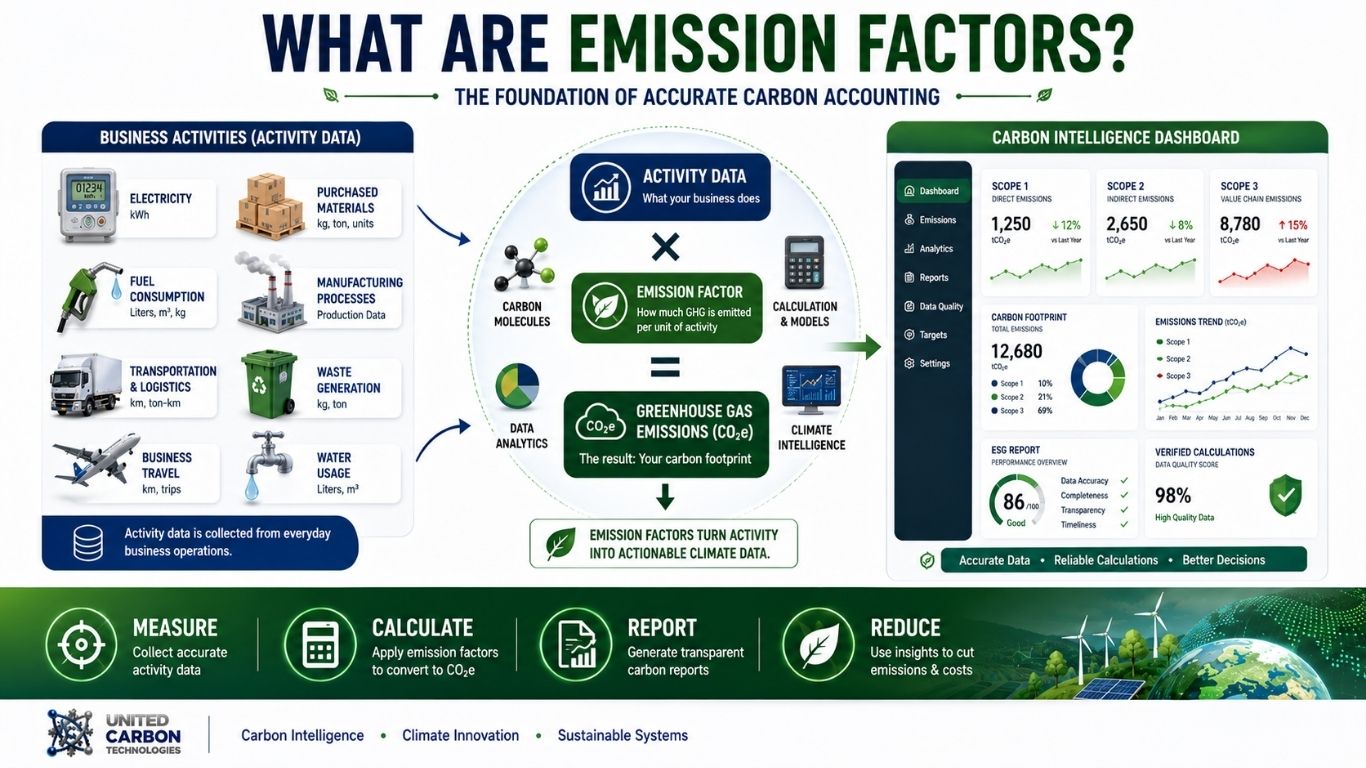
An emission factor is a scientifically derived conversion value used to estimate the amount of greenhouse gas emissions produced by a specific activity. Instead of directly measuring emissions from every process, businesses multiply operational data—such as electricity consumption, fuel usage, transportation distance, or material quantities—by an appropriate emission factor to calculate carbon dioxide equivalent (CO₂e) emissions.
Emission factors simplify greenhouse gas accounting by providing standardized methods that enable organizations to calculate emissions consistently across different operations, suppliers, and reporting periods.
Simple Formula
For example, if a facility consumes electricity during the year, multiplying the total electricity used by the appropriate electricity emission factor estimates the associated greenhouse gas emissions.
2. Why Emission Factors Matter in Carbon Accounting
Without emission factors, businesses would struggle to convert operational activities into measurable greenhouse gas emissions. They provide a consistent scientific foundation for calculating Scope 1, Scope 2, and Scope 3 emissions while enabling organizations to compare performance over time and identify opportunities for emissions reduction.
Emission Factors Help Businesses:
- Calculate greenhouse gas emissions consistently.
- Improve ESG and sustainability reporting.
- Measure Scope 1, Scope 2, and Scope 3 emissions.
- Identify emission hotspots.
- Track progress toward Net Zero targets.
- Support climate-related decision-making.
The quality of your greenhouse gas calculations depends not only on collecting accurate operational data but also on selecting reliable and up-to-date emission factors.
United Carbon Technologies is developing Carbon Intelligence solutions that help businesses automate emissions calculations, manage emission factors, improve Scope 3 reporting, and build reliable ESG reporting systems.
3. How Do Emission Factors Work?
Emission factors convert activity data into greenhouse gas emissions using a simple mathematical calculation. Instead of directly measuring carbon dioxide released from every activity, businesses multiply operational data by an established emission factor.
The process is straightforward but highly effective because emission factors are developed using scientific research, industry data, and internationally recognized methodologies.
Examples
| Activity | Activity Data | Emission Factor | Result |
|---|---|---|---|
| Electricity | 1,000 kWh | kg CO₂e/kWh | Estimated Emissions |
| Diesel | 500 Litres | kg CO₂e/Litre | Estimated Emissions |
| Business Travel | 5,000 km | kg CO₂e/km | Estimated Emissions |
This standardized approach ensures businesses calculate emissions consistently across different reporting periods.
4. Types of Emission Factors
Emission factors are available for thousands of business activities. The appropriate factor depends on the type of activity being measured.
Common Categories
- Electricity generation
- Diesel, petrol, LPG and natural gas
- Employee commuting
- Business air travel
- Freight transportation
- Purchased goods and services
- Waste disposal
- Water consumption
- Manufacturing materials
- Agricultural activities
Selecting the correct category improves the reliability of greenhouse gas calculations.
5. Where Do Emission Factors Come From?
Emission factors are developed by governments, international organizations, research institutions, and recognized sustainability bodies. These organizations continuously update their databases to reflect changes in technology, fuel composition, electricity grids, and industrial processes.
Widely Used Sources
- IPCC Guidelines
- GHG Protocol methodologies
- National greenhouse gas inventories
- Government environmental agencies
- International Energy Agency (IEA)
- Scientific research publications
- Industry-specific databases
Organizations should always document the source and reporting year of every emission factor used in their carbon inventory.
6. Practical Business Examples
Emission factors are used every day across different business functions to estimate greenhouse gas emissions.
Examples
- Calculating emissions from office electricity consumption.
- Estimating fuel emissions from company vehicles.
- Measuring logistics and freight transportation emissions.
- Calculating emissions from employee business travel.
- Estimating emissions from purchased materials.
- Preparing annual ESG and sustainability reports.
Regardless of industry, emission factors provide a practical way to quantify environmental impact using available operational data.
7. Common Mistakes When Using Emission Factors
Using emission factors incorrectly can significantly affect the accuracy of carbon accounting. Businesses should establish quality checks to ensure calculations remain credible and consistent.
Avoid These Common Errors
- Using outdated emission factors.
- Selecting the wrong activity category.
- Mixing different measurement units.
- Ignoring regional electricity differences.
- Using supplier estimates without validation.
- Failing to document calculation assumptions.
- Applying factors from unrelated industries.
8. Choosing the Right Emission Factors
The most suitable emission factor depends on the organization's location, reporting boundary, activity type, and available operational data.
Best Practices
- Use the latest available databases.
- Prefer country-specific factors where possible.
- Use supplier-specific factors when verified.
- Maintain consistency across reporting years.
- Document every data source.
- Review factors annually.
9. Digital Carbon Intelligence Makes Calculations Easier
Managing hundreds of emission factors manually can quickly become difficult as businesses grow. Modern Carbon Intelligence platforms automatically apply appropriate emission factors based on activity data, reducing manual work and improving reporting consistency.
Digital platforms can also update factor libraries, track calculation methodologies, generate audit-ready reports, and integrate with procurement, ERP, utility, and ESG reporting systems.
10. The Future of Emission Factors
As businesses demand more accurate climate reporting, emission factors will continue to become more localized, industry-specific, and data-driven. Future carbon accounting systems are expected to combine artificial intelligence, real-time operational data, digital twins, and automated reporting to improve calculation accuracy.
Organizations that build strong emissions data management practices today will be better prepared for evolving ESG reporting requirements and future climate regulations.
Improve Your Carbon Calculations with Climate Intelligence
United Carbon Technologies is developing Carbon Intelligence solutions that help organizations manage emission factors, automate greenhouse gas calculations, improve Scope 1, Scope 2, and Scope 3 reporting, and build reliable ESG reporting systems.
Digital carbon accounting enables businesses to reduce manual calculations, improve reporting accuracy, and transform operational data into meaningful sustainability insights.
India Context
Indian businesses are increasingly adopting carbon accounting as customers, investors, financial institutions, and regulators seek greater transparency in environmental performance. Choosing appropriate emission factors is particularly important because India's electricity grid, industrial processes, transportation systems, and manufacturing sectors differ from many other countries. Using relevant and up-to-date emission factors helps organizations produce more accurate greenhouse gas inventories and supports credible ESG disclosures.
What's Next?
Once businesses understand emission factors, the next step is learning how organizational boundaries, operational boundaries, and data quality influence greenhouse gas inventories. Together, these concepts create the foundation of reliable carbon accounting and climate intelligence.
Related Reads
- How to Collect Supplier Carbon Data
- Spend-Based vs Activity-Based Carbon Accounting Explained
- Understanding Scope 3 Emissions
- Carbon Accounting Explained
- ESG Reporting Checklist for Businesses
- How Climate Data Helps Businesses Make Better Decisions
💡 Expert Insight
Many businesses focus on collecting more activity data but overlook the importance of selecting appropriate emission factors. Even high-quality operational data can produce misleading results if outdated or unsuitable emission factors are used. Organizations should regularly review their factor libraries, document calculation assumptions, and adopt recognized methodologies to maintain confidence in their carbon accounting and ESG reporting.
Conclusion
Emission factors are the foundation of modern carbon accounting. They transform everyday operational activities into measurable greenhouse gas emissions, enabling organizations to understand their environmental impact and identify opportunities for improvement.
By selecting appropriate emission factors, maintaining accurate operational data, and using recognized calculation methodologies, businesses can build reliable carbon inventories that support ESG reporting, climate risk management, regulatory readiness, and long-term sustainability goals.
As climate reporting expectations continue to grow, organizations that invest in robust emissions calculation practices today will be better positioned to make informed decisions and accelerate their transition toward a low-carbon future.
Quick Summary
- Emission factors convert activity data into greenhouse gas emissions.
- They are essential for Scope 1, Scope 2, and Scope 3 reporting.
- Different activities require different emission factors.
- Reliable emission factors improve reporting accuracy.
- Organizations should use current and well-documented data sources.
- Digital Carbon Intelligence platforms automate emissions calculations.
- Good emission factors support better climate decisions.
Frequently Asked Questions (FAQs)
1. What is an emission factor?
An emission factor is a scientifically developed value used to convert activity data into greenhouse gas emissions.
2. Why are emission factors important?
They enable businesses to calculate carbon emissions consistently and support accurate ESG reporting.
3. Where do emission factors come from?
They are developed by governments, international organizations, research institutions, and recognized sustainability frameworks.
4. Can emission factors change over time?
Yes. They are regularly updated to reflect changes in energy systems, technology, and scientific understanding.
5. Are emission factors different for every country?
Often yes, particularly for electricity, because each country's energy mix is different.
6. What activities use emission factors?
Electricity, fuel consumption, transportation, manufacturing, waste, water use, business travel, and purchased goods are common examples.
7. Can small businesses use emission factors?
Yes. Emission factors help organizations of all sizes estimate greenhouse gas emissions without installing complex monitoring systems.
8. How often should emission factors be reviewed?
Organizations should review them at least annually or whenever updated databases become available.
9. Can software automatically apply emission factors?
Yes. Modern Carbon Intelligence and ESG platforms automatically match activity data with appropriate emission factors.
10. Do emission factors improve Net Zero planning?
Yes. Reliable emission calculations help organizations identify reduction opportunities and monitor progress toward climate goals.
Key Takeaways
- Emission factors are fundamental to carbon accounting.
- Use reliable and current data sources.
- Select factors that match your activity and region.
- Review and document calculation methodologies regularly.
- Digital tools improve consistency, transparency, and reporting efficiency.
Build Smarter Carbon Accounting with United Carbon Technologies
Understanding emission factors is the first step toward accurate greenhouse gas reporting. Explore more practical guides from United Carbon Technologies to strengthen your carbon accounting, improve ESG reporting, and build data-driven climate strategies for your organization.