
Double Materiality in ESG: How Indian Businesses Can Prepare for the Next Stage of Sustainability Reporting

Double Materiality in ESG: How Indian Businesses Can Prepare for the Next Stage of Sustainability Reporting
By United Carbon Technologies | Climate Knowledge Hub India
Published: September 14, 2026 | Last Updated: September 14, 2026
Double materiality is becoming an important concept in ESG and sustainability reporting. For Indian businesses, understanding both how sustainability issues affect the company and how the company affects people and the environment can strengthen ESG strategy, risk management, and future reporting readiness.
What is double materiality in ESG?
Double materiality in ESG means assessing sustainability issues from two perspectives: how environmental, social, and governance issues can affect a business financially, and how the business's activities can affect people, society, and the environment.
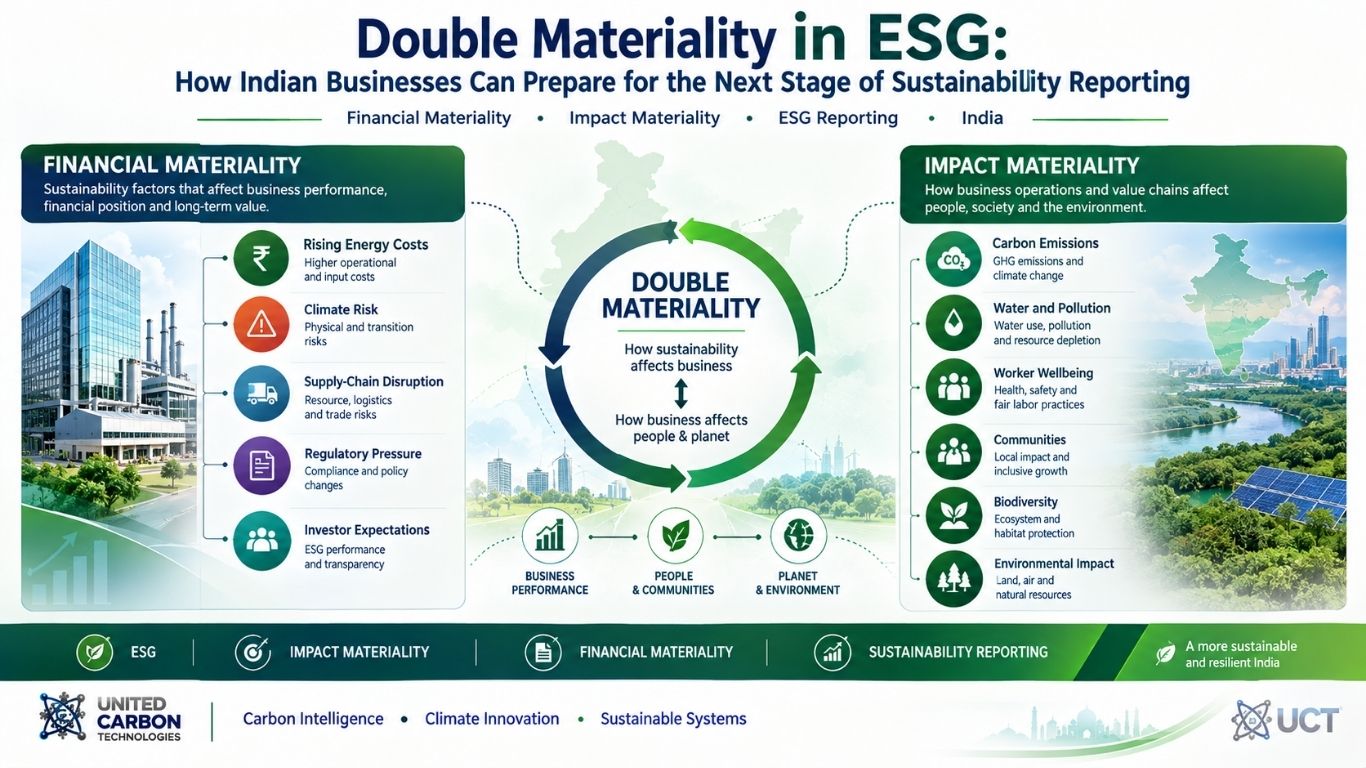
ESG reporting is moving beyond simply listing sustainability initiatives. Businesses are increasingly expected to understand which sustainability issues are significant, how those issues affect business performance, and how corporate activities affect the environment and society.
This is where the concept of double materiality becomes important. Instead of looking at sustainability only from the company's financial perspective, double materiality considers both sides of the relationship between business and sustainability.
For Indian companies, this approach can provide a stronger foundation for ESG reporting, climate-risk management, stakeholder engagement, and long-term business planning.
Did you know?
Double materiality combines two perspectives: the financial effects that sustainability issues can have on a business and the environmental or social impacts that the business can create.
What Does Materiality Mean in ESG?
Materiality is the process of identifying sustainability topics that are important enough to influence business decisions, stakeholders, reporting, or long-term strategy.
For example, a manufacturing company may identify energy consumption, carbon emissions, worker safety, water use, supply-chain practices, and regulatory compliance as potentially material issues.
The challenge is determining which issues matter most and understanding the different ways in which they matter.
What Is the Difference Between Single and Double Materiality?
Traditional financial materiality generally focuses on whether an issue can affect the company's financial performance, financial position, enterprise value, or business prospects.
Double materiality expands this assessment by adding the company's impact on the environment and society.
| Perspective | Key Question | Example |
|---|---|---|
| Financial Materiality | How can a sustainability issue affect the business? | Climate-related regulation may increase operating costs. |
| Impact Materiality | How does the business affect people and the environment? | A company's operations may generate greenhouse gas emissions. |
| Double Materiality | How do both directions of impact and influence matter? | Climate change can affect the company while the company's emissions affect the climate. |
The Two Dimensions of Double Materiality
1. Financial Materiality
Financial materiality examines how sustainability-related risks and opportunities can influence a company's financial performance and future prospects.
- Climate-related physical risks
- Transition risks from changing regulations
- Energy price volatility
- Resource availability
- Changing customer expectations
- Supply-chain disruptions
- Access to capital and investment expectations
2. Impact Materiality
Impact materiality examines the actual or potential effects that a business's activities, products, services, and value chain can have on people and the environment.
- Greenhouse gas emissions
- Water consumption and pollution
- Waste generation
- Worker health and safety
- Human rights
- Community impacts
- Biodiversity and ecosystems
Double materiality therefore connects ESG, carbon accounting, climate risk, and sustainability performance into a broader business decision-making framework.
Why Double Materiality Matters for Indian Businesses
Indian businesses are operating in an environment where sustainability expectations are becoming increasingly important. Large companies, investors, lenders, customers, export markets, regulators, and supply-chain partners may increasingly demand reliable ESG information.
For businesses that already collect ESG information, double materiality can help move reporting from a compliance exercise toward a strategic process.
- Identify the sustainability issues most relevant to the business.
- Understand climate and environmental risks.
- Identify significant impacts across operations and value chains.
- Improve ESG data collection.
- Strengthen stakeholder engagement.
- Support more informed sustainability decisions.
- Prepare for evolving reporting expectations.
Understanding material sustainability issues is the starting point for better ESG data, carbon accounting, climate-risk assessment, and sustainability reporting.
Double Materiality Is More Than an ESG Reporting Exercise
A strong double-materiality assessment should not simply produce a list of topics for a sustainability report. It can become a management tool that helps organizations understand where sustainability issues create risks, opportunities, dependencies, and impacts.
For example, water availability may be an environmental issue, but for a water-intensive manufacturer it can also become an operational and financial risk. Similarly, greenhouse gas emissions may represent an environmental impact while increasing exposure to carbon-related regulation, changing customer requirements, or transition risks.
This two-way perspective is what makes double materiality particularly useful for strategic ESG management.
Understanding double materiality in ESG for Indian businesses can help organizations build stronger sustainability strategies, improve ESG reporting readiness, and identify risks and opportunities before they become significant business challenges.
How Can Indian Businesses Conduct a Double Materiality Assessment?
A double materiality assessment should begin with a clear understanding of the business, its operations, stakeholders, and value chain. The objective is to identify sustainability issues that are significant from both an impact and financial perspective.
Businesses do not need to begin with a complicated system. A structured process can help organizations gradually identify, assess, prioritize, and monitor their most important sustainability topics.
- Understand the business and its value chain.
- Identify relevant ESG and sustainability topics.
- Identify key stakeholders and affected groups.
- Assess actual and potential impacts.
- Assess sustainability-related risks and opportunities.
- Evaluate impact materiality and financial materiality.
- Prioritize the most significant topics.
- Validate the results with appropriate management and governance teams.
- Connect material topics with ESG reporting, targets, and business strategy.
Step 1: Understand the Business and Its Value Chain
Before identifying material topics, a business should understand how its activities create value and where its environmental, social, and economic impacts occur.
This assessment should not be limited to the company's own offices, factories, or facilities. Suppliers, logistics providers, customers, employees, communities, products, and other business relationships may also be relevant.
For example, a manufacturing business may need to consider:
- Raw-material sourcing
- Energy consumption
- Water consumption
- Greenhouse gas emissions
- Waste generation
- Worker health and safety
- Supplier practices
- Transportation and logistics
- Product-related impacts
- Climate-related risks
Understanding the value chain helps businesses identify sustainability issues that may otherwise remain outside their normal reporting boundaries.
Step 2: Identify the Relevant Sustainability Topics
The next step is to develop a broad list of sustainability topics that could potentially affect the business or be affected by the business.
Depending on the sector, these topics may include:
| Environmental | Social | Governance |
|---|---|---|
| Climate change | Worker health and safety | Business ethics |
| Carbon emissions | Human rights | Anti-corruption |
| Water and pollution | Employee wellbeing | Data governance |
| Waste management | Diversity and inclusion | Risk management |
| Biodiversity | Community impacts | Corporate governance |
The purpose is to create a comprehensive starting point rather than immediately deciding which topics are material. Topics can then be assessed using evidence, stakeholder input, business information, and relevant sustainability data.
Step 3: Identify Stakeholders and Affected Groups
Stakeholder perspectives can provide important information about how a company's activities affect people, communities, customers, suppliers, investors, and other groups.
Relevant stakeholders may include:
- Employees
- Customers
- Suppliers
- Investors
- Lenders and financial institutions
- Local communities
- Business partners
- Regulators
- Industry organizations
Stakeholder engagement can be conducted through surveys, interviews, meetings, questionnaires, workshops, complaints mechanisms, customer feedback, supplier assessments, or other appropriate channels.
The objective is not simply to count how many stakeholders mention a particular issue. Businesses should understand the significance, scale, likelihood, and consequences of the impacts, risks, and opportunities associated with each topic.
Step 4: Identify Impacts, Risks, and Opportunities
After identifying the broad sustainability topics, businesses should examine the specific impacts, risks, and opportunities associated with them.
For example, climate change may be identified as a broad sustainability topic. A more detailed assessment could identify several related issues.
| Area | Example |
|---|---|
| Impact | Greenhouse gas emissions from business operations. |
| Risk | Extreme weather affecting facilities or supply chains. |
| Opportunity | Energy efficiency and renewable energy investments. |
This approach helps organizations move from broad ESG statements toward specific issues that can be measured, managed, and incorporated into business decisions.
Step 5: Assess Impact Materiality
Impact materiality examines the significance of the actual or potential effects that a business can have on people and the environment.
For negative impacts, businesses can consider factors such as the scale of the impact, the number of people or areas affected, the seriousness of the consequences, and the likelihood that the impact may occur.
For example, a business may assess:
- How serious is the environmental or social impact?
- How widespread is the impact?
- How many people or communities could be affected?
- How difficult would the impact be to reverse or remedy?
- How likely is the impact to occur?
A significant environmental impact can therefore remain material even when it does not immediately create a direct financial loss for the company.
Step 6: Assess Financial Materiality
Financial materiality examines how sustainability-related risks and opportunities can affect the company's financial position, performance, cash flows, access to finance, or future business prospects.
Potential financial effects may include:
- Higher operating costs
- Supply-chain disruption
- Changes in energy and resource prices
- Regulatory costs
- Loss of customers or market opportunities
- Higher financing or insurance costs
- Changes in asset values
- Changes in investor expectations
- New revenue opportunities
Time horizon is also important. Some sustainability-related risks may have limited financial effects in the short term but become more significant over the medium or long term.
For Indian businesses, this can be particularly relevant when considering climate-related risks, changing customer expectations, resource availability, energy costs, regulatory developments, and access to domestic or international markets.
How Do Businesses Prioritize Material Topics?
Once impact materiality and financial materiality have been assessed, businesses can prioritize the topics that require greater attention.
A simple assessment could look like this:
| ESG Topic | Impact Materiality | Financial Materiality |
|---|---|---|
| Climate change | High | High |
| Water management | High | Medium |
| Employee wellbeing | Medium | High |
| Office waste | Low | Low |
Topics that are significant from either perspective should not automatically be ignored. Double materiality requires businesses to maintain visibility of both dimensions rather than reducing every sustainability issue to a single financial score.
What Should a Double Materiality Matrix Show?
A double materiality matrix can provide a visual representation of the results of the assessment. One dimension can represent impact materiality while the other represents financial materiality.
Topics positioned highly on both dimensions may represent areas of particular strategic importance for the organization.
Key point:
A double materiality matrix should support decision-making rather than simply create a visual for an ESG report. The underlying evidence, assumptions, assessment criteria, and stakeholder perspectives are equally important.
How Can Double Materiality Improve ESG Reporting?
The results of a double materiality assessment can help a company determine which sustainability information should receive greater attention in its ESG reporting.
Material topics can be connected with:
- ESG policies
- Performance indicators
- Carbon accounting
- Climate-risk assessment
- Sustainability targets
- Management responsibilities
- Data collection systems
- Stakeholder communication
For example, if carbon emissions are identified as highly material, the company may need more reliable emissions data, defined reduction targets, energy information, operational metrics, and appropriate management oversight.
This is where carbon footprint measurement and carbon accounting become important components of a broader ESG data system.
Why Double Materiality Is Becoming Relevant for Indian Businesses
India's ESG landscape is becoming increasingly data-driven. Businesses are facing growing expectations from investors, customers, financial institutions, supply-chain partners, export markets, and other stakeholders for credible sustainability information.
For listed companies, sustainability reporting frameworks and evolving disclosure expectations make reliable ESG information increasingly important. For unlisted businesses and MSMEs, the impact may also come indirectly through customers, suppliers, lenders, exporters, and larger companies within their value chains.
This means that double materiality can be useful even when a business is not directly required to prepare a formal double materiality assessment under a particular reporting framework.
It can help Indian businesses understand which sustainability issues are most important today and which issues could become strategically important as markets, regulations, technology, and stakeholder expectations evolve.
What Does Double Materiality Mean for Indian MSMEs?
For an Indian MSME, double materiality does not have to begin with a large sustainability department or an expensive reporting system.
A business can begin by identifying its major environmental, social, and governance issues and then connecting those issues with available operational and financial information.
For example:
- A manufacturing MSME can assess energy consumption and carbon emissions.
- A textile business can examine water, chemicals, worker safety, and supply-chain impacts.
- A food business can assess agricultural dependencies, water, packaging, and waste.
- An exporter can examine sustainability requirements in its target markets.
- A service business can assess employee wellbeing, energy use, data governance, and business ethics.
The important step is to begin building a repeatable process rather than treating ESG information as a one-time reporting requirement.
How Can Businesses Prepare for the Next Stage of ESG Reporting?
Businesses preparing for more structured sustainability reporting should start building their ESG information systems before reporting requirements or customer expectations make the process urgent.
A practical starting point includes:
- Identify the company's major ESG topics.
- Map important stakeholders and value-chain relationships.
- Identify actual and potential sustainability impacts.
- Identify sustainability-related risks and opportunities.
- Assess both impact and financial materiality.
- Define measurable ESG indicators.
- Improve the quality of carbon and sustainability data.
- Assign responsibilities for ESG information.
- Document the assessment methodology and evidence.
- Review material topics periodically.
The earlier a business starts organizing this information, the easier it becomes to respond to future reporting, customer, investor, and market expectations.
United Carbon Technologies is developing climate intelligence and carbon measurement solutions for Indian businesses, helping organizations move toward more structured sustainability data and ESG decision-making.
Explore more insights on ESG, ESG reporting, climate risk, carbon footprint, and climate intelligence through the Climate Knowledge Hub India.
Related Reads:
- What Is a Carbon Footprint? (Beginner Guide)
- What Is Carbon Footprint in India?
- What Is Carbon Footprint Calculator?
- How to Measure Carbon Footprint for Small Businesses
- What Is Carbon Accounting?
- Why Carbon Accounting Matters for Businesses
- Carbon Accounting vs Carbon Footprint Explained
- Carbon Accounting Process Step by Step
- How Carbon Measurement Works
Double Materiality in ESG: Quick Summary
Double materiality helps businesses look at sustainability from two directions: how sustainability issues can affect the business and how the business can affect people and the environment.
For Indian businesses, this approach can strengthen ESG reporting readiness, climate-risk management, stakeholder engagement, carbon accounting, and long-term sustainability strategy.
The key is not simply to create a materiality matrix. The real objective is to connect material sustainability issues with reliable data, measurable performance, business decisions, and continuous improvement.
In Part 3: We will explore the most important questions businesses should ask about double materiality, including practical FAQs, followed by the final climate intelligence CTA and structured data for this article.
Frequently Asked Questions About Double Materiality in ESG
1. What is double materiality in ESG?
Double materiality in ESG means assessing sustainability issues from two perspectives: how sustainability issues can affect the business financially and how the company's activities can affect people and the environment.
2. What is the difference between financial materiality and impact materiality?
Financial materiality focuses on how sustainability-related risks and opportunities can affect a company's financial performance, position, or future prospects. Impact materiality focuses on the actual or potential effects that the company's activities, products, services, and value chain can have on people and the environment.
3. Why is double materiality important for Indian businesses?
Double materiality can help Indian businesses understand which sustainability issues are most significant to their operations, stakeholders, risks, opportunities, and long-term strategy. It can also strengthen ESG reporting readiness as sustainability expectations continue to evolve.
4. Do Indian MSMEs need to conduct a double materiality assessment?
Not every Indian MSME is required to conduct a formal double materiality assessment under a specific reporting framework. However, MSMEs can use the concept as a practical management tool to understand ESG risks, environmental and social impacts, customer expectations, and value-chain requirements.
5. How does double materiality relate to ESG reporting?
A double materiality assessment can help businesses identify which sustainability topics deserve greater attention in ESG reporting. The results can then be connected with ESG indicators, carbon accounting, climate-risk assessment, sustainability targets, and business strategy.
6. What topics can be included in a double materiality assessment?
Depending on the business and sector, topics may include climate change, carbon emissions, energy, water, waste, biodiversity, worker health and safety, human rights, employee wellbeing, community impacts, business ethics, governance, supply-chain practices, and climate-related risks.
7. How is impact materiality assessed?
Impact materiality can be assessed by considering the significance of actual or potential impacts on people and the environment. Factors may include the scale, scope, severity, likelihood, and ability to remedy or reverse an impact, depending on the nature of the issue.
8. How is financial materiality assessed?
Financial materiality considers whether sustainability-related risks and opportunities could significantly influence areas such as revenues, costs, cash flows, assets, access to finance, business continuity, market opportunities, or future business prospects. The relevant time horizon should also be considered.
9. Does double materiality only apply to large companies?
No. While formal reporting requirements may differ according to company type and applicable regulations, the underlying concept can be useful for businesses of different sizes. An MSME can use a simplified assessment to understand its most important sustainability impacts, risks, and opportunities.
10. How can a company prepare for double materiality?
A company can begin by mapping its business and value chain, identifying ESG topics, engaging relevant stakeholders, assessing impacts and financial risks and opportunities, prioritizing material topics, documenting the methodology, and connecting the results with ESG data, targets, reporting, and business decisions.
Start Building Your Climate Intelligence
Understanding double materiality is an important step toward more informed ESG management. But meaningful sustainability decisions require more than identifying material topics—they require reliable data, carbon measurement, ESG indicators, and the ability to connect sustainability performance with business decisions.
United Carbon Technologies is developing climate intelligence and carbon measurement solutions for Indian businesses, combining climate education, emission measurement, ESG reporting, and sustainability-focused technology.
Measure. Understand. Report. Act.
Explore the Future of Climate Intelligence
Learn ESG, sustainability, carbon intelligence, and climate-tech concepts shaping the future of business and environmental strategy..
Join readers building climate intelligence knowledge for a sustainable future.
Join the Climate Knowledge Challenge
✔ Free Climate Learning Resources | ✔ ESG & Sustainability Insights | ✔ Early Access to ACIS Climate Intelligence Platform | ✔ Community of Future Climate Leaders