

Green Hydrogen in India: Where It Can Help Businesses Reduce Industrial Emissions
Search Description: Green hydrogen in India can help businesses reduce industrial emissions. Learn where it can replace fossil fuels and hydrogen in hard-to-abate sectors.
By United Carbon Technologies | Climate Knowledge Hub India
Published: October 1, 2026 | Updated: October 1, 2026
Follow United Carbon Technologies for practical insights on ESG, carbon accounting, climate intelligence, sustainability and emerging climate technologies.
+ Follow for ESG Insights
As Indian businesses look beyond conventional energy-efficiency measures, green hydrogen is emerging as a potential tool for reducing emissions in industrial activities where direct electrification may be difficult. It is particularly relevant to sectors that already use hydrogen as an industrial feedstock or require high-temperature energy and chemical processes.
India's National Green Hydrogen Mission is designed to build a domestic green hydrogen ecosystem, with an objective of developing at least 5 million metric tonnes (MMT) per year of green hydrogen production capacity by 2030. The Mission identifies applications including ammonia, petroleum refining, steel, shipping, mobility and synthetic fuels.
For businesses, however, the important question is not simply whether hydrogen is a clean technology. The more practical question is: Where can green hydrogen actually reduce industrial emissions, and where might another decarbonization option make more sense?
Featured Snippet: What Is Green Hydrogen?
Green hydrogen is hydrogen produced using renewable energy, most commonly by using renewable electricity to split water into hydrogen and oxygen through electrolysis. When produced with qualifying renewable electricity and under the applicable standards, it can provide a lower-emission alternative to hydrogen produced from fossil fuels.
Its greatest climate value is expected in applications where hydrogen is already needed as a feedstock or where direct electrification is technically difficult, rather than automatically replacing electricity across every industrial process.
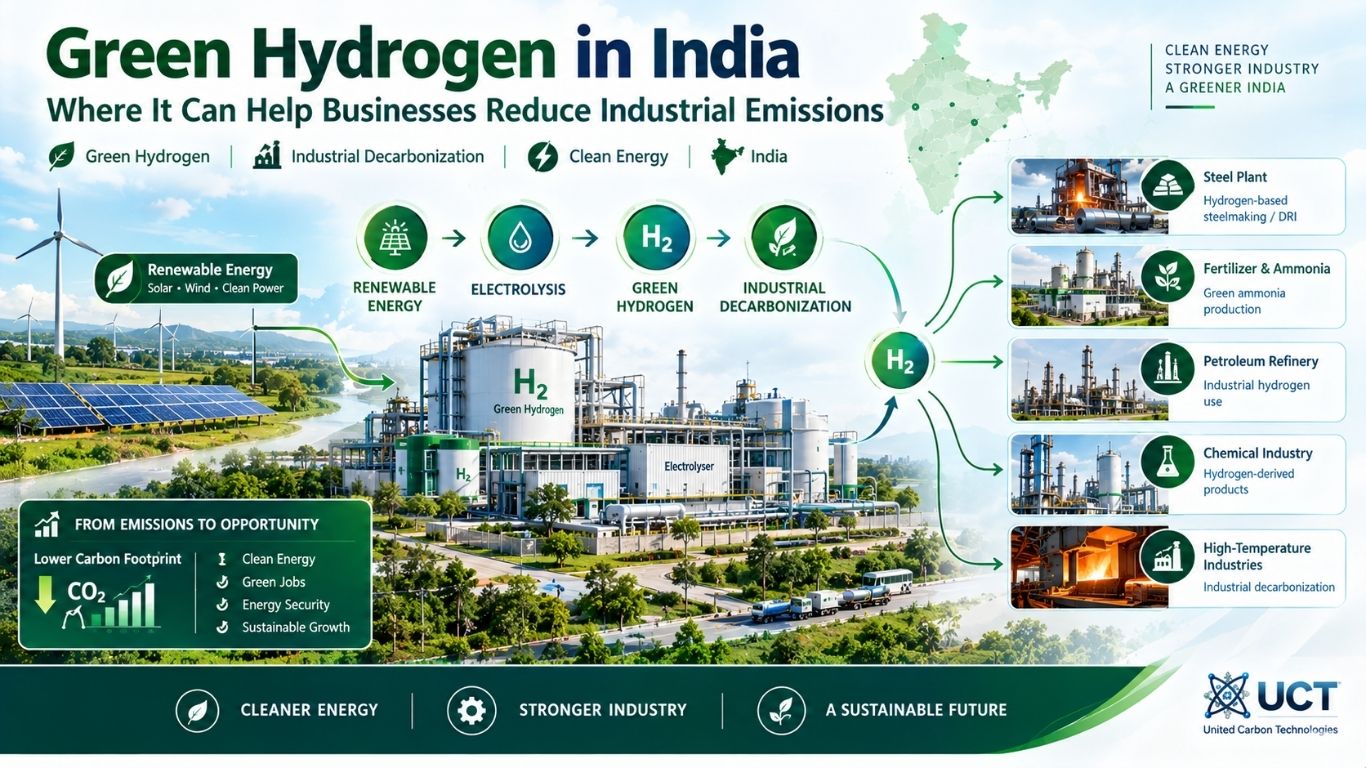
Green hydrogen can support industrial decarbonization where hydrogen-based processes or high-temperature applications are difficult to electrify directly.
Introduction: Why Green Hydrogen Matters for Indian Industry
India's industrial economy includes several sectors where reducing emissions is more complicated than simply replacing a fossil-fuel-powered machine with an electric alternative. Fertilizer production, petroleum refining, steelmaking, chemicals, shipping and other energy-intensive activities can involve hydrogen feedstocks, high-temperature processes or fuels that are difficult to replace through direct electrification alone.
This is where green hydrogen enters the decarbonization discussion.
Hydrogen is not a primary energy source like sunlight or wind. Instead, it is an energy carrier and industrial molecule that can be produced using different energy sources. Conventional hydrogen production in industry has historically relied heavily on fossil fuels, while green hydrogen aims to produce hydrogen using renewable energy.
The distinction matters for corporate carbon accounting. Simply using the word "hydrogen" does not automatically mean an activity is low-carbon. The emissions associated with hydrogen depend on how it is produced, what electricity or energy source is used, how it is transported and stored, and how it is ultimately consumed.
For Indian businesses developing long-term decarbonization strategies, green hydrogen therefore needs to be evaluated as part of a broader energy, carbon and industrial-transition strategy.
Measure Before You Decarbonize
Before considering green hydrogen or other emerging climate technologies, businesses need to understand where their emissions are actually coming from.
Carbon footprint measurement can help identify the major sources of Scope 1 and Scope 2 emissions, understand energy consumption patterns and determine where technology-based interventions may have the greatest relevance.
Explore UCT Climate IntelligenceRelated Reads
Continue exploring India's industrial decarbonization, climate technology and carbon-intelligence landscape with these related UCT guides:
→ Marginal Abatement Cost Curves Explained: How Companies Can Prioritize Carbon Reduction Projects
Understand how businesses can compare different emissions-reduction opportunities and prioritize decarbonization investments.
→ Just Transition Explained: How Indian Businesses Can Decarbonize Without Leaving Workers Behind
Explore the business and workforce considerations involved in India's transition toward a lower-carbon economy.
→ Climate Scenario Analysis: How Businesses Can Test Their Resilience Against Future Climate Risks
Learn how businesses can evaluate future climate scenarios and understand their potential implications for operations and strategy.
→ What Is a Corporate Climate Transition Plan? A Practical Guide for Indian Businesses
Learn how companies can translate climate targets into a structured transition strategy with measurable actions.
→ ESG Assurance Explained: What Indian Companies Need to Know Before Their Reports Are Reviewed
Understand why reliable ESG data, documentation and internal controls matter as sustainability reporting becomes more rigorous.
Did You Know?
India's National Green Hydrogen Mission notes that around 5 MMT of hydrogen is consumed annually in India for industrial purposes, including petroleum refining, ammonia production for fertilizers, methanol production and metal-related applications. The Mission identifies fossil-fuel-derived hydrogen as a major opportunity for substitution with green hydrogen.
1. What Makes Green Hydrogen Different from Conventional Hydrogen?
Hydrogen itself is a colourless gas. The terms grey, blue and green hydrogen describe the production pathway and associated emissions rather than different forms of the hydrogen molecule.
Grey Hydrogen
Grey hydrogen is generally produced from fossil fuels, particularly natural gas, without capturing the resulting carbon dioxide emissions. It has historically been widely used in industrial applications because the technology and supply chains are established.
Blue Hydrogen
Blue hydrogen generally refers to hydrogen produced from fossil fuels with carbon capture, utilization or storage applied to part of the resulting carbon dioxide emissions. Its overall emissions depend on the production pathway, capture performance, methane leakage and other lifecycle factors.
Green Hydrogen
Green hydrogen is produced using renewable energy. The most commonly discussed pathway is electrolysis, in which electricity is used to split water into hydrogen and oxygen.
For companies, the distinction is important because the climate benefit of hydrogen depends on its production emissions and lifecycle characteristics, not simply on the fact that the end product is hydrogen.
2. Why India Is Exploring Green Hydrogen for Industrial Decarbonization
India's industrial decarbonization challenge is closely connected to its growing energy and material requirements. Some industrial processes can be electrified relatively easily, while others involve chemical reactions, hydrogen feedstocks or very high temperatures.
The National Green Hydrogen Mission was launched with an initial outlay of ₹19,744 crore and an objective of developing India as a global hub for green hydrogen and its derivatives. Its strategy includes support for green hydrogen production, electrolyser manufacturing, pilot projects, infrastructure, research and development, skill development and demand creation.
The Mission specifically identifies opportunities in areas such as ammonia production, petroleum refining and steel, while also examining applications in shipping, mobility and synthetic fuels.
This creates an important distinction for businesses: green hydrogen is not intended to replace every fossil fuel or every form of electricity. Its strongest potential lies in applications where hydrogen has an existing industrial role or where alternatives such as direct electrification may be technically challenging.
The Industrial Decarbonization Logic
A simplified transition pathway can look like this:
↓
Renewable Energy + Electrolysis
↓
Green Hydrogen
↓
Industrial Feedstock / Fuel / Chemical Intermediate
↓
Potential Reduction in Fossil-Based Emissions
The actual emissions reduction achieved will depend on the baseline technology, renewable electricity source, hydrogen production efficiency, transportation and storage requirements, and the application in which the hydrogen is used.
Where Could Green Hydrogen Fit Into Your Business?
The first step is not necessarily purchasing hydrogen or installing an electrolyser. Businesses can begin by mapping their major energy-consuming processes, existing hydrogen use, fossil-fuel dependence and emissions sources.
A structured carbon and energy assessment can help identify whether green hydrogen should be considered alongside electrification, renewable electricity, energy efficiency, biomass, process redesign or other decarbonization options.
Talk to Our ESG TeamFor Indian Businesses
Green hydrogen should be evaluated as part of a company's broader decarbonization roadmap, not as a standalone technology purchase.
Companies considering future hydrogen use should examine their current emissions baseline, energy demand, process requirements, renewable electricity availability, hydrogen sourcing options, infrastructure needs and the expected carbon benefit before making investment decisions.
3. Where Can Green Hydrogen Help Indian Businesses Reduce Industrial Emissions?
The strongest business case for green hydrogen is not necessarily found wherever fossil fuels are used. Its potential is particularly relevant in industrial activities where hydrogen already functions as a feedstock or where replacing combustion with direct electricity is technically difficult.
For Indian businesses, several sectors stand out because of their existing hydrogen consumption, energy intensity or long-term decarbonization requirements.
3.1 Fertilizer and Ammonia Production
Fertilizer production is one of the most important potential applications for green hydrogen because hydrogen is already an essential input in ammonia production.
Conventional ammonia production generally relies on hydrogen derived from fossil fuels. Green hydrogen can potentially replace this fossil-based hydrogen while maintaining the role of hydrogen as a chemical feedstock.
The resulting green ammonia can then be used in fertilizer production and may also become relevant to international trade and emerging clean-fuel applications.
For fertilizer manufacturers, therefore, green hydrogen can represent more than an energy substitution. It can become part of a process-level decarbonization strategy.
3.2 Petroleum Refining
Hydrogen is also widely used in petroleum refining for processes such as hydroprocessing and desulfurization.
Refineries therefore represent another industrial application where replacing fossil-derived hydrogen with lower-emission hydrogen could contribute to emissions reduction.
The potential benefit depends on the refinery's existing hydrogen demand, production pathway, energy requirements, renewable electricity availability and the lifecycle emissions associated with the alternative hydrogen supply.
For large refining companies, this means that green hydrogen may be evaluated alongside other measures such as energy efficiency, renewable electricity procurement, process optimization and carbon-management technologies.
3.3 Steel and Direct Reduced Iron
Steel is one of the most closely watched sectors in the global green-hydrogen transition.
Traditional steelmaking routes can rely heavily on coal, particularly metallurgical coal used in blast-furnace-based production. One emerging pathway is the use of hydrogen in direct reduced iron (DRI) production.
In a hydrogen-based DRI process, hydrogen can act as a reducing agent to remove oxygen from iron ore. Depending on the production system and electricity source, this can substantially change the emissions profile of the ironmaking process compared with conventional coal-based reduction.
For Indian steel companies, the opportunity is therefore connected not only to replacing a fuel but potentially to changing the underlying production pathway.
3.4 Chemicals and Petrochemicals
The chemical sector offers another area where hydrogen can have both energy and feedstock applications.
Hydrogen is used directly or indirectly in several chemical processes. Companies producing methanol, ammonia, synthetic fuels and other hydrogen-derived products may therefore have opportunities to incorporate green hydrogen into their future production systems.
However, the carbon benefit needs to be assessed across the complete production chain. A hydrogen-derived product should not automatically be described as low-carbon without examining the electricity source, production process, material inputs and associated emissions.
3.5 High-Temperature Industrial Processes
Some industrial activities require temperatures that can be challenging to achieve economically through direct electrification.
In such cases, hydrogen can potentially function as a fuel or energy carrier. Potential applications can include selected high-temperature industrial processes where the technical characteristics of hydrogen combustion or hydrogen-based processing are compatible with the equipment and product requirements.
This does not mean hydrogen is automatically the preferred option. Direct electrification, renewable electricity, energy efficiency and other technologies can sometimes provide simpler or more efficient pathways.
The right question for a business is therefore: What is the lowest-emission technically feasible pathway for this specific industrial process?
4. Green Hydrogen vs Direct Electrification: Why the Difference Matters
One of the most important questions in industrial decarbonization is whether a process should use hydrogen at all.
Green hydrogen is produced using electricity. Electrolysis requires substantial electricity to produce hydrogen, and converting electricity into hydrogen and then using that hydrogen as an energy carrier involves energy losses.
Directly using renewable electricity can therefore be more energy-efficient where a process can be electrified without major technical limitations.
| Decarbonization option | Potential relevance | Key consideration |
|---|---|---|
| Direct electrification | Processes that can efficiently use electricity | Electricity availability and grid/renewable infrastructure |
| Green hydrogen | Hydrogen feedstocks and selected hard-to-electrify processes | Renewable electricity, electrolyser efficiency, storage and logistics |
| Energy efficiency | Almost every industrial sector | Process optimization and capital investment |
| Renewable electricity | Electricity-related emissions | Power sourcing, additionality and availability |
This comparison highlights an important principle: hydrogen should generally be considered where its specific properties provide value that direct electrification cannot easily provide.
5. How Green Hydrogen Can Influence a Company's Carbon Footprint
The emissions impact of green hydrogen depends on what it replaces.
Consider a company currently purchasing hydrogen produced from fossil fuels. If the company transitions to qualifying low-emission hydrogen, the change can potentially reduce emissions associated with the hydrogen supply.
The same principle applies when hydrogen replaces a fossil fuel in an application where direct electrification is technically difficult.
However, the company must establish a reliable baseline before claiming an emissions reduction.
A Simplified Carbon-Reduction Assessment
Baseline emissions
↓
Emissions associated with green-hydrogen pathway
↓
Potential emissions difference
A credible assessment should consider more than the emissions at the point of use. Businesses may need to examine electricity generation, hydrogen production, compression, storage, transportation and other relevant lifecycle stages depending on the accounting boundary and claim being made.
6. What Indian Businesses Need to Evaluate Before Adopting Green Hydrogen
Green hydrogen can involve significant infrastructure and energy requirements. Businesses therefore need to evaluate the economics and operational implications before treating it as a near-term decarbonization solution.
6.1 Current Hydrogen Consumption
Companies that already consume hydrogen may have a more direct pathway to evaluating green hydrogen than companies that have no existing hydrogen requirement.
The first question should be: How much hydrogen does the business currently consume, and how is that hydrogen produced?
6.2 Renewable Electricity Availability
Electrolysis requires electricity. The availability, cost, sourcing arrangement and emissions characteristics of renewable electricity can therefore strongly influence the feasibility and environmental performance of a green-hydrogen project.
6.3 Hydrogen Production and Storage
Hydrogen has different storage and transportation requirements from conventional fuels. Businesses considering onsite production need to evaluate electrolyser capacity, water requirements, compression, storage, safety systems and operational integration.
6.4 Infrastructure and Logistics
Not every business needs to produce hydrogen onsite. In some cases, purchased hydrogen or hydrogen-derived products may be more appropriate.
This creates a broader question around India's developing hydrogen infrastructure, including production hubs, transportation systems, storage facilities and industrial demand centres.
6.5 Carbon Accounting and Emissions Claims
Companies should also determine how the change will be reflected in their greenhouse-gas inventory and sustainability reporting.
The relevant accounting treatment will depend on the activity, organizational boundary, energy source, contractual arrangements and applicable reporting methodology.
A company should therefore establish the baseline and documentation before making public emissions-reduction claims.
Build the Carbon Baseline First
Emerging technologies such as green hydrogen become easier to evaluate when a company understands its existing emissions profile.
UCT's climate-intelligence approach focuses on connecting carbon measurement, ESG reporting and sustainability decision-making so businesses can identify where technology and operational interventions may fit into their decarbonization journey.
Explore UCT Climate Intelligence7. Green Hydrogen Is Part of a Larger Industrial Transition
It is tempting to view green hydrogen as a single technology that can solve industrial emissions. The reality is more nuanced.
Industrial decarbonization will likely involve a combination of approaches: energy efficiency, renewable electricity, electrification, process redesign, circularity, alternative fuels, low-carbon materials, carbon-management technologies and, in selected applications, green hydrogen.
For Indian businesses, the strategic challenge is to determine which combination of technologies matches the company's processes, emissions profile and transition timeline.
A steel producer may evaluate hydrogen-based DRI. A fertilizer producer may investigate green ammonia. A refinery may assess low-emission hydrogen for existing hydrogen-intensive processes. Another company may discover that direct electrification provides a more practical route.
The technology decision should therefore follow the emissions assessment—not replace it.
The Key Takeaway
For Indian businesses, green hydrogen has particular relevance in hydrogen-intensive industries and selected hard-to-abate industrial processes. Its potential climate benefit depends on the production pathway, renewable-energy source, application, infrastructure and what conventional technology it replaces.
8. What Could the Green Hydrogen Opportunity Look Like for Indian Businesses?
The business opportunity around green hydrogen is likely to develop differently across industries. Companies with existing hydrogen demand may be able to evaluate substitution opportunities more directly, while other businesses may first need to determine whether hydrogen has a genuine role in their future production system.
This distinction is important because the transition to green hydrogen is not simply a matter of changing one fuel for another. It can involve new production equipment, electricity procurement, storage infrastructure, safety systems, transportation arrangements and changes to industrial processes.
For companies planning investments through 2030 and beyond, green hydrogen can therefore be considered as part of a long-term industrial transition roadmap.
A Practical Business Evaluation Framework
Step 1 — Measure
Establish the company's current Scope 1 and Scope 2 emissions and identify major industrial energy and process-emission sources.
Step 2 — Identify
Determine where hydrogen is already used and where fossil fuels or other high-emission inputs are difficult to replace.
Step 3 — Compare
Compare green hydrogen with direct electrification, renewable electricity, energy efficiency and other technically feasible alternatives.
Step 4 — Assess
Evaluate renewable electricity availability, hydrogen production, storage, transportation, water requirements, safety and infrastructure.
Step 5 — Calculate
Estimate the potential emissions reduction, capital requirements, operating costs and long-term business implications.
Step 6 — Integrate
Place the selected intervention within the company's wider decarbonization, ESG and climate-transition strategy.
This approach helps prevent a common problem in emerging-technology planning: selecting a technology first and trying to justify its use afterwards.
9. Green Hydrogen and Corporate ESG Reporting
As companies increase their focus on climate disclosures and transition planning, investments in green hydrogen may eventually become relevant to several areas of corporate sustainability reporting.
Depending on the company's activities and reporting framework, the transition could influence information relating to energy consumption, greenhouse-gas emissions, climate targets, capital expenditure, technology deployment and progress against decarbonization objectives.
For example, a company replacing fossil-based hydrogen with a lower-emission alternative may need reliable information about the quantity of hydrogen consumed, its production pathway, associated emissions factors and the evidence supporting the reported emissions reduction.
This makes data quality particularly important.
A technology project can only support a credible climate claim when the underlying activity data, emissions factors, energy sourcing information and accounting methodology are appropriately documented.
From Technology Project to ESG Data
↓
Energy + Hydrogen Data
↓
Emissions Calculation
↓
Carbon Accounting
↓
ESG / Climate Reporting
↓
Transition Progress Tracking
This connection between technology deployment and sustainability data is increasingly important as businesses move from broad climate commitments toward measurable transition plans.
10. Challenges That Businesses Should Not Overlook
Despite its potential, green hydrogen comes with technical, economic and infrastructure challenges.
Cost and Energy Requirements
Electrolysis requires significant electricity. The cost and availability of renewable electricity can therefore strongly influence the economics of green hydrogen production.
Infrastructure
Hydrogen production, compression, storage and transportation require specialized infrastructure. Companies need to consider whether the required infrastructure already exists or whether additional investment will be necessary.
Water Requirements
Electrolysis requires water as a feedstock. While the quantity required for the electrolysis reaction itself is relatively small compared with the overall water demand of some industrial processes, businesses still need to assess water availability, treatment requirements and local water-stress conditions.
Safety and Industrial Integration
Hydrogen has specific handling, storage and safety requirements. Industrial facilities considering hydrogen deployment need appropriate engineering, operating procedures, monitoring and safety systems.
Lifecycle Emissions
A low-carbon hydrogen claim requires more than identifying the production technology. Businesses should consider the electricity source, production efficiency, transportation and other relevant lifecycle emissions when assessing the environmental performance of a hydrogen pathway.
11. What Green Hydrogen Means for the Future of Industrial Decarbonization in India
India's industrial transition will not follow a single technology pathway.
Some emissions can be reduced through energy efficiency. Some processes can shift directly to renewable electricity. Others may require new materials, process technologies or carbon-management solutions.
Green hydrogen is most relevant where its chemical and energy characteristics solve a problem that electricity alone cannot easily solve.
That makes hydrogen particularly interesting for sectors such as ammonia and fertilizer production, refining, steel and selected chemical and high-temperature industrial applications.
The future business opportunity will therefore depend not simply on how much hydrogen India produces, but on where hydrogen can create genuine industrial value while reducing emissions.
Did You Know?
India's National Green Hydrogen Mission is designed not only around hydrogen production but also around electrolyser manufacturing, pilot projects, infrastructure, research and development, standards, skill development and demand creation. This means the emerging hydrogen economy involves an ecosystem of industrial participants rather than only hydrogen producers.
12. How Businesses Can Start Preparing Today
A company does not necessarily need to immediately invest in an electrolyser to prepare for the green hydrogen economy.
A practical starting point is to understand the company's existing industrial energy and hydrogen profile.
- Measure current Scope 1 and Scope 2 emissions.
- Map major fossil-fuel-consuming industrial processes.
- Identify existing hydrogen consumption and its production pathway.
- Assess which processes may be difficult to electrify directly.
- Monitor India's emerging green hydrogen supply ecosystem.
- Evaluate renewable electricity availability and procurement options.
- Compare hydrogen with other technically feasible decarbonization pathways.
- Track applicable standards, policies and reporting requirements.
- Build reliable data systems before making emissions-reduction claims.
- Integrate hydrogen opportunities into the company's wider climate-transition plan.
For many businesses, this preparation can begin with measurement rather than infrastructure investment.
Start With Your Emissions Baseline
Before selecting green hydrogen, electrification or any other decarbonization technology, businesses need visibility into their current emissions.
UCT is developing climate-intelligence and carbon-measurement solutions designed to help Indian businesses understand emissions, organize sustainability data and build more informed climate strategies.
Talk to Our ESG TeamQuick Summary
- Green hydrogen is hydrogen produced using renewable energy, most commonly through electrolysis.
- Its strongest industrial applications can be where hydrogen is already required or where direct electrification is difficult.
- Fertilizer and ammonia production is a major potential application because hydrogen is a key feedstock.
- Refining can potentially use lower-emission hydrogen in existing hydrogen-intensive processes.
- Steel is exploring hydrogen-based pathways such as direct reduced iron.
- Selected chemical and high-temperature industrial processes may also have potential applications.
- Green hydrogen should not automatically replace direct electrification where electrification is technically and economically practical.
- Businesses need to evaluate electricity, water, infrastructure, storage, safety, lifecycle emissions and cost.
- Carbon accounting and reliable activity data are essential for credible emissions-reduction claims.
- Green hydrogen should be considered as part of a broader industrial decarbonization and climate-transition strategy.
Frequently Asked Questions
1. What is green hydrogen?
Green hydrogen is hydrogen produced using renewable energy, commonly by using renewable electricity to split water into hydrogen and oxygen through electrolysis.
2. Why is green hydrogen important for India?
Green hydrogen could help decarbonize industrial applications where hydrogen is already used as a feedstock or where direct electrification may be technically difficult.
3. Which Indian industries could use green hydrogen?
Potential applications include fertilizer and ammonia production, petroleum refining, steel, chemicals, shipping and selected high-temperature industrial processes.
4. Can green hydrogen replace fossil fuels in every industry?
No. Green hydrogen is not a universal replacement for fossil fuels. Where direct electrification is practical, using electricity directly can avoid the energy losses associated with producing and converting hydrogen.
5. How can green hydrogen reduce industrial emissions?
It can potentially replace hydrogen produced from fossil fuels or serve as a lower-emission fuel or reducing agent in selected industrial processes. The actual emissions reduction depends on the baseline and the complete hydrogen production pathway.
6. Is green hydrogen the same as green ammonia?
No. Green hydrogen is hydrogen produced through a low-emission renewable-energy pathway. Green ammonia is ammonia produced using hydrogen from a low-emission pathway, generally combined with nitrogen through the ammonia production process.
7. Is green hydrogen suitable for small businesses?
The economics and technical requirements can make direct green-hydrogen production more relevant to larger industrial applications. Smaller businesses may instead encounter hydrogen indirectly through their suppliers, industrial products or future energy and material supply chains.
8. What should a company assess before adopting green hydrogen?
Companies should assess current emissions, hydrogen consumption, process requirements, renewable electricity availability, hydrogen production and storage, water requirements, infrastructure, safety, cost and lifecycle emissions.
9. Can green hydrogen reduce Scope 1 emissions?
It can potentially reduce Scope 1 emissions when it replaces a fossil fuel or fossil-based process input within a company's organizational boundary. The accounting treatment depends on the specific activity and applicable greenhouse-gas accounting methodology.
10. How does green hydrogen connect with ESG reporting?
A green-hydrogen project can generate data relevant to energy use, greenhouse-gas emissions, climate targets, transition planning and sustainability reporting. Reliable documentation is important when reporting associated emissions reductions.
Building a Lower-Carbon Industrial Future
Green hydrogen could become an important part of India's industrial decarbonization journey—but its role will depend on where it provides a technically appropriate and measurable emissions-reduction pathway.
For businesses, the starting point is clear: measure the emissions, understand the process, compare the alternatives, and then evaluate the technology.
Explore United Carbon TechnologiesAbout United Carbon Technologies
United Carbon Technologies is an India-focused climate-tech and sustainability initiative working across carbon intelligence, ESG reporting, carbon measurement, climate technology and sustainable systems.
Through its climate-intelligence and carbon-measurement initiatives, UCT focuses on helping Indian businesses better understand emissions data and sustainability requirements as the transition toward a lower-carbon economy develops.
Built as part of ongoing climate-tech research and sustainability initiatives.