

What Is Climate Change? A Simple Guide for Beginners (2026 India Edition)
By United Carbon Technologies | Climate Knowledge Hub India
Published: April 18, 2025 |
Last Updated: July 18, 2026
Follow the United Carbon Technologies Climate Knowledge Hub for practical articles on climate change, ESG, carbon accounting, sustainability, renewable energy, Net Zero, and climate technology.
Climate change is no longer a distant environmental issue—it is affecting weather patterns, ecosystems, economies, and everyday life across the globe. From record-breaking heatwaves and floods to changing rainfall patterns and rising sea levels, its impacts are becoming increasingly visible in India and around the world. Understanding what climate change is, why it happens, and how it affects people is the first step toward building a more sustainable future. Whether you are a student, professional, business owner, policymaker, or simply curious about climate issues, this guide explains climate change in simple language with practical examples relevant to India.
What is climate change?
Climate change refers to long-term shifts in Earth's average temperatures and weather patterns. While natural climate variations have always existed, today's rapid climate change is primarily caused by human activities such as burning fossil fuels, deforestation, industrial emissions, and unsustainable land use. These activities increase greenhouse gases in the atmosphere, trapping more heat and warming the planet.
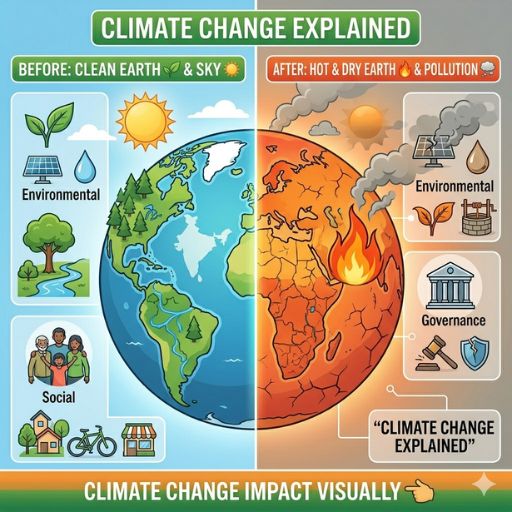
Climate change affects ecosystems, weather, agriculture, economies, and communities worldwide. Understanding the science is the first step toward meaningful climate action.
Introduction
Climate change has become one of the defining challenges of the 21st century. Scientists, governments, businesses, and communities are increasingly working together to understand its causes and develop solutions. Unlike temporary weather events, climate change refers to long-term changes in Earth's climate system that occur over decades or even centuries.
In India, climate change is already influencing agriculture, water availability, biodiversity, energy demand, public health, and disaster management. Farmers experience irregular monsoons, cities face longer heatwaves, and coastal communities deal with increasing flood risks. These changes affect everyone—from households and businesses to policymakers and future generations.
Although climate change may seem like a complex scientific topic, its basic concepts are surprisingly easy to understand. This guide explains the science behind climate change using simple language, real-world examples, and practical insights that anyone can follow.
🌍 Learn Climate Science with UCT
Understanding climate change is the foundation of carbon management, ESG reporting, sustainability, and Net Zero strategies. At United Carbon Technologies (UCT), we simplify climate knowledge for students, professionals, MSMEs, corporates, and sustainability teams through practical guides, educational resources, and climate intelligence solutions.
💡 Did You Know?
- 🌡️ Earth's average surface temperature has increased by approximately 1.2°C since the late 19th century.
- 🔥 The last decade has been the warmest ever recorded globally.
- 🌧️ India is witnessing more frequent heatwaves, extreme rainfall events, and changing monsoon patterns.
- 🌍 Nearly every sector—including agriculture, healthcare, infrastructure, finance, and manufacturing—is affected by climate change.
Understanding Climate Change in Simple Terms
Imagine Earth wrapped in a blanket. This blanket is made up of gases naturally present in the atmosphere, including carbon dioxide (CO₂), methane (CH₄), nitrous oxide (N₂O), and water vapour. These gases trap part of the Sun's heat and keep our planet warm enough for life. This natural process is known as the greenhouse effect.
Problems arise when human activities add excessive greenhouse gases into the atmosphere. Burning coal, oil, and natural gas for electricity, transportation, and industries releases enormous amounts of carbon dioxide. Deforestation removes trees that naturally absorb carbon dioxide, while agriculture and livestock release methane and nitrous oxide.
As greenhouse gas concentrations increase, more heat becomes trapped in the atmosphere. Over time, this causes Earth's average temperature to rise, leading to climate change.
Weather vs Climate: Understanding the Difference
One of the biggest misconceptions is confusing weather with climate.
| Weather | Climate |
|---|---|
| Short-term atmospheric conditions | Long-term average weather patterns over decades |
| Can change every hour or day | Changes slowly over many years |
| Today's rain or sunshine | Average rainfall and temperature over 30 years |
For example, one unusually cold day does not disprove climate change. Scientists study decades of weather observations to identify long-term trends in temperature, rainfall, storms, and seasonal patterns.
🌱 Curious About Your Climate Impact?
Climate change begins with greenhouse gas emissions generated through our daily activities. Understanding your personal or business carbon footprint is one of the easiest ways to identify opportunities for climate action.
Climate Change Knowledge for Businesses
For businesses, climate change is more than an environmental issue—it is a strategic business challenge affecting operations, supply chains, investor expectations, insurance costs, regulations, ESG reporting, and long-term resilience.
United Carbon Technologies helps organizations understand carbon emissions, ESG reporting, BRSR requirements, carbon accounting, climate risk, and Net Zero strategies through practical climate intelligence solutions.
What Causes Climate Change?
Climate change is driven by both natural processes and human activities. Throughout Earth's history, volcanic eruptions, variations in solar radiation, and natural climate cycles have influenced the planet's climate. However, scientists agree that the rapid warming observed since the Industrial Revolution is primarily caused by human-generated greenhouse gas emissions.
Since the late 1800s, industrialization has dramatically increased the burning of coal, oil, and natural gas. These fossil fuels release carbon dioxide (CO₂), the largest contributor to global warming. Combined with deforestation, industrial expansion, transportation, and modern agriculture, greenhouse gas concentrations have reached their highest levels in hundreds of thousands of years.
Major Human Causes of Climate Change
- Burning Fossil Fuels – Coal, petrol, diesel, and natural gas used for electricity, transportation, and industries release large quantities of carbon dioxide.
- Deforestation – Trees absorb carbon dioxide. Cutting forests reduces Earth's natural ability to remove greenhouse gases from the atmosphere.
- Industrial Processes – Manufacturing, cement production, chemical industries, and mining release significant greenhouse gases.
- Agriculture – Rice cultivation, fertilizers, and livestock emit methane and nitrous oxide.
- Waste Management – Organic waste decomposing in landfills produces methane, a greenhouse gas much stronger than carbon dioxide over shorter time periods.
The Greenhouse Effect Explained
The greenhouse effect is a completely natural process that makes life on Earth possible. Without greenhouse gases, Earth's average temperature would be around -18°C instead of the comfortable 15°C that supports ecosystems and human civilization.
Problems occur when excessive greenhouse gases trap more heat than the Earth's natural systems can balance. This enhanced greenhouse effect leads to rising global temperatures and changing climate patterns.
- Carbon Dioxide (CO₂)
- Methane (CH₄)
- Nitrous Oxide (N₂O)
- Fluorinated Gases
- Water Vapour (natural greenhouse gas)
Effects of Climate Change Around the World
Climate change affects almost every aspect of life. Rising temperatures influence rainfall, oceans, forests, biodiversity, agriculture, infrastructure, and public health. Many of these impacts are already visible across continents.
Some of the Most Significant Effects Include:
- 🌡️ Rising average global temperatures
- 🔥 More frequent and intense heatwaves
- 🌊 Rising sea levels due to melting glaciers and thermal expansion
- 🌪️ Stronger cyclones and extreme weather events
- 🌧️ Irregular rainfall patterns
- 🌾 Reduced agricultural productivity in many regions
- 🐘 Loss of biodiversity and wildlife habitats
- 💧 Water scarcity in vulnerable areas
- 🏥 Increased health risks from heat stress and air pollution
Climate Change in India
India is among the countries most vulnerable to climate change because of its diverse geography, large population, long coastline, and dependence on agriculture. Rising temperatures and changing weather patterns already affect millions of people every year.
Major Climate Challenges Facing India
- Longer and more intense heatwaves
- Changing monsoon behaviour
- Floods in urban and rural regions
- Water shortages in several states
- Melting Himalayan glaciers
- Coastal erosion and rising sea levels
- Increasing pressure on agriculture
- Greater frequency of droughts
Farmers are experiencing uncertain rainfall, cities are facing urban flooding, and coastal communities must prepare for stronger cyclones. These challenges highlight why climate resilience has become a national priority.
How Climate Change Affects Businesses
Climate change is no longer just an environmental issue—it has become a business issue. Companies across every industry face physical risks, financial risks, operational challenges, and increasing expectations from customers, investors, and regulators.
Business Impacts Include:
- Supply chain disruptions
- Higher energy costs
- Insurance and financial risks
- Changing regulations
- Pressure to reduce emissions
- Growing ESG reporting requirements
- Investor expectations for sustainability
- Climate-related operational risks
This is why more organizations are investing in carbon accounting, climate risk assessments, ESG reporting, renewable energy, and Net Zero strategies.
What Can Individuals Do to Fight Climate Change?
Although governments and businesses play major roles, individuals also contribute to climate action through everyday decisions.
Simple Actions That Make a Difference
- Switch to energy-efficient appliances
- Reduce unnecessary electricity consumption
- Use public transport, cycling, or walking whenever possible
- Reduce food waste
- Eat more locally produced food
- Plant and protect trees
- Reduce single-use plastics
- Recycle responsibly
- Conserve water
- Support sustainable businesses
Climate Change Myths vs Facts
| Myth | Fact |
|---|---|
| Climate has always changed naturally. | Natural changes occur, but current warming is primarily driven by human activities. |
| One cold winter proves climate change isn't real. | Weather is short-term. Climate refers to long-term trends. |
| Individual actions don't matter. | Millions of small actions combined create significant environmental impact. |
| Climate action harms economic growth. | Sustainability creates innovation, jobs, efficiency, and long-term resilience. |
India's Climate Journey
India is rapidly expanding renewable energy, electric mobility, climate-resilient infrastructure, and sustainable development initiatives. National commitments toward achieving Net Zero emissions by 2070, along with increased adoption of ESG reporting and climate-smart technologies, demonstrate India's growing role in global climate action.
Indian businesses, startups, educational institutions, researchers, and citizens all have important roles to play in building a low-carbon and climate-resilient economy.
Why Trust United Carbon Technologies?
United Carbon Technologies (UCT) is building India's Climate Intelligence ecosystem through climate education, ESG solutions, carbon accounting tools, sustainability consulting, and climate technology innovation. Our mission is to simplify climate science and empower businesses and individuals to make informed sustainability decisions.
Continue Your Climate Learning
- Understanding Carbon Footprints
- What Are Greenhouse Gases?
- Renewable Energy Explained
- Net Zero Explained
- How Carbon Accounting Works
- Climate Change and Indian Agriculture
- Sustainable Living Tips for Urban India
- ESG Explained for Beginners
Quick Summary
- Climate change is the long-term alteration of Earth's climate system.
- Human activities are the primary cause of modern global warming.
- Greenhouse gases trap heat and increase Earth's temperature.
- India is highly vulnerable to climate impacts.
- Businesses increasingly address climate risks through ESG and carbon management.
- Individual actions collectively contribute to meaningful climate action.
- Climate education is the first step toward sustainability.
Frequently Asked Questions
1. What is climate change in simple words?
Climate change is the long-term warming and changing weather patterns of Earth caused mainly by greenhouse gas emissions from human activities.
2. What causes climate change?
The main causes include burning fossil fuels, deforestation, industrial activities, agriculture, and waste generation.
3. Is climate change the same as global warming?
No. Global warming refers specifically to rising temperatures, while climate change includes broader changes in weather patterns and ecosystems.
4. Why is climate change important?
It affects health, agriculture, water, biodiversity, economies, infrastructure, and future generations.
5. How does climate change affect India?
India experiences heatwaves, floods, changing monsoons, glacier melting, water shortages, and agricultural challenges.
6. Can climate change be stopped?
While existing warming cannot be reversed immediately, emissions can be reduced significantly to slow future climate change.
7. What are greenhouse gases?
Greenhouse gases are atmospheric gases that trap heat, including carbon dioxide, methane, and nitrous oxide.
8. What is the greenhouse effect?
It is the natural process that keeps Earth warm enough for life, but excessive greenhouse gases strengthen this effect.
9. What can individuals do?
Reduce energy use, conserve water, recycle, travel sustainably, reduce waste, and support climate-friendly practices.
10. Why should businesses care about climate change?
Climate change affects supply chains, regulations, investor expectations, operational risks, and long-term business resilience.
🌍 Build Your Climate Knowledge with UCT
Climate literacy is becoming an essential skill for students, professionals, entrepreneurs, ESG teams, and business leaders. Continue exploring our growing Climate Knowledge Hub to understand carbon accounting, sustainability, renewable energy, ESG reporting, climate technology, and India's transition toward a low-carbon future.
Start Learning Today →Join thousands of readers learning about climate science, carbon intelligence, and sustainable business practices.