

How Heatwaves Are Increasing Across the Globe and India (Causes, Impacts & Solutions)
By United Carbon Technologies | Climate Knowledge Hub India
Join readers exploring climate science, sustainability, ESG, carbon intelligence, and environmental innovations across India.
Heatwaves are becoming longer, more frequent, and more intense across the world. Rising global temperatures, climate change, urbanization, and changing weather patterns are increasing heat-related risks for people, businesses, agriculture, and ecosystems—especially in India.
Part of the Climate Knowledge Hub by United Carbon Technologies — helping individuals and organizations understand climate risks, sustainability, ESG, and India's transition toward climate resilience.
Why are heatwaves increasing?
Heatwaves are increasing because global warming is raising average temperatures while changing atmospheric and weather patterns. Urban heat islands, deforestation, and climate change are making extreme heat events more frequent, longer-lasting, and more severe across many regions, including India.
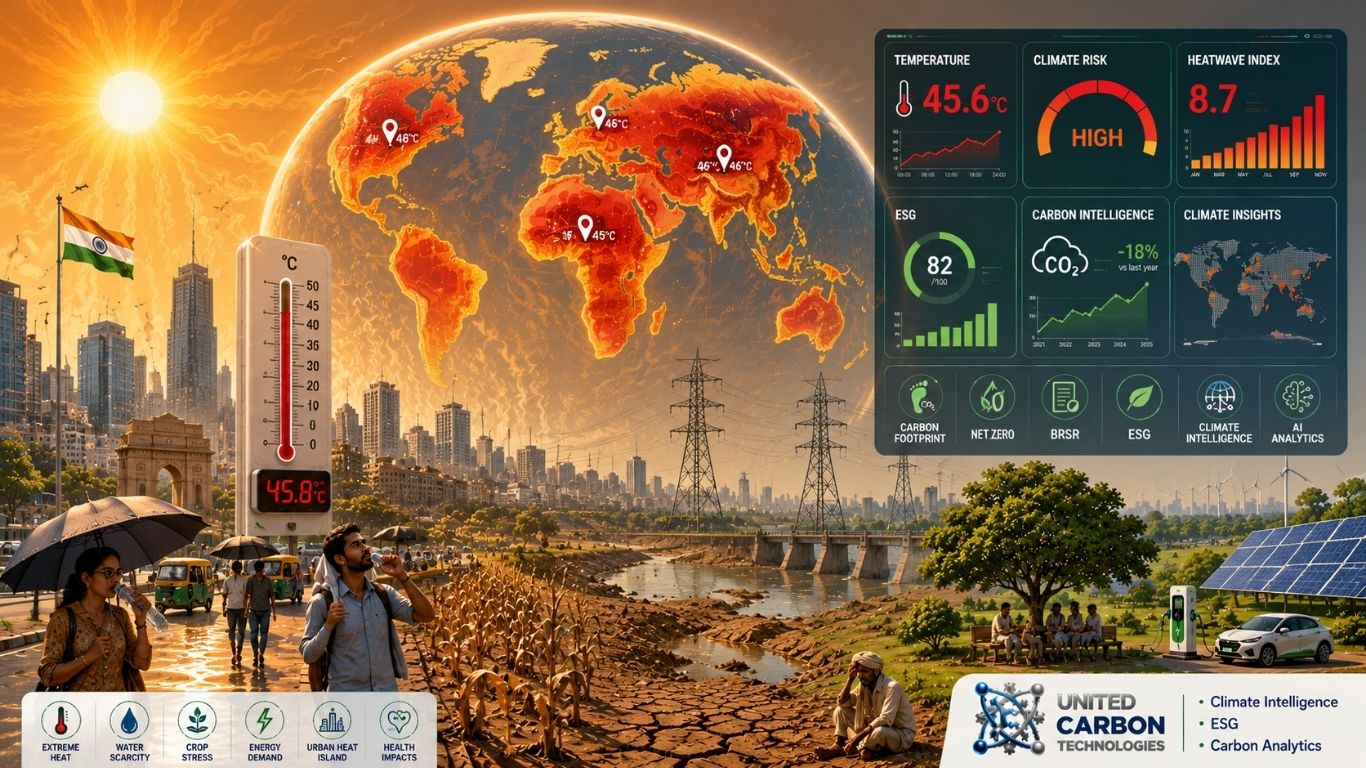
Extreme heat is no longer an occasional weather event—it is becoming one of the most visible impacts of climate change. Across continents, record-breaking temperatures are occurring more frequently, affecting human health, agriculture, ecosystems, infrastructure, and economic productivity.
India is particularly vulnerable because of its large population, rapidly growing cities, dependence on agriculture, and increasing energy demand. Heatwaves now arrive earlier, last longer, and often reach temperatures that were once considered rare.
Understanding why heatwaves are increasing is essential for building climate resilience. Governments, businesses, and individuals all have an important role in reducing climate risks while adapting to a warmer future.
What Is a Heatwave?
A heatwave is a prolonged period of unusually high temperatures that exceeds the normal climate conditions for a particular region. Heatwaves may last several days or even weeks and often combine high daytime temperatures with warm nights, giving people and ecosystems little opportunity to recover.
Although definitions vary between countries, heatwaves are generally identified when temperatures remain significantly above seasonal averages for consecutive days.
Characteristics of Heatwaves
- Extremely high daytime temperatures
- Warmer-than-normal nights
- Low rainfall and dry conditions
- Higher humidity in some regions, increasing heat stress
- Greater risk of droughts, wildfires, and water shortages
Why Are Heatwaves Increasing Across the Globe?
Scientists attribute the increasing frequency and intensity of heatwaves primarily to climate change. Rising greenhouse gas concentrations trap more heat in Earth's atmosphere, increasing average global temperatures and making extreme heat events more likely.
Several factors are contributing to this trend.
- Increasing greenhouse gas emissions from fossil fuels
- Global warming caused by higher atmospheric carbon dioxide levels
- Deforestation reducing natural cooling effects
- Rapid urbanization creating heat-retaining cities
- Changing weather and atmospheric circulation patterns
- Declining natural ecosystems that regulate climate
As average temperatures continue to rise, weather events that were once considered rare are becoming increasingly common across many parts of the world.
Understanding why extreme heat is increasing enables households, businesses, schools, and local governments to make informed decisions that improve resilience and reduce climate-related risks.
Why India Is Becoming More Vulnerable to Heatwaves
India is one of the countries most exposed to extreme heat because of its geography, population density, expanding cities, and dependence on climate-sensitive sectors such as agriculture and water resources.
Many regions now experience longer summers, higher average temperatures, and more frequent heatwave conditions than they did only a few decades ago.
Key Reasons Heatwaves Are Increasing in India
- Rapid urban expansion creating urban heat islands
- Loss of trees and green spaces
- Rising greenhouse gas emissions
- Growing electricity demand for cooling
- Changing rainfall and monsoon patterns
- Increasing land surface temperatures
- Climate variability influenced by global warming
Cities with dense buildings, asphalt roads, and limited vegetation often remain much hotter than nearby rural areas, increasing health risks during prolonged heat events.
Understanding climate risks today helps households, businesses, and policymakers prepare for tomorrow's challenges.
Heatwaves, water stress, and energy disruptions are becoming material ESG risks. Digital climate intelligence can help organizations monitor environmental indicators, strengthen sustainability reporting, and build long-term resilience.
Urban Heat Island Effect: Why Cities Feel Even Hotter
Cities often experience temperatures several degrees higher than nearby rural areas because of the Urban Heat Island (UHI) effect. Concrete buildings, asphalt roads, limited green spaces, and dense infrastructure absorb heat during the day and slowly release it at night, preventing cities from cooling down.
Rapid urbanization across India has intensified this effect, making heatwaves longer, more severe, and increasingly dangerous for millions of people living in metropolitan regions.
- Concrete and asphalt store solar heat
- Reduced tree cover limits natural cooling
- High-rise buildings restrict airflow
- Vehicle emissions and air conditioners generate additional heat
- Night-time temperatures remain unusually high
How Heatwaves Affect Human Health
Extreme heat places enormous stress on the human body. Older adults, children, outdoor workers, and individuals with existing medical conditions face the greatest risks during prolonged heat events.
- Heat exhaustion and heat stroke
- Dehydration and electrolyte imbalance
- Cardiovascular and respiratory complications
- Reduced productivity and physical performance
- Higher hospital admissions during extreme heat events
Public health agencies increasingly recommend hydration, shaded environments, modified working hours, and early warning systems to reduce heat-related illnesses.
Heatwaves and Agriculture: A Growing Threat to Food Security
Agriculture is highly sensitive to temperature extremes. Prolonged heat can damage crops, reduce soil moisture, lower livestock productivity, and disrupt food supply chains.
- Reduced crop yields
- Heat stress affecting livestock
- Lower soil moisture availability
- Increased irrigation demand
- Greater risks to farmer livelihoods
Climate-resilient farming practices, efficient irrigation, drought-resistant crop varieties, and improved weather forecasting are becoming increasingly important for India's agricultural future.
Water Resources Under Increasing Pressure
Heatwaves accelerate evaporation from reservoirs, rivers, and soils while simultaneously increasing water demand from households, industries, and agriculture.
- Declining reservoir levels
- Groundwater depletion
- Higher drinking water demand
- Reduced river flows during dry seasons
- Greater competition for limited water resources
Integrated water management and rainwater harvesting are becoming essential climate adaptation strategies across many regions.
Rising Energy Demand and Pressure on Power Grids
During heatwaves, electricity demand rises sharply as homes, offices, hospitals, and industries rely heavily on cooling systems. This creates additional pressure on power generation and transmission infrastructure.
- Higher air-conditioner usage
- Peak electricity demand
- Greater risk of power shortages
- Higher operating costs for utilities
- Need for smarter and more resilient energy systems
Energy efficiency, renewable energy, battery storage, and smart grid technologies will play a major role in managing future heat-related electricity demand.
Business and Economic Impacts of Increasing Heatwaves
Heatwaves are no longer viewed only as environmental events—they are becoming significant business and financial risks. Organizations across sectors are beginning to incorporate extreme heat into enterprise risk management, ESG reporting, and climate adaptation planning.
- Reduced employee productivity
- Supply chain disruptions
- Higher cooling and operational costs
- Infrastructure damage and maintenance expenses
- Insurance and climate-related financial risks
- Greater investor focus on climate resilience
Businesses that understand climate risks early can strengthen operational resilience, improve sustainability performance, and prepare for future regulatory expectations. Climate intelligence platforms, environmental data analytics, and ESG dashboards are becoming valuable tools for monitoring climate-related risks and supporting better decision-making.
Why Heatwaves Matter More Than Ever for India
India's combination of rapid urbanization, growing population, rising energy demand, agricultural dependence, and climate variability makes the country particularly vulnerable to extreme heat. Strengthening climate resilience will require coordinated action involving governments, businesses, researchers, and citizens.
Investments in green infrastructure, urban planning, renewable energy, climate technology, early warning systems, and public awareness can help reduce the long-term impacts of rising temperatures while supporting sustainable economic development.
How India Can Adapt to Increasing Heatwaves
While reducing greenhouse gas emissions is essential for limiting future warming, India must also strengthen its ability to adapt to increasingly frequent and intense heatwaves. Climate adaptation involves preparing communities, infrastructure, businesses, and ecosystems to withstand rising temperatures and reduce their long-term impacts.
Effective adaptation requires coordinated action from governments, businesses, researchers, and citizens. Investments made today can significantly improve resilience against future climate extremes.
- Expand urban forests, parks, and green infrastructure
- Develop heat-resilient city planning and building designs
- Strengthen early warning systems and emergency response plans
- Improve water conservation and rainwater harvesting
- Promote climate-smart agriculture and drought-resistant crops
- Increase renewable energy capacity and energy efficiency
- Encourage public awareness and climate education
- Integrate climate risk into long-term development planning
The Growing Role of Climate Technology and Climate Intelligence
As climate risks become more complex, technology is playing an increasingly important role in helping governments, businesses, and communities understand, predict, and respond to environmental changes. Modern climate intelligence combines environmental data, satellite observations, artificial intelligence, IoT sensors, weather forecasting, and analytics to support informed decision-making.
Instead of reacting after disasters occur, organizations are beginning to use predictive climate intelligence to identify risks earlier and improve resilience.
- Real-time environmental monitoring
- Heatwave forecasting and early warning systems
- Carbon footprint measurement and emissions analytics
- Water and energy consumption monitoring
- Climate risk assessment for businesses
- ESG performance tracking
- Sustainability reporting and regulatory compliance
- AI-powered environmental decision support
Building India's Carbon Intelligence Platform
At United Carbon Technologies, we believe climate action begins with better data, better decisions, and greater awareness. That is why we are building ACIS (Artificial Carbon Intelligence System)—an India-focused climate intelligence ecosystem designed to simplify carbon measurement, ESG reporting, sustainability analytics, and climate education.
Our long-term vision is to help businesses, institutions, policymakers, researchers, and citizens better understand environmental data and make informed sustainability decisions through digital climate intelligence.
The platform is being designed to support a wide range of climate-related capabilities, including:
- Carbon footprint measurement
- ESG dashboards and analytics
- BRSR reporting support
- Climate risk assessment
- Environmental KPI monitoring
- Sustainability performance tracking
- Climate education through UCT Academy
- India-centric carbon intelligence tools and datasets
As climate regulations evolve and sustainability becomes central to business strategy, accessible climate intelligence platforms will play a critical role in helping India build a resilient, low-carbon future.
Related Climate & Sustainability Guides
- What Is Climate Change? A Complete Beginner Guide
- What Is Carbon Footprint in India?
- What Is Climate Risk and Why It Matters
- How Households Can Reduce Carbon Emissions
- Climate Technologies That Can Help Save Our Planet
- India's Carbon Intelligence Platform Explained
- How Renewable Energy Reduces Carbon Emissions
- What Is Net Zero?
- Heatwaves are becoming more frequent, longer, and more intense because of climate change.
- Global warming increases the likelihood of record-breaking temperatures across many regions.
- India is especially vulnerable due to rapid urbanization, high population density, and changing weather patterns.
- Extreme heat affects public health, agriculture, water resources, electricity demand, infrastructure, and business operations.
- Urban Heat Island effects make cities significantly hotter than surrounding rural areas.
- Climate adaptation, renewable energy, and resilient infrastructure are essential for reducing future risks.
- Climate intelligence platforms will help governments and businesses better understand environmental risks and improve sustainability planning.
- Building climate awareness today is one of the most effective ways to prepare for tomorrow's challenges.
Frequently Asked Questions About Heatwaves
1. Why are heatwaves becoming more frequent?
Heatwaves are becoming more frequent because global temperatures are rising due to increasing greenhouse gas emissions. Climate change makes extreme heat events more likely, more intense, and longer lasting.
2. How does climate change increase heatwaves?
Climate change raises average global temperatures, making it easier for weather systems to produce prolonged periods of extreme heat. Scientific studies show that many recent heatwaves have become more severe because of human-induced global warming.
3. Why is India experiencing more extreme heat?
India's rapid urbanization, changing rainfall patterns, rising temperatures, and Urban Heat Island effect are increasing both the frequency and intensity of heatwaves across many regions.
4. What is the Urban Heat Island effect?
The Urban Heat Island effect occurs when cities become significantly warmer than nearby rural areas because concrete, asphalt, buildings, and limited vegetation absorb and retain heat.
5. How do heatwaves affect human health?
Heatwaves can cause dehydration, heat exhaustion, heat stroke, cardiovascular stress, respiratory problems, and increased health risks for children, elderly people, and outdoor workers.
6. How do heatwaves affect agriculture?
Extreme heat reduces crop yields, increases water demand, stresses livestock, lowers soil moisture, and threatens food security by disrupting agricultural productivity.
7. How do heatwaves affect businesses?
Businesses may experience reduced employee productivity, higher cooling costs, supply chain disruptions, infrastructure stress, increased insurance risks, and greater climate-related financial exposure.
8. What technologies help manage heatwave risks?
Artificial intelligence, satellite monitoring, IoT sensors, climate intelligence platforms, weather forecasting systems, smart grids, and environmental analytics help monitor, predict, and manage heatwave impacts.
9. How can India adapt to increasing heatwaves?
India can improve resilience by expanding green infrastructure, strengthening early warning systems, improving water management, increasing renewable energy, adopting climate-smart agriculture, and investing in climate technology.
10. Why is climate intelligence important for the future?
Climate intelligence helps governments, businesses, and communities understand environmental risks, improve sustainability planning, strengthen ESG reporting, and make informed decisions in a changing climate.
Build Your Climate Intelligence
Climate change is reshaping the future of business, cities, industries, and everyday life. The more you understand climate science, carbon emissions, ESG, sustainability, and climate technology today, the better prepared you'll be for tomorrow.
Whether you're a student, professional, business leader, policymaker, or simply curious about climate action, building climate knowledge is the first step toward creating meaningful impact.
Join thousands of learners exploring climate intelligence with United Carbon Technologies.
YOUR ACTION • OUR PLANET • TOGETHER WE BUILD A SUSTAINABLE FUTURE
✓ Free Climate Learning Resources | ✓ ESG & Sustainability Insights | ✓ Carbon Intelligence Updates | ✓ Early Access to ACIS