

Carbon Border Adjustment Mechanism (CBAM) Explained for Indian Exporters
By United Carbon Technologies | Climate Knowledge Hub India
Join thousands of readers learning about ESG, carbon accounting, Net Zero, climate technology, sustainability, and India's low-carbon transition.
The Carbon Border Adjustment Mechanism (CBAM) is the European Union's carbon pricing policy for imports. Indian exporters in sectors such as steel, aluminium, cement, fertilizers, hydrogen, and electricity must understand CBAM to remain competitive, comply with reporting requirements, and prepare for a low-carbon global economy.
What is the Carbon Border Adjustment Mechanism (CBAM)?
The Carbon Border Adjustment Mechanism (CBAM) is a European Union regulation that applies a carbon price to certain imported goods based on the greenhouse gas emissions generated during their production. It aims to prevent carbon leakage, promote cleaner manufacturing, and ensure imported products face carbon costs similar to those produced within the EU.
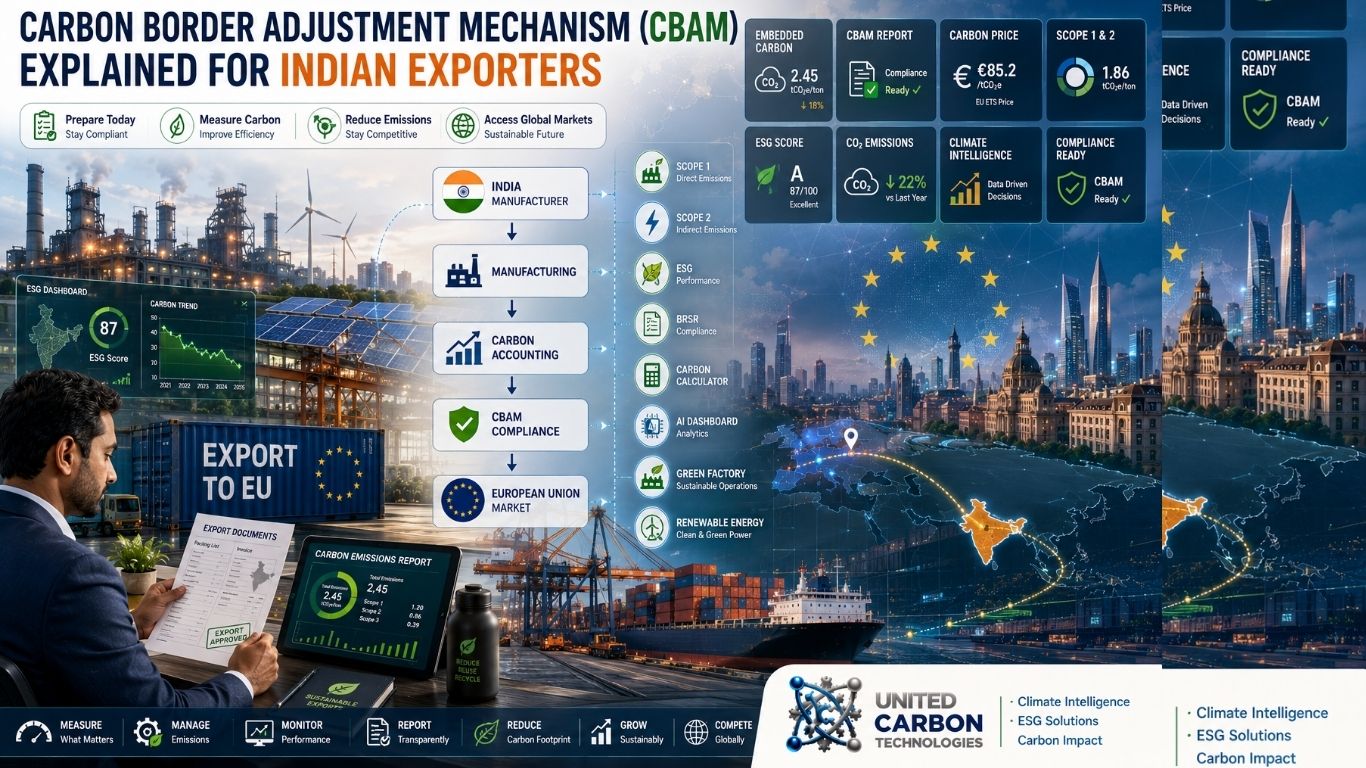
Global trade is entering a new era where carbon emissions are becoming just as important as product quality and price. Countries are increasingly adopting climate-related trade policies that encourage cleaner manufacturing and reduce greenhouse gas emissions across global supply chains.
One of the most significant developments is the European Union's Carbon Border Adjustment Mechanism (CBAM). This policy changes how exporters access one of the world's largest markets by requiring importers to account for the carbon emissions embedded in specific products.
For Indian exporters, CBAM represents both a challenge and an opportunity. Companies that accurately measure emissions, improve energy efficiency, and invest in low-carbon production can strengthen their competitiveness in international markets. Businesses that delay preparing may face additional costs, compliance risks, and pressure from global customers.
The European Union's Carbon Border Adjustment Mechanism is one of the world's first large-scale carbon border policies. It encourages manufacturers worldwide to measure and reduce greenhouse gas emissions, making carbon data an increasingly important part of international trade.
Why Was CBAM Introduced?
The European Union has committed to becoming climate neutral by 2050. As European manufacturers invest in cleaner technologies and pay for carbon emissions through the EU Emissions Trading System (EU ETS), there is a risk that production could shift to countries with less stringent climate regulations. This phenomenon is known as carbon leakage.
CBAM was introduced to create a more level playing field. By applying a carbon price to certain imported goods, the EU aims to ensure that domestic and imported products face comparable carbon costs, encouraging cleaner production globally while protecting the competitiveness of European industries.
How Does CBAM Work?
Under CBAM, importers into the European Union must report the greenhouse gas emissions associated with certain imported products. During the transition phase, the focus is on emissions reporting. As the mechanism is fully implemented, importers will purchase CBAM certificates reflecting the embedded carbon emissions of imported goods, aligning their carbon costs with those paid by EU manufacturers.
This means exporters need accurate emissions data, robust carbon accounting systems, and transparent reporting processes to support their customers and maintain market access.
Which Indian Industries Are Most Affected?
The first phase of CBAM applies to several carbon-intensive sectors that have high greenhouse gas emissions during production.
- Steel and Iron
- Aluminium
- Cement
- Fertilizers
- Hydrogen
- Electricity
Many Indian manufacturers operating in these sectors export significant volumes to Europe. As CBAM evolves, additional industries and products may be brought under its scope, making carbon measurement increasingly important across supply chains.
CBAM Timeline: Transition Phase vs Definitive Phase
The Carbon Border Adjustment Mechanism is being introduced gradually, giving businesses time to develop carbon accounting systems and improve emissions reporting before financial obligations are fully implemented.
Transition Phase
During the transition period, importers into the European Union are required to report the greenhouse gas emissions embedded in imported goods. No CBAM certificates are purchased during this phase, but companies must collect accurate emissions data and submit regular reports.
This period allows exporters, importers, and regulators to establish reliable carbon accounting practices while preparing for the full implementation of the mechanism.
Definitive Phase
As CBAM enters its definitive phase, importers will be required to purchase CBAM certificates that reflect the embedded carbon emissions of imported products. The cost will depend on the emissions associated with manufacturing and the prevailing EU carbon price.
For exporters, this means lower-carbon products may become more competitive in European markets, creating a strong financial incentive to improve manufacturing efficiency and reduce emissions.
CBAM Reporting Requirements
Accurate emissions reporting is at the heart of CBAM compliance. European importers rely on emissions data provided by manufacturers to calculate the embedded carbon associated with imported products.
Typical Information Required
- Product category and classification.
- Quantity of goods exported.
- Production facility details.
- Direct greenhouse gas emissions.
- Indirect emissions from purchased electricity.
- Production methodologies.
- Energy sources used during manufacturing.
- Supporting documentation and calculations.
Reliable reporting systems reduce compliance risks while improving trust between exporters, customers, and regulators.
Understanding Embedded Carbon Emissions
Embedded emissions represent the greenhouse gases generated during the production of a product before it reaches the customer. These emissions become part of the product's overall carbon footprint and form the basis of CBAM calculations.
For example, producing one tonne of steel requires significant amounts of electricity, fuel, and industrial processes. The carbon emissions generated throughout manufacturing become the product's embedded emissions.
Accurately calculating embedded carbon is becoming an essential capability for exporters serving international markets.
Need Help Preparing Your Business for the Low-Carbon Economy?
Whether you're beginning your ESG journey, measuring your carbon footprint, preparing for BRSR, or responding to new regulations like CBAM, our experts can help you understand the next steps and identify practical opportunities for improvement.
Direct and Indirect Emissions Under CBAM
CBAM considers emissions generated during the manufacturing process. Understanding the distinction between direct and indirect emissions is essential for accurate reporting.
Direct Emissions
Direct emissions are greenhouse gases released from sources owned or controlled by the manufacturer. Examples include fuel combustion in boilers, industrial furnaces, manufacturing equipment, and production processes.
Indirect Emissions
Indirect emissions arise from purchased electricity, heating, or cooling used during manufacturing. Even though these emissions occur at the power plant, they are attributed to the manufacturing process because the electricity is consumed by the facility.
For many manufacturers, electricity-related emissions represent a significant portion of their total carbon footprint, making energy efficiency and renewable electricity increasingly important.
Why Carbon Accounting Is Critical for CBAM
CBAM has transformed carbon accounting from a voluntary sustainability initiative into a strategic business capability. Companies can no longer rely on estimates or incomplete environmental data—they need accurate, transparent, and auditable greenhouse gas inventories.
A robust carbon accounting system helps organizations:
- Measure greenhouse gas emissions accurately.
- Calculate product-level carbon footprints.
- Support CBAM reporting requirements.
- Improve operational efficiency.
- Identify emission reduction opportunities.
- Strengthen ESG reporting.
- Prepare for future climate regulations.
- Build trust with international customers.
How CBAM Connects with Scope 1, Scope 2 & Scope 3 Emissions
Although CBAM has its own reporting methodology, it closely aligns with internationally recognized carbon accounting principles used in ESG reporting and greenhouse gas inventories.
- Scope 1: Direct emissions from manufacturing processes and on-site fuel combustion.
- Scope 2: Indirect emissions from purchased electricity, steam, heating, or cooling.
- Scope 3: Value chain emissions that may become increasingly important as global climate reporting expands.
Companies that already measure Scope 1, Scope 2, and Scope 3 emissions have a strong foundation for meeting CBAM requirements while supporting ESG reporting, BRSR disclosures, Net Zero planning, and climate risk management.
Building a comprehensive carbon inventory today is not just about compliance—it is becoming a competitive advantage in global trade.
How Indian Exporters Can Prepare for CBAM
Preparing for the Carbon Border Adjustment Mechanism requires more than simply understanding the regulation. Companies must build reliable systems to measure emissions, improve operational efficiency, and provide transparent carbon data to international customers.
Businesses that start preparing today will be better positioned to comply with future regulations, reduce compliance costs, and strengthen their competitiveness in global markets.
Practical Steps for Exporters
- Measure your organization's carbon footprint.
- Identify emission-intensive production processes.
- Calculate product-level embedded emissions.
- Improve energy efficiency across manufacturing facilities.
- Increase the use of renewable electricity.
- Develop accurate carbon accounting systems.
- Maintain detailed emissions documentation.
- Train sustainability and compliance teams.
- Engage suppliers to improve supply chain emissions data.
- Adopt digital ESG and carbon management platforms.
Early preparation not only simplifies CBAM compliance but also supports long-term sustainability goals and strengthens relationships with international customers.
Common Challenges Businesses Face
Many organizations are beginning their carbon reporting journey for the first time. While the objectives of CBAM are straightforward, collecting accurate emissions data across complex manufacturing operations can be challenging.
Typical Challenges Include
- Lack of reliable carbon emissions data.
- Limited understanding of greenhouse gas accounting.
- Difficulty calculating product-level emissions.
- Manual spreadsheets and disconnected systems.
- Incomplete supplier information.
- Changing international sustainability regulations.
- Limited internal sustainability expertise.
- Verification and documentation requirements.
These challenges are encouraging businesses to move from manual reporting toward automated climate intelligence systems capable of managing carbon data continuously.
Turn Sustainability Data into Business Intelligence
United Carbon Technologies helps organizations simplify carbon accounting, ESG reporting, BRSR compliance, Net Zero planning, climate risk management, and sustainability reporting using practical consulting and next-generation digital solutions.
We're also developing ACIS (Advanced Carbon Intelligence System), an AI-powered climate intelligence platform designed to automate emissions measurement, ESG reporting, energy analytics, Scope 1, 2 & 3 tracking, and sustainability dashboards.
The Future of Global Trade Is Low Carbon
CBAM represents a broader shift in international commerce. Around the world, governments, investors, customers, and financial institutions are placing increasing value on transparent climate performance. Carbon emissions are becoming a measurable business metric alongside quality, cost, and delivery.
Future exporters will increasingly need to demonstrate:
- Verified greenhouse gas inventories.
- Lower product carbon footprints.
- Renewable energy adoption.
- Sustainable manufacturing practices.
- Transparent ESG reporting.
- Climate risk management.
- Continuous carbon performance improvement.
Businesses that invest in climate intelligence today will be better prepared for tomorrow's regulations while building stronger brands, attracting global customers, and improving long-term resilience.
Related Reads
- What Is Carbon Accounting? Complete Guide
- Understanding Scope 1, Scope 2 & Scope 3 Emissions
- ESG Reporting Explained for Indian Companies
- What Is BRSR? A Complete Guide
- How Businesses Measure Carbon Footprints
- What Is Net Zero? Complete Guide
- How Electricity Usage Impacts Carbon Footprint
- Climate Intelligence: The Future of Sustainability
- CBAM is the European Union's carbon pricing mechanism for certain imported goods.
- Indian exporters in sectors such as steel, aluminium, cement, fertilizers, hydrogen, and electricity are directly affected.
- The mechanism requires accurate reporting of embedded greenhouse gas emissions.
- Reliable carbon accounting is essential for CBAM compliance.
- Scope 1 and Scope 2 emissions play a central role in emissions calculations.
- Digital ESG platforms simplify carbon data collection and reporting.
- AI-powered climate intelligence will become increasingly important for international trade.
- Businesses that prepare early can improve competitiveness, reduce compliance risks, and strengthen access to global markets.
Frequently Asked Questions (FAQs)
1. What is the Carbon Border Adjustment Mechanism (CBAM)?
The Carbon Border Adjustment Mechanism (CBAM) is a European Union regulation that places a carbon price on certain imported goods based on the greenhouse gas emissions generated during their production. Its objective is to prevent carbon leakage and encourage cleaner manufacturing worldwide.
2. Why was CBAM introduced?
CBAM was introduced to create a level playing field between European manufacturers, who pay for carbon emissions under the EU Emissions Trading System (EU ETS), and foreign producers exporting to the European Union. It supports the EU's climate neutrality goals while promoting global decarbonization.
3. Which Indian industries are affected by CBAM?
Indian exporters in sectors such as iron and steel, aluminium, cement, fertilizers, hydrogen, and electricity are currently the most affected. The scope may expand to additional products and industries in the future.
4. What are embedded carbon emissions?
Embedded carbon emissions are the greenhouse gases generated during the production of a product before it reaches the customer. CBAM uses these emissions to calculate the carbon cost associated with imported goods.
5. Is CBAM linked to carbon accounting?
Yes. Accurate carbon accounting is essential for CBAM compliance. Businesses must measure, calculate, and report greenhouse gas emissions using internationally recognized methodologies to support reporting requirements.
6. How does CBAM relate to Scope 1 and Scope 2 emissions?
CBAM primarily considers direct emissions (Scope 1) from manufacturing processes and indirect emissions (Scope 2) associated with purchased electricity. Accurate measurement of both is critical for emissions reporting.
7. Will CBAM increase costs for Indian exporters?
Exporters with carbon-intensive production processes may face higher costs if their products have significant embedded emissions. Companies that improve energy efficiency and reduce emissions can strengthen their competitiveness in European markets.
8. How can businesses prepare for CBAM?
Businesses should begin measuring their carbon footprint, establish robust carbon accounting systems, improve energy efficiency, adopt renewable energy where feasible, and implement digital platforms for emissions monitoring and ESG reporting.
9. Why is digital carbon reporting becoming important?
Manual spreadsheets are increasingly inadequate for complex carbon reporting requirements. Digital climate intelligence platforms automate data collection, improve reporting accuracy, simplify compliance, and provide real-time sustainability insights.
10. How will AI and climate intelligence support CBAM compliance?
Artificial Intelligence can automate emissions calculations, identify reduction opportunities, improve reporting accuracy, monitor sustainability performance continuously, and generate insights that help businesses comply with CBAM while reducing operational emissions.
Explore the Future of Climate Intelligence
Learn ESG, sustainability, carbon intelligence, and climate-tech concepts shaping the future of business and environmental strategy..
Join readers building climate intelligence knowledge for a sustainable future.
Join the Climate Knowledge Challenge
✔ Free Climate Learning Resources | ✔ ESG & Sustainability Insights | ✔ Early Access to ACIS Climate Intelligence Platform | ✔ Community of Future Climate Leaders