

Carbon Offsetting: Benefits, Risks, and Best Practices
By United Carbon Technologies | Climate Knowledge Hub India
Practical insights on carbon accounting, climate action, ESG reporting, sustainability, and emerging carbon market opportunities.
Carbon offsetting allows individuals and organizations to compensate for greenhouse gas emissions by supporting verified climate projects such as reforestation, renewable energy, and methane reduction. While offsets can contribute to climate action, they should complement—not replace—direct emissions reductions. Understanding their benefits, limitations, and best practices is essential for building credible Net Zero strategies.
What is carbon offsetting?
Carbon offsetting is the practice of compensating for greenhouse gas emissions by investing in verified projects that reduce, remove, or prevent an equivalent amount of carbon dioxide or other greenhouse gases from entering the atmosphere.
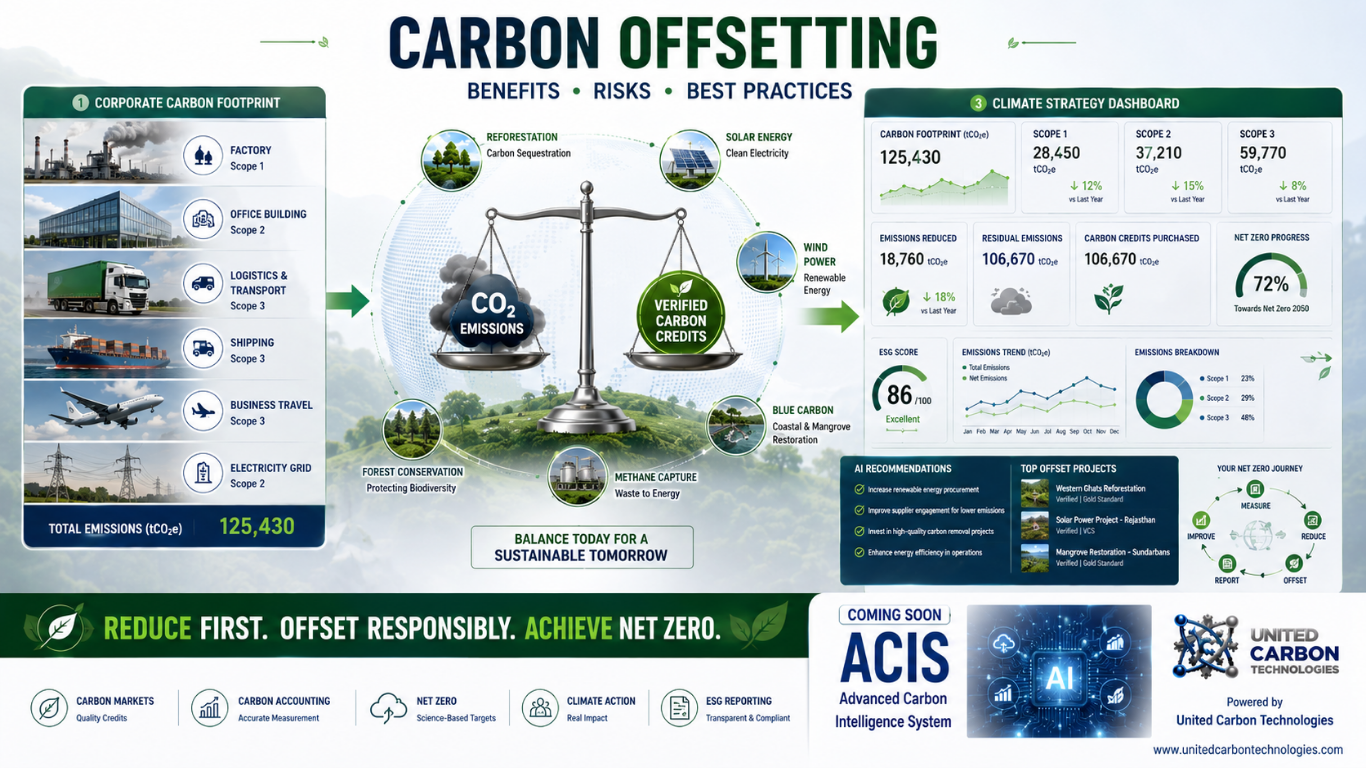
As governments, businesses, and individuals work toward reducing greenhouse gas emissions, carbon offsetting has emerged as one of the most widely discussed climate solutions. Around the world, organizations purchase carbon credits to compensate for emissions that are difficult to eliminate immediately, while supporting projects that protect forests, expand renewable energy, restore ecosystems, or capture greenhouse gases.
However, carbon offsetting is often misunderstood. Some view offsets as an effective way to accelerate climate action, while others question their credibility and long-term environmental impact. The reality lies somewhere in between: high-quality carbon offsets can play a valuable role when they are used responsibly and alongside meaningful emissions reductions.
For businesses developing Net Zero strategies, understanding how carbon offsets work—and recognizing both their strengths and limitations—is becoming increasingly important as climate regulations, investor expectations, and sustainability reporting standards continue to evolve.
A single verified carbon credit generally represents the reduction or removal of one metric tonne of carbon dioxide equivalent (1 tCO₂e). Millions of carbon credits are traded globally each year to support climate projects ranging from renewable energy to ecosystem restoration.
What Is Carbon Offsetting?
Carbon offsetting is a climate action mechanism through which emissions generated in one location are balanced by supporting verified projects that reduce, avoid, or remove greenhouse gas emissions elsewhere. Instead of eliminating emissions directly, organizations compensate for unavoidable emissions by financing projects that deliver measurable environmental benefits.
Examples of offset projects include:
- Afforestation and reforestation.
- Forest conservation initiatives.
- Renewable energy projects.
- Methane capture from landfills.
- Clean cooking technologies.
- Industrial emissions reduction.
- Blue carbon ecosystem restoration.
- Carbon capture and storage projects.
Each verified project generates carbon credits based on independently measured emissions reductions or removals, providing organizations with a mechanism to compensate for a portion of their carbon footprint.
Why Carbon Offsetting Matters
Many sectors—including aviation, heavy manufacturing, shipping, agriculture, and construction—cannot eliminate all emissions immediately using today's technologies. Carbon offsetting provides a transitional solution that allows organizations to take climate action while investing in long-term emissions reductions.
When combined with robust carbon accounting and direct decarbonization efforts, offsetting can help organizations:
- Support global climate projects.
- Contribute to Net Zero commitments.
- Address residual emissions.
- Meet stakeholder expectations.
- Strengthen sustainability strategies.
- Demonstrate environmental responsibility.
Benefits of Carbon Offsetting
When implemented responsibly, carbon offsetting can complement broader climate action strategies. It enables organizations to support verified emission reduction projects while working to reduce their own operational emissions through efficiency improvements, renewable energy adoption, and sustainable business practices.
Some of the key benefits include:
- Supports global climate mitigation projects.
- Helps compensate for unavoidable or residual emissions.
- Accelerates progress toward Net Zero commitments.
- Encourages investment in renewable energy.
- Protects forests and biodiversity.
- Promotes sustainable development in local communities.
- Improves corporate ESG performance.
- Strengthens climate leadership and brand reputation.
High-quality offset projects often deliver additional environmental and social benefits beyond carbon reductions, such as improving air quality, conserving ecosystems, creating employment opportunities, and supporting rural livelihoods.
Risks and Criticisms of Carbon Offsetting
Despite its potential, carbon offsetting has also faced significant criticism. Not all carbon credits deliver the same environmental value, and poorly designed projects may fail to achieve the emissions reductions they claim.
Common concerns include:
- Greenwashing through excessive reliance on offsets.
- Overestimated carbon reduction claims.
- Lack of project transparency.
- Double counting of carbon credits.
- Permanence risks, particularly in forestry projects.
- Leakage, where emissions shift to another location.
- Weak verification and monitoring.
- Variable quality across voluntary carbon markets.
For these reasons, leading sustainability frameworks recommend using carbon offsets only after organizations have made every reasonable effort to reduce direct emissions through operational improvements and cleaner technologies.
Types of Carbon Offset Projects
Carbon credits are generated through a wide range of climate projects. Each project type contributes differently to greenhouse gas reduction or removal, making project selection an important part of a credible offsetting strategy.
1. Reforestation and Afforestation
Planting new forests and restoring degraded landscapes helps absorb atmospheric carbon dioxide while improving biodiversity and ecosystem resilience.
2. Renewable Energy Projects
Solar, wind, hydroelectric, and other renewable energy projects reduce dependence on fossil fuels and lower greenhouse gas emissions.
3. Methane Capture
Capturing methane from landfills, wastewater treatment facilities, or agricultural operations prevents one of the most potent greenhouse gases from entering the atmosphere.
4. Clean Cooking Solutions
Efficient cookstoves and cleaner household energy technologies reduce fuel consumption, improve indoor air quality, and decrease carbon emissions.
5. Blue Carbon Projects
Mangroves, salt marshes, and seagrass ecosystems store significant amounts of carbon while protecting coastal biodiversity and communities.
6. Carbon Capture and Storage (CCS)
Emerging technologies capture carbon dioxide from industrial processes or directly from the atmosphere and store it safely underground.
Voluntary vs Compliance Carbon Markets
Carbon credits are traded through two primary market systems, each serving different regulatory and business objectives.
Voluntary Carbon Markets (VCMs)
Organizations and individuals voluntarily purchase carbon credits to support sustainability goals, corporate responsibility initiatives, or Net Zero commitments. These markets are driven by private sector demand and independent certification standards.
Compliance Carbon Markets
Compliance markets operate under government regulations that require organizations to reduce or offset emissions. Companies participating in emissions trading systems must comply with legally established carbon caps and reporting requirements.
Understanding the distinction between voluntary and compliance markets helps organizations choose appropriate carbon strategies based on regulatory obligations and sustainability objectives.
The most credible climate strategy begins with measuring your carbon footprint, improving efficiency, and reducing emissions. Carbon offsets should complement—not replace—direct climate action.
United Carbon Technologies helps organizations measure greenhouse gas emissions, strengthen carbon accounting, develop ESG reporting frameworks, and design science-informed climate strategies that prioritize real emissions reductions before carbon offsetting.
Best Practices for Responsible Carbon Offsetting
Carbon offsetting delivers the greatest climate value when it is integrated into a comprehensive decarbonization strategy rather than used as a standalone solution. Leading organizations follow internationally recognized principles to ensure that offsets contribute to genuine climate action.
Recommended best practices include:
- Measure your complete carbon footprint before purchasing offsets.
- Prioritize direct emissions reductions through energy efficiency and operational improvements.
- Offset only unavoidable or residual emissions.
- Select independently verified, high-quality carbon credits.
- Evaluate project permanence, additionality, and transparency.
- Diversify investments across multiple climate project types.
- Maintain transparent documentation for ESG reporting.
- Review and update offset strategies regularly.
Organizations that follow these practices are better positioned to build trust with investors, customers, regulators, and other stakeholders while contributing meaningfully to global climate goals.
Carbon Offsetting and Net Zero Strategies
Carbon offsetting is often associated with Net Zero commitments, but the two concepts are not identical. Achieving Net Zero requires organizations to significantly reduce greenhouse gas emissions across their operations and value chains before using offsets to address residual emissions that cannot yet be eliminated.
A credible Net Zero journey typically follows this sequence:
- Measure greenhouse gas emissions.
- Identify major emission sources.
- Reduce emissions through efficiency and innovation.
- Transition to renewable energy where feasible.
- Engage suppliers to reduce value chain emissions.
- Offset only the remaining unavoidable emissions.
- Continuously improve performance year after year.
This approach aligns with international climate guidance and helps organizations avoid overreliance on offsets while demonstrating genuine progress toward long-term sustainability goals.
The Future of Carbon Markets
Carbon markets are evolving rapidly as governments strengthen climate policies and businesses increase investments in sustainability. Advances in technology, digital monitoring, and international cooperation are expected to improve the credibility and effectiveness of carbon offset projects.
Key trends shaping the future include:
- Higher-quality carbon credit standards.
- Greater transparency and third-party verification.
- Satellite-based monitoring of climate projects.
- AI-powered carbon project assessment.
- Blockchain-enabled carbon credit traceability.
- Expansion of Article 6 carbon markets under the Paris Agreement.
- Increased corporate demand for premium carbon credits.
- Stronger integration of carbon markets with ESG reporting.
As carbon markets mature, organizations will increasingly focus on purchasing high-integrity credits that deliver measurable environmental and social outcomes.
How Climate Intelligence Can Improve Carbon Market Decisions
The future of carbon offsetting extends beyond simply purchasing carbon credits. Organizations are increasingly using climate intelligence to determine when offsets are appropriate, evaluate project quality, forecast residual emissions, and prioritize investments that deliver the greatest climate impact.
AI-powered analytics and enterprise carbon data can help businesses:
- Estimate future residual emissions.
- Compare carbon offset project performance.
- Assess supplier decarbonization opportunities.
- Identify the most cost-effective reduction pathways.
- Track offset portfolios over time.
- Support transparent ESG disclosures.
- Improve Net Zero planning.
- Strengthen climate risk management.
By combining carbon accounting with predictive analytics, organizations can make more informed decisions about when to reduce emissions directly and when high-quality carbon offsets may play a supporting role.
How ACIS Is Being Designed to Support Smarter Carbon Strategies
At United Carbon Technologies, we believe effective climate action begins with accurate measurement and informed decision-making. Our upcoming Advanced Carbon Intelligence System (ACIS) is being designed to help organizations strengthen carbon accounting, sustainability reporting, and climate intelligence before considering carbon offsetting as part of broader Net Zero strategies.
Future ACIS capabilities are planned to include:
- Enterprise carbon footprint dashboards.
- Scope 1, Scope 2, and Scope 3 calculations.
- Carbon hotspot identification.
- Residual emissions forecasting.
- AI-powered climate insights.
- ESG reporting support.
- Scenario analysis for Net Zero planning.
- Carbon reduction opportunity tracking.
- Executive sustainability dashboards.
- Future integration with carbon market intelligence.
By combining robust carbon accounting with intelligent analytics, ACIS aims to help organizations prioritize emissions reductions while making informed, transparent, and credible climate decisions.
Related Reads
- How Companies Calculate Their Corporate Carbon Footprint
- What Is Carbon Accounting?
- What Are Carbon Credits?
- Understanding Scope 1, Scope 2 & Scope 3 Emissions
- What Is Net Zero?
- How ESG Software Simplifies Sustainability Reporting
- Carbon offsetting compensates for unavoidable greenhouse gas emissions by supporting verified climate projects.
- High-quality offsets should complement—not replace—direct emissions reductions.
- Verified carbon projects include reforestation, renewable energy, methane capture, blue carbon, and carbon removal initiatives.
- Organizations should evaluate project quality, transparency, permanence, and additionality before purchasing carbon credits.
- Net Zero strategies prioritize measuring, reducing, and avoiding emissions before using offsets.
- Carbon markets are becoming more transparent through improved standards, AI, satellite monitoring, and digital verification.
- Climate intelligence helps organizations make informed decisions about emissions reductions and responsible carbon offsetting.
- United Carbon Technologies is developing ACIS to support enterprise carbon accounting, ESG reporting, predictive analytics, and smarter climate decision-making.
Frequently Asked Questions (FAQs)
1. What is carbon offsetting?
Carbon offsetting is the practice of compensating for greenhouse gas emissions by purchasing verified carbon credits that support projects which reduce, remove, or prevent an equivalent amount of greenhouse gases from entering the atmosphere.
2. What is a carbon credit?
A carbon credit typically represents one metric tonne of carbon dioxide equivalent (1 tCO₂e) that has been reduced, avoided, or removed through a verified climate project.
3. Is carbon offsetting the same as reducing emissions?
No. Reducing emissions lowers greenhouse gases produced by an organization's own activities, while carbon offsetting compensates for unavoidable emissions by supporting verified climate projects. Leading sustainability frameworks recommend reducing emissions first and using offsets only for residual emissions.
4. What types of projects generate carbon credits?
Carbon credits may be generated through reforestation, renewable energy, methane capture, clean cooking initiatives, blue carbon ecosystems, carbon capture technologies, and other verified emissions reduction projects.
5. What is the difference between voluntary and compliance carbon markets?
Voluntary carbon markets allow organizations to purchase credits voluntarily to meet sustainability goals, while compliance markets operate under government regulations that require organizations to reduce or offset emissions.
6. Are all carbon offsets reliable?
No. The quality of carbon offsets varies significantly. Organizations should prioritize independently verified projects that demonstrate additionality, permanence, transparency, and robust monitoring.
7. How do businesses use carbon offsetting in Net Zero strategies?
Businesses first measure and reduce emissions through operational improvements, renewable energy, and supplier engagement. Carbon offsets are then used to compensate for residual emissions that cannot yet be eliminated.
8. Can individuals purchase carbon offsets?
Yes. Individuals can purchase verified carbon credits to offset emissions from activities such as air travel, commuting, household energy use, and events through reputable carbon offset providers.
9. Why is carbon accounting important before offsetting?
Accurate carbon accounting identifies the largest emission sources and helps organizations prioritize reductions. Without measurement, businesses cannot determine how many emissions remain or how many offsets may be appropriate.
10. How is United Carbon Technologies supporting smarter carbon management?
United Carbon Technologies is developing the Advanced Carbon Intelligence System (ACIS) to help organizations measure greenhouse gas emissions, improve carbon accounting, strengthen ESG reporting, and use climate intelligence to support informed Net Zero and carbon market decisions.
Build Credible Climate Action with Better Carbon Intelligence
Carbon offsetting is most effective when it complements accurate carbon accounting and meaningful emissions reductions. Understanding carbon markets, climate risks, and sustainability best practices enables organizations to make responsible, transparent, and future-ready climate decisions.
Explore practical resources on carbon accounting, carbon markets, ESG reporting, Net Zero strategies, climate technology, and sustainability through the United Carbon Technologies Climate Knowledge Hub.
Whether you're beginning your climate journey or strengthening enterprise sustainability programs, informed decisions today will create measurable environmental impact tomorrow.
Measure Better. Reduce First. Offset Responsibly.
✔ Practical Carbon Accounting Guides | ✔ Carbon Markets & ESG Insights | ✔ Early Access to ACIS Climate Intelligence Platform | ✔ Join India's Growing Climate Community