

How ESG Software Simplifies Sustainability Reporting
By United Carbon Technologies | Climate Knowledge Hub India
Learn about ESG reporting, carbon accounting, sustainability technology, climate intelligence, Net Zero, and emerging digital solutions.
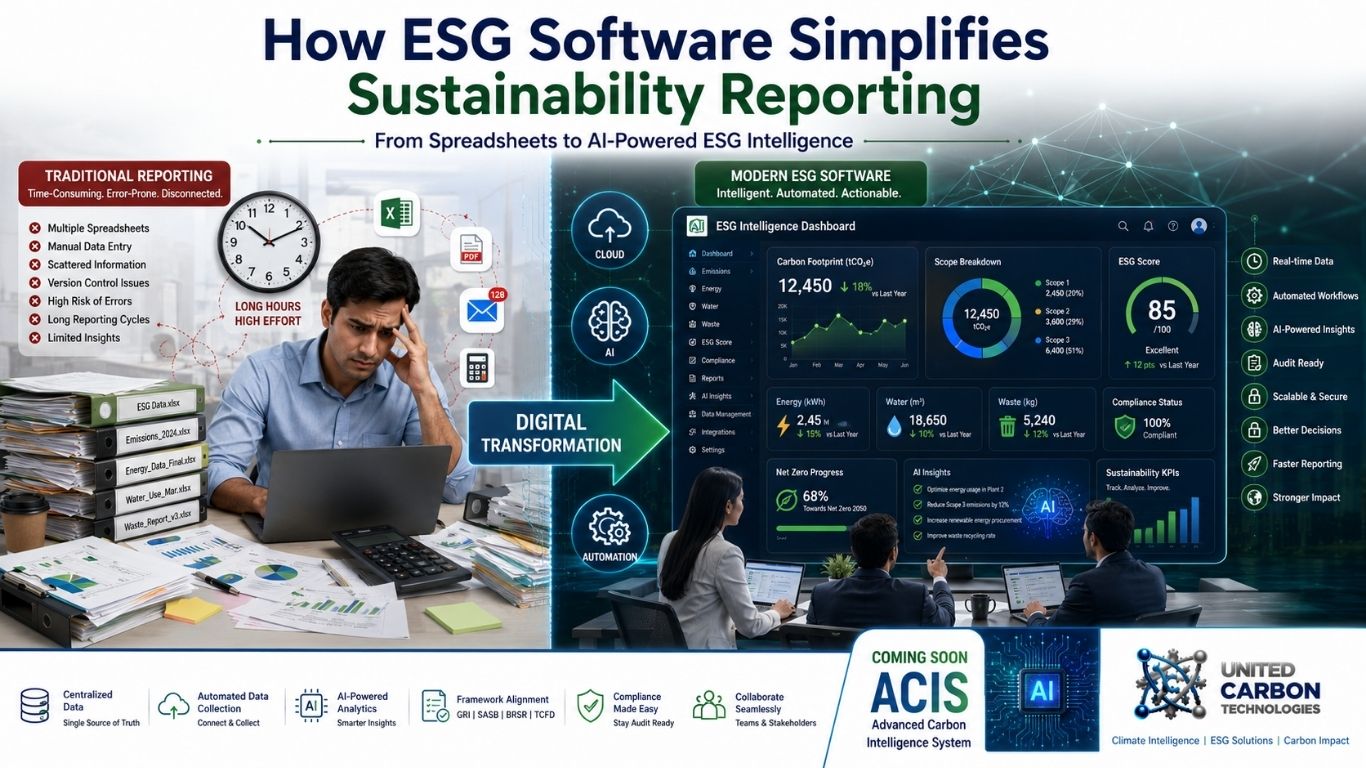
As sustainability reporting becomes increasingly important, organizations are moving away from spreadsheets and manual data collection toward intelligent ESG software platforms. Modern ESG software helps businesses collect environmental, social, and governance data, automate reporting, improve accuracy, and meet growing regulatory and investor expectations.
How does ESG software simplify sustainability reporting?
ESG software simplifies sustainability reporting by automatically collecting, organizing, analyzing, and reporting Environmental, Social, and Governance (ESG) data. It reduces manual work, improves reporting accuracy, supports regulatory compliance, and enables organizations to make better sustainability decisions using real-time insights.
Companies today generate enormous amounts of sustainability data—from electricity consumption and greenhouse gas emissions to water use, waste generation, employee diversity, and supply chain information. Managing this information manually has become increasingly difficult as reporting standards evolve and stakeholders demand greater transparency.
ESG software has emerged as a powerful solution for organizations seeking to streamline sustainability reporting. Instead of relying on multiple spreadsheets and disconnected systems, businesses can centralize ESG data, automate calculations, generate reports, and gain real-time visibility into their sustainability performance.
Whether an organization is preparing ESG reports, calculating carbon emissions, complying with regulations, or setting Net Zero goals, modern ESG platforms help simplify complex processes while improving decision-making and operational efficiency.
Many organizations still manage sustainability reporting using spreadsheets, making data collection time-consuming and prone to errors. ESG software automates these processes, enabling faster reporting, improved data accuracy, and better compliance with evolving ESG standards.
What Is ESG Software?
ESG software is a digital platform that helps organizations collect, manage, analyze, and report Environmental, Social, and Governance (ESG) information. It serves as a centralized system for tracking sustainability performance across multiple departments, facilities, and supply chains.
Rather than manually compiling information from various sources, ESG software brings together operational data into a single platform where organizations can monitor environmental impacts, generate reports, identify improvement opportunities, and demonstrate compliance with ESG frameworks.
Modern ESG software often combines carbon accounting, sustainability reporting, energy management, compliance monitoring, climate analytics, dashboards, and executive reporting into one integrated solution.
Why Traditional Sustainability Reporting Is Challenging
Many businesses begin their sustainability journey using spreadsheets and manually prepared reports. While this approach may work initially, it becomes increasingly difficult as organizations grow, regulations evolve, and reporting requirements become more detailed.
Common challenges include:
- Collecting ESG data from multiple departments.
- Managing information from different facilities and suppliers.
- Inconsistent reporting formats.
- Manual calculation errors.
- Difficulty tracking historical performance.
- Time-consuming report preparation.
- Limited visibility into sustainability metrics.
- Challenges in verifying and auditing ESG data.
These challenges often delay reporting and make it harder for organizations to confidently communicate their sustainability performance to investors, customers, regulators, and other stakeholders.
How ESG Software Simplifies Sustainability Reporting
ESG software transforms sustainability reporting from a manual compliance exercise into a continuous, data-driven business process. By automating repetitive tasks and providing centralized visibility, organizations can spend less time collecting data and more time improving sustainability performance.
Key capabilities include:
- Automated ESG data collection.
- Centralized sustainability database.
- Real-time dashboards.
- Carbon footprint calculations.
- Scope 1, Scope 2, and Scope 3 emissions tracking.
- Automated report generation.
- Audit-ready documentation.
- Performance benchmarking.
- Executive ESG dashboards.
- Continuous sustainability monitoring.
These capabilities help organizations improve reporting accuracy while reducing administrative workload and supporting better strategic decisions.
Key Features of Modern ESG Software
The best ESG software platforms do far more than generate reports. They provide organizations with a centralized system for collecting sustainability data, monitoring performance, identifying risks, and supporting strategic decision-making.
Today's leading ESG solutions typically include the following capabilities:
- Centralized ESG data management.
- Carbon accounting and emissions tracking.
- Energy and utility monitoring.
- Waste and water management.
- Automated ESG report generation.
- Compliance management.
- Real-time sustainability dashboards.
- Supplier and Scope 3 data collection.
- Target tracking for Net Zero initiatives.
- AI-powered sustainability insights.
These features enable organizations to transform sustainability from an annual reporting exercise into an ongoing business management process.
How ESG Software Automates Data Collection
One of the biggest challenges in sustainability reporting is collecting reliable data from multiple departments and facilities. ESG software significantly reduces manual effort by integrating data from various operational systems into one centralized platform.
Instead of requesting spreadsheets every reporting cycle, organizations can automatically collect information from:
- Electricity bills and utility providers.
- Fuel consumption records.
- ERP systems.
- HR management systems.
- Procurement and supply chain platforms.
- IoT sensors and smart meters.
- Travel management systems.
- Waste management vendors.
- Renewable energy monitoring systems.
- Environmental monitoring equipment.
Automated data collection improves consistency, reduces human errors, and provides sustainability teams with more time to focus on strategy instead of manual reporting.
How ESG Software Supports Carbon Accounting
Carbon accounting is one of the most valuable capabilities of ESG software. Organizations must measure greenhouse gas emissions accurately to understand their environmental impact and comply with growing reporting requirements.
Modern ESG platforms simplify carbon accounting by automatically converting activity data into greenhouse gas emissions using internationally recognized emission factors.
Typical calculations include:
- Scope 1 — Direct emissions from company-owned operations, fuel use, and vehicles.
- Scope 2 — Indirect emissions from purchased electricity, steam, heating, and cooling.
- Scope 3 — Indirect emissions across the value chain, including suppliers, logistics, business travel, employee commuting, and product life cycles.
Instead of performing complex calculations manually, ESG software automates emissions estimation while maintaining consistency and transparency across reporting periods.
Supporting Multiple ESG Reporting Frameworks
Organizations often need to comply with multiple sustainability reporting frameworks simultaneously. ESG software helps simplify compliance by organizing data according to internationally recognized standards and reporting requirements.
Depending on organizational needs, ESG software can support reporting aligned with:
- BRSR (Business Responsibility and Sustainability Reporting)
- GRI (Global Reporting Initiative)
- ISSB Sustainability Standards
- TCFD Climate-related Financial Disclosures
- CDP Climate Disclosure
- SASB Standards
- CSRD (Corporate Sustainability Reporting Directive)
- CBAM-related reporting requirements.
By maintaining a single source of ESG data, organizations can efficiently prepare reports for multiple stakeholders without repeating the same data collection process.
Reliable sustainability reporting begins with accurate, organized data. Digital ESG platforms help organizations reduce reporting effort, improve transparency, and make informed sustainability decisions with confidence.
Whether you're starting your ESG journey or scaling enterprise sustainability reporting, United Carbon Technologies helps organizations simplify carbon accounting, ESG reporting, climate intelligence, and sustainability data management through practical consulting and next-generation digital solutions.
Who Uses ESG Software?
ESG software is no longer limited to large multinational corporations. As sustainability expectations continue to grow, organizations of all sizes are adopting digital platforms to manage environmental performance, improve reporting accuracy, and strengthen stakeholder confidence.
Industries increasingly using ESG software include:
- Manufacturing.
- Information Technology.
- Banking and Financial Services.
- Healthcare.
- Pharmaceuticals.
- Construction and Infrastructure.
- Retail and Consumer Goods.
- Energy and Utilities.
- Logistics and Transportation.
- Export-oriented businesses.
As ESG reporting becomes a standard business practice, digital sustainability platforms are becoming essential tools for organizations seeking long-term resilience, regulatory readiness, and competitive advantage.
Benefits of Using ESG Software
Organizations that adopt ESG software gain far more than faster reporting. They build a strong foundation for sustainability management by improving data quality, reducing operational risks, and supporting better business decisions.
Key benefits include:
- Improved ESG data accuracy and consistency.
- Reduced manual reporting effort.
- Faster sustainability report preparation.
- Greater transparency for investors and stakeholders.
- Better regulatory compliance.
- Real-time sustainability performance monitoring.
- Improved carbon emissions management.
- Enhanced decision-making through analytics.
- Lower compliance risks.
- Support for long-term Net Zero strategies.
Instead of treating ESG as an annual reporting exercise, organizations can use ESG software to continuously monitor performance, identify improvement opportunities, and drive measurable sustainability outcomes.
How Artificial Intelligence Is Transforming ESG Software
Artificial Intelligence (AI) is rapidly changing the way organizations manage sustainability. Rather than simply storing ESG data, next-generation platforms use AI to analyze trends, detect anomalies, forecast emissions, and recommend actions that improve environmental performance.
AI-powered ESG software can help organizations:
- Detect missing or inconsistent ESG data.
- Predict future carbon emissions.
- Identify opportunities to reduce energy consumption.
- Forecast sustainability risks.
- Automate compliance monitoring.
- Generate executive-ready ESG insights.
- Benchmark sustainability performance.
- Recommend emission reduction strategies.
- Support climate risk assessments.
- Improve sustainability decision-making.
As ESG reporting becomes more data-intensive, AI will play a central role in helping organizations move from reactive reporting to proactive sustainability management.
The Future of ESG Software
The future of ESG software extends well beyond compliance reporting. Organizations are increasingly seeking intelligent platforms that integrate sustainability into everyday business operations.
Emerging trends include:
- Real-time ESG dashboards.
- Continuous sustainability reporting.
- Cloud-based ESG platforms.
- AI-driven carbon accounting.
- IoT-enabled environmental monitoring.
- Digital twins for sustainability management.
- Automated Scope 3 data collection.
- Predictive climate risk analytics.
- Integrated supplier sustainability management.
- Enterprise-wide climate intelligence platforms.
Organizations investing in digital sustainability technologies today will be better prepared for evolving regulations, investor expectations, and global climate commitments.
How ACIS Is Being Built to Simplify ESG Reporting
At United Carbon Technologies, we believe sustainability reporting should be intelligent, automated, and actionable. That vision is driving the development of our Advanced Carbon Intelligence System (ACIS)—a next-generation SaaS platform designed to simplify carbon accounting, ESG reporting, and climate intelligence for organizations of all sizes.
Rather than relying on disconnected spreadsheets and manual calculations, ACIS is being developed as an integrated platform where businesses can measure emissions, monitor sustainability performance, and generate meaningful environmental insights from a single dashboard.
Planned ACIS capabilities include:
- Corporate Carbon Footprint Calculator.
- Scope 1, Scope 2 & Scope 3 emissions management.
- Automated ESG Reporting Dashboard.
- Energy consumption analytics.
- Climate Intelligence Dashboard.
- Carbon reduction opportunity tracking.
- AI-powered sustainability recommendations.
- Emission trend visualization.
- Compliance-ready reporting.
- Executive sustainability dashboards.
Our long-term goal is to help businesses transform sustainability reporting from a compliance obligation into a strategic business advantage powered by intelligent climate data.
Continue Learning: ESG, Carbon & Sustainability
Continue exploring India's growing climate intelligence ecosystem with these beginner-friendly guides on ESG reporting, carbon accounting, Net Zero, sustainability, and climate technology.
- What Is ESG? A Complete Beginner Guide
- What Is Carbon Footprint in India?
- What Are Scope 1, Scope 2 & Scope 3 Emissions?
- What Is Carbon Accounting?
- What Are Carbon Credits in India?
- Carbon Markets in India Explained
- What Is Net Zero? Complete Guide
- India's Carbon Intelligence Platform Explained
- How Businesses Measure Operational Carbon
- How Businesses Collect Scope 3 Data
- Sustainability KPIs Every Company Should Track
- Carbon Reporting Software: What Businesses Should Look For
- Climate Technologies That Can Help Save the Planet
- How Renewable Energy Reduces Carbon Emissions
- Explore All ESG & Sustainability Articles
- ESG software centralizes sustainability data across an organization.
- It automates carbon accounting and ESG reporting.
- Modern platforms improve reporting accuracy and regulatory compliance.
- AI is making ESG software smarter through predictive analytics and automated insights.
- Digital dashboards help organizations monitor ESG performance in real time.
- ESG software supports frameworks such as BRSR, GRI, ISSB, CSRD, CDP, and TCFD.
- Businesses of every size are adopting ESG software to improve sustainability performance.
- United Carbon Technologies is developing ACIS to simplify carbon accounting, ESG reporting, and climate intelligence through an integrated SaaS platform.
Frequently Asked Questions (FAQs)
1. What is ESG software?
ESG software is a digital platform that helps organizations collect, manage, analyze, and report Environmental, Social, and Governance (ESG) data. It simplifies sustainability reporting, carbon accounting, compliance, and performance monitoring through automation and real-time dashboards.
2. Why do companies need ESG software?
Companies use ESG software to improve reporting accuracy, automate data collection, reduce manual work, meet regulatory requirements, and provide investors and stakeholders with transparent sustainability information.
3. Can ESG software calculate carbon emissions?
Yes. Modern ESG software can calculate greenhouse gas emissions by converting operational data into carbon emissions using recognized emission factors. Many platforms support Scope 1, Scope 2, and Scope 3 carbon accounting.
4. What data does ESG software collect?
ESG software can collect information related to energy consumption, fuel use, greenhouse gas emissions, water usage, waste generation, employee diversity, workplace safety, governance metrics, supplier data, and other sustainability indicators.
5. Does ESG software support BRSR reporting in India?
Yes. Many ESG platforms help organizations organize sustainability data for Business Responsibility and Sustainability Reporting (BRSR) while also supporting international reporting frameworks such as GRI, ISSB, CDP, TCFD, and CSRD.
6. What industries benefit from ESG software?
Manufacturing, IT, banking, healthcare, pharmaceuticals, logistics, retail, energy, infrastructure, construction, and export-oriented businesses all benefit from using ESG software to improve sustainability performance and regulatory compliance.
7. How does ESG software improve sustainability reporting?
It automates data collection, centralizes ESG information, reduces reporting errors, generates dashboards, simplifies carbon accounting, and enables organizations to prepare sustainability reports more efficiently.
8. Can AI improve ESG software?
Yes. Artificial Intelligence can identify reporting anomalies, predict emissions, automate compliance checks, generate sustainability insights, recommend emission reduction opportunities, and improve ESG decision-making.
9. What is the difference between ESG software and carbon accounting software?
Carbon accounting software focuses primarily on measuring greenhouse gas emissions, whereas ESG software provides a broader platform that includes environmental, social, governance, compliance, reporting, dashboards, and sustainability management.
10. How is United Carbon Technologies contributing to ESG technology?
United Carbon Technologies is developing the Advanced Carbon Intelligence System (ACIS), an integrated SaaS platform designed to simplify carbon accounting, ESG reporting, climate intelligence, emissions analytics, and sustainability decision-making through intelligent digital tools.
Start Your Climate Knowledge Journey Today
Climate change, carbon accounting, ESG reporting, and sustainability are transforming the way organizations operate. Whether you're a student, sustainability professional, business leader, policymaker, or climate enthusiast, building practical knowledge today helps create smarter decisions for tomorrow.
Join thousands of learners exploring topics including ESG reporting, carbon accounting, climate technology, biodiversity, renewable energy, Net Zero strategies, climate intelligence, sustainable business, and environmental innovation through India's growing Climate Knowledge Hub.
Every article you read strengthens your understanding of climate action and contributes to building a more sustainable future.
Learn Today. Lead Tomorrow.
✔ Free Climate Learning Resources | ✔ Weekly Climate & Sustainability Insights | ✔ Early Access to ACIS Climate Intelligence Platform | ✔ Join India's Growing Climate Community