

IFRS S1 and IFRS S2 Explained: A Complete Guide for Businesses (2026)
Learn the difference between IFRS S1 and IFRS S2, their reporting requirements, and how businesses can prepare for global sustainability and climate disclosures.
By United Carbon Technologies | Climate Knowledge Hub India
Published: July 2026 | Last Updated: July 2026 | 15 min read
Join professionals learning about ESG Reporting, Climate Disclosure, Carbon Accounting, Climate Intelligence, Sustainability Governance, and Net Zero.
As sustainability reporting becomes increasingly important worldwide, businesses are expected to disclose how environmental and social issues may affect financial performance. To improve consistency and comparability, the International Sustainability Standards Board (ISSB) introduced two foundational standards—IFRS S1 and IFRS S2.
Although these standards are closely connected, they serve different purposes. IFRS S1 establishes the general framework for sustainability-related financial disclosures, while IFRS S2 focuses specifically on climate-related risks and opportunities. Together, they provide organizations with a global baseline for sustainability reporting.
This guide explains IFRS S1 and IFRS S2 in simple language, highlights their key differences, and outlines practical steps businesses can take to strengthen sustainability reporting and climate governance.
Featured Snippet
IFRS S1 provides the general requirements for sustainability-related financial disclosures, while IFRS S2 focuses specifically on climate-related disclosures. Together, these ISSB Standards help businesses report sustainability risks and opportunities in a consistent, investor-focused manner.
Introduction
Investors increasingly seek reliable information about how sustainability issues may affect an organization's financial performance. Traditional financial statements alone often do not capture important sustainability-related risks such as climate change, resource availability, regulatory changes, or evolving stakeholder expectations.
IFRS S1 and IFRS S2 help organizations communicate these risks using standardized, globally comparable disclosures. They encourage companies to integrate sustainability into governance, strategy, risk management, and performance measurement rather than treating ESG reporting as a separate compliance exercise.
Whether your organization is beginning its ESG journey or strengthening an existing sustainability program, understanding these standards is becoming an important capability for long-term business success.
💡 Did You Know?
- IFRS S1 and IFRS S2 are the first two sustainability disclosure standards issued by the ISSB.
- Both standards are designed to improve investor-focused sustainability reporting.
- IFRS S2 incorporates many concepts previously recommended by the TCFD for climate-related disclosures.
- Businesses with international investors or global supply chain customers increasingly monitor these reporting frameworks.
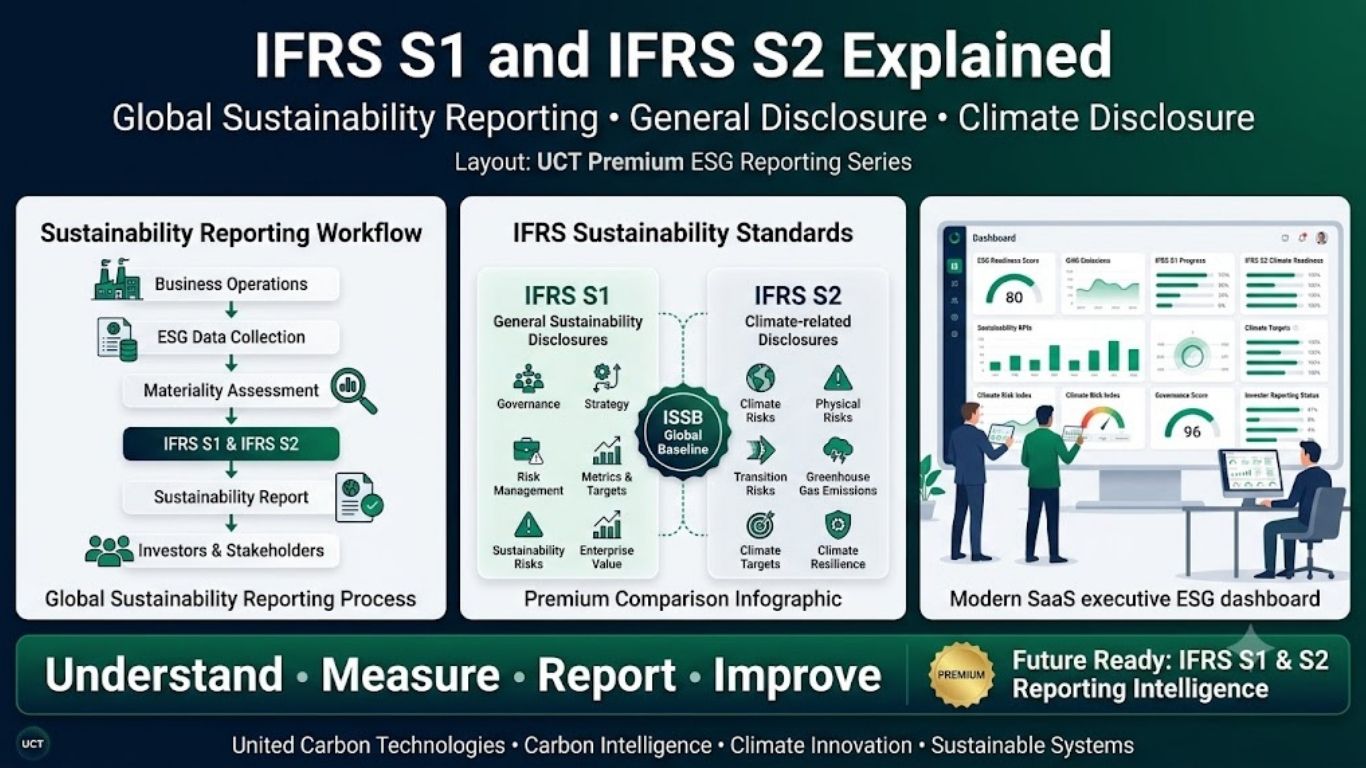
1. What Is IFRS S1?
IFRS S1 establishes the general requirements for disclosing sustainability-related risks and opportunities that could reasonably affect an organization's enterprise value over the short, medium, or long term.
IFRS S1 Covers
- Sustainability governance
- Business strategy
- Risk management
- Sustainability metrics
- Performance targets
- Material sustainability issues
- Decision-useful disclosures
- Enterprise value creation
2. What Is IFRS S2?
IFRS S2 builds on IFRS S1 by focusing specifically on climate-related risks and opportunities. It guides organizations in reporting how climate change may affect business strategy, financial performance, operations, and long-term resilience.
IFRS S2 Covers
- Climate governance
- Climate strategy
- Physical climate risks
- Transition risks
- Climate opportunities
- Greenhouse gas emissions
- Climate targets
- Scenario analysis
Understanding IFRS S1 and IFRS S2 today helps organizations prepare for tomorrow's reporting expectations.
Build a Strong ESG Reporting Foundation
United Carbon Technologies is developing an ESG & Carbon Intelligence Platform designed to help organizations centralize sustainability information, strengthen Carbon Accounting, monitor ESG metrics, and simplify sustainability reporting through intelligent dashboards. Planned capabilities are intended to support organizations preparing for globally recognized sustainability reporting frameworks, including IFRS S1 and IFRS S2 aligned reporting workflows.
3. Key Differences Between IFRS S1 and IFRS S2
Although IFRS S1 and IFRS S2 work together, they address different aspects of sustainability reporting. IFRS S1 provides the overall framework for sustainability-related financial disclosures, while IFRS S2 focuses specifically on climate-related information.
| IFRS S1 | IFRS S2 |
|---|---|
| General sustainability disclosures | Climate-related disclosures |
| All sustainability risks and opportunities | Climate risks and opportunities only |
| Enterprise value focus | Climate resilience focus |
| Applicable across ESG topics | Dedicated climate reporting standard |
| Governance, Strategy, Risk, Metrics | Governance, Strategy, Risk, Metrics & Climate Targets |
- IFRS S1 = The complete sustainability reporting framework.
- IFRS S2 = The climate reporting standard built on IFRS S1.
4. The Four Core Disclosure Pillars
Both IFRS S1 and IFRS S2 follow the same four disclosure pillars, helping organizations create consistent and comparable sustainability reports.
1. Governance
- Board oversight
- Management responsibilities
- Decision-making processes
2. Strategy
- Sustainability risks
- Business opportunities
- Financial impacts
3. Risk Management
- Risk identification
- Risk assessment
- Risk mitigation
4. Metrics & Targets
- ESG KPIs
- Carbon emissions
- Climate targets
- Performance monitoring
These four pillars create a common reporting structure that improves transparency and comparability across organizations.
5. How Businesses Can Prepare
Preparing for IFRS S1 and IFRS S2 begins long before publishing a sustainability report. Organizations should establish reliable governance structures, improve ESG data quality, and integrate sustainability into business planning.
Preparation Checklist
- Assign ESG governance responsibilities.
- Identify material sustainability topics.
- Measure greenhouse gas emissions.
- Improve Carbon Accounting systems.
- Assess climate-related risks.
- Develop sustainability KPIs.
- Strengthen internal controls.
- Review disclosures annually.
6. Common Challenges During Implementation
Many organizations face practical challenges when implementing sustainability reporting frameworks, particularly during the early stages of data collection and governance.
Common Challenges
- Incomplete ESG data
- Manual reporting processes
- Weak Carbon Accounting systems
- Limited sustainability expertise
- Supplier data gaps
- Evolving reporting expectations
- Cross-functional coordination
- Technology limitations
Addressing these challenges early improves reporting quality and supports better business decision-making.
7. Technology's Role in IFRS Reporting
Modern sustainability reporting increasingly depends on technology. Digital ESG platforms help organizations collect, validate, analyze, and visualize sustainability information while reducing manual reporting effort.
Centralized ESG systems improve data consistency, strengthen governance, and simplify executive reporting across multiple business units.
United Carbon Technologies is developing an integrated ESG & Carbon Intelligence Platform to centralize sustainability metrics, Carbon Accounting, executive dashboards, and reporting workflows. Planned capabilities are intended to support organizations preparing for globally recognized sustainability disclosure frameworks, including IFRS S1 and IFRS S2.
8. IFRS S1 & S2 in the Indian Context
Indian businesses are increasingly interacting with international investors, multinational customers, and global supply chains where sustainability disclosures play a growing role. While reporting requirements depend on applicable regulations and business circumstances, understanding IFRS S1 and IFRS S2 helps organizations improve ESG maturity and align with internationally recognized reporting practices.
Businesses that invest in governance, high-quality sustainability data, and climate risk management today are likely to be better prepared for future reporting expectations.
9. Best Practices for High-Quality Sustainability Reporting
- Embed sustainability into business strategy.
- Strengthen board oversight.
- Improve Carbon Accounting accuracy.
- Develop measurable ESG KPIs.
- Standardize reporting processes.
- Improve supplier sustainability data.
- Review disclosures regularly.
- Leverage digital ESG technologies.
10. Building a Future-Ready Reporting System
IFRS S1 and IFRS S2 provide a consistent foundation for sustainability reporting. Rather than treating sustainability as a separate reporting activity, organizations can integrate ESG considerations into governance, strategy, risk management, and performance measurement.
Businesses that strengthen sustainability data today are better positioned to improve transparency, enhance investor confidence, and support long-term value creation.
Simplify ESG Reporting with Better Data
United Carbon Technologies is developing an ESG & Carbon Intelligence Platform to help organizations centralize sustainability information, improve Carbon Accounting, monitor ESG KPIs, and visualize executive dashboards. Our vision is to simplify sustainability reporting while supporting organizations preparing for globally recognized disclosure frameworks.
India Context
As India's sustainability ecosystem continues to mature, organizations that voluntarily strengthen governance, Carbon Accounting, climate disclosures, and ESG reporting capabilities can improve investor confidence and strengthen relationships with global customers and supply chain partners.
What's Next?
Once businesses understand IFRS S1 and IFRS S2, the next steps include implementing materiality assessments, improving Carbon Accounting, developing ESG dashboards, strengthening sustainability governance, and measuring climate-related performance indicators.
Related Reads
- ISSB Standards Explained for Indian Businesses
- Materiality Assessment Explained for ESG Reporting
- Building an ESG Dashboard: Metrics Every Company Should Monitor
- What Is Sustainability Governance?
- How Businesses Improve Carbon Data Quality
- Carbon Accounting Explained
💡 Expert Insight
Successful sustainability reporting depends less on producing a polished report and more on building robust governance, reliable data systems, and clear accountability. Organizations that integrate sustainability into everyday business processes are better equipped to adapt to evolving disclosure expectations and stakeholder demands.
Conclusion
IFRS S1 and IFRS S2 provide organizations with a globally recognized structure for reporting sustainability-related and climate-related financial information. Together, they help businesses improve transparency, communicate material risks and opportunities, and strengthen investor confidence.
By investing in governance, Carbon Accounting, and high-quality ESG data, organizations can build reporting systems that support long-term resilience and sustainable growth.
Quick Summary
- IFRS S1 covers general sustainability disclosures.
- IFRS S2 focuses on climate-related disclosures.
- Both standards use four common disclosure pillars.
- Reliable ESG data improves reporting quality.
- Technology simplifies sustainability reporting.
- Carbon Accounting supports climate disclosures.
- Strong governance strengthens long-term business resilience.
Frequently Asked Questions (FAQs)
1. What is IFRS S1?
It establishes the general requirements for sustainability-related financial disclosures.
2. What is IFRS S2?
It focuses specifically on climate-related financial disclosures.
3. What is the biggest difference between IFRS S1 and IFRS S2?
IFRS S1 covers all sustainability topics, while IFRS S2 is dedicated to climate-related disclosures.
4. Who developed IFRS S1 and IFRS S2?
They were developed by the International Sustainability Standards Board (ISSB).
5. Why are these standards important?
They improve transparency, comparability, and investor-focused sustainability reporting.
6. Do these standards apply only to large companies?
Organizations of different sizes may benefit from understanding them, particularly those with global stakeholders.
7. How does Carbon Accounting support IFRS S2?
Accurate emissions data supports credible climate-related disclosures.
8. How can technology help?
Digital ESG platforms centralize sustainability data and streamline reporting.
9. What should businesses do first?
Establish governance, improve ESG data quality, and identify material sustainability issues.
10. Why should Indian businesses understand IFRS S1 and IFRS S2?
They can improve ESG readiness, support investor confidence, and align with internationally recognized sustainability reporting practices.
Key Takeaways
- IFRS S1 and IFRS S2 form the foundation of ISSB reporting.
- Governance, strategy, risk management, and metrics are central to both standards.
- Reliable ESG and carbon data improve disclosure quality.
- Digital platforms make sustainability reporting more efficient.
- Early preparation strengthens long-term reporting readiness.
Prepare for the Future of Sustainability Reporting
Explore more expert resources from United Carbon Technologies on ISSB Standards, Carbon Accounting, ESG reporting, climate disclosures, and sustainability governance. Stay connected for updates on our upcoming ESG & Carbon Intelligence Platform designed to simplify sustainability data management and executive reporting.