

The Role of AI in Predicting Corporate Carbon Footprints
By United Carbon Technologies | Global Climate & Sustainability Insights
Weekly insights on climate intelligence, carbon accounting, ESG reporting, artificial intelligence, sustainability technology, and Net Zero innovation.
Artificial Intelligence is transforming corporate sustainability by helping organizations move beyond historical carbon reporting toward predictive climate intelligence. By analyzing operational, procurement, energy, and supply chain data, AI can forecast future emissions, identify carbon hotspots, and support proactive decision-making for Net Zero strategies.
How does AI help predict corporate carbon footprints?
AI predicts corporate carbon footprints by analyzing historical emissions, operational activities, energy consumption, procurement data, and supply chain patterns to forecast future greenhouse gas emissions and identify opportunities for carbon reduction before emissions occur.
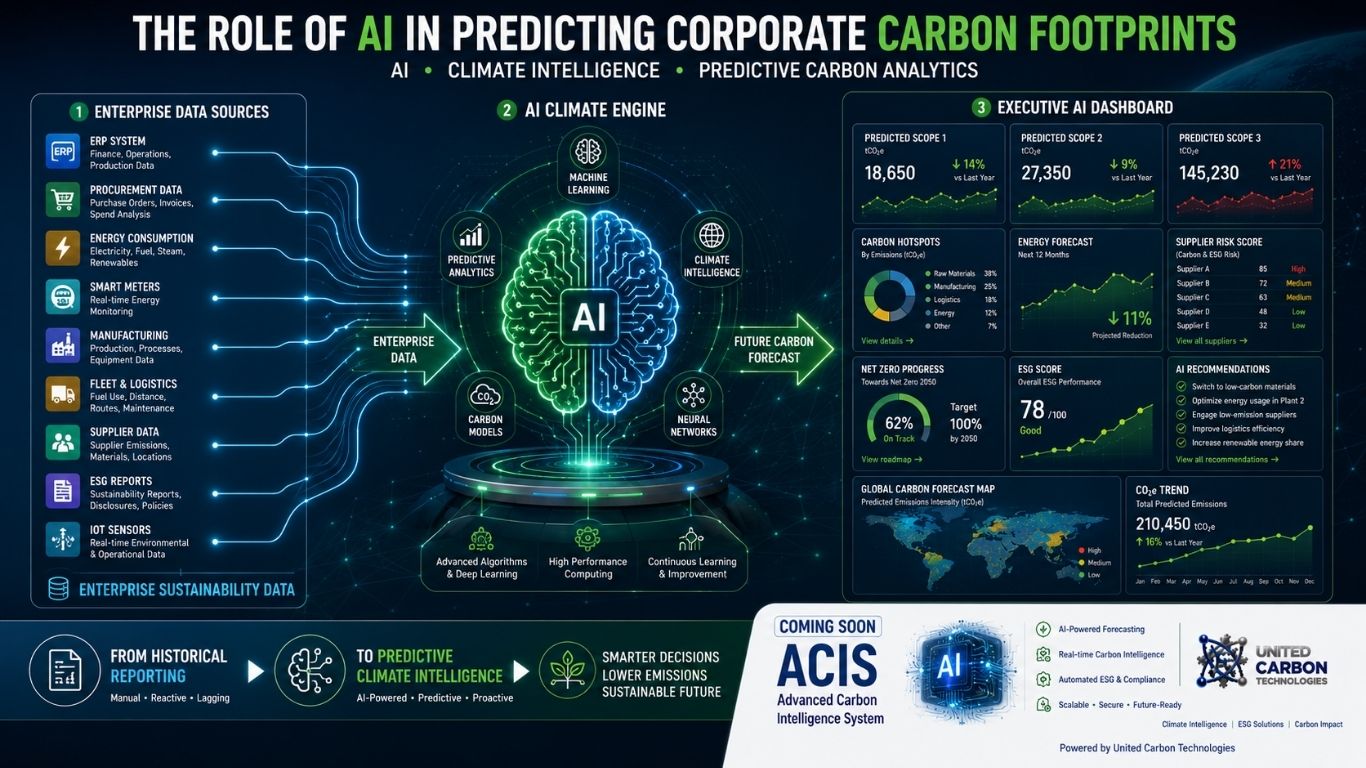
For decades, corporate carbon accounting has focused primarily on measuring historical emissions. Organizations collected activity data, calculated greenhouse gas emissions, published sustainability reports, and then developed reduction plans based on what had already happened.
Today, the rapid advancement of Artificial Intelligence is changing this approach. Instead of simply reporting emissions after the fact, organizations can increasingly predict future carbon footprints, identify emerging risks, and evaluate reduction opportunities before emissions occur.
This shift from carbon reporting to carbon prediction is creating a new category of sustainability technology known as Climate Intelligence. By combining machine learning, predictive analytics, enterprise data, and carbon accounting methodologies, organizations can make sustainability decisions with greater speed, accuracy, and confidence.
For sustainability leaders across North America, Europe, and global markets, AI is becoming a strategic tool for improving emissions forecasting, supplier engagement, energy management, ESG reporting, and Net Zero planning.
Most organizations currently measure carbon emissions using historical data that may be weeks or months old. AI-powered climate intelligence platforms are beginning to enable near real-time emissions forecasting, allowing businesses to anticipate carbon impacts before operational decisions are finalized.
Why Traditional Carbon Accounting Has Limitations
Conventional carbon accounting remains essential for sustainability reporting, but it has a significant limitation—it is largely retrospective. Organizations calculate emissions after energy has been consumed, products have been manufactured, suppliers have delivered goods, and transportation activities have occurred.
This approach creates several challenges:
- Limited ability to prevent emissions before they occur.
- Delayed sustainability decision-making.
- Reactive rather than proactive carbon management.
- Difficulty forecasting future emissions.
- Limited visibility into emerging carbon risks.
- Challenges in evaluating alternative scenarios.
As climate regulations and stakeholder expectations increase, organizations need tools that support forward-looking sustainability strategies rather than simply documenting historical performance.
What Is Predictive Carbon Intelligence?
Predictive carbon intelligence uses Artificial Intelligence, machine learning, advanced analytics, and carbon accounting methodologies to estimate future greenhouse gas emissions based on current and anticipated business activities.
Rather than asking:
“What were our emissions last year?”
Organizations can begin asking:
“What will our emissions look like next quarter, next year, or under different operational scenarios?”
This transition enables sustainability teams to become strategic advisors who help shape future business decisions instead of simply reporting outcomes.
How AI Predicts Corporate Carbon Footprints
Artificial Intelligence predicts future carbon emissions by identifying patterns within large volumes of enterprise data. Unlike traditional reporting tools that summarize past performance, AI continuously analyzes operational information to estimate how future business decisions may affect greenhouse gas emissions.
AI combines historical carbon inventories with real-time business data to generate predictive models that improve as new information becomes available.
Typical AI workflow includes:
- Collect enterprise operational data.
- Clean and standardize information.
- Analyze historical emission trends.
- Identify relationships between business activities and emissions.
- Generate predictive carbon models.
- Continuously improve forecasts using machine learning.
Instead of waiting until the end of a reporting period, organizations can estimate future emissions while business activities are still being planned.
Enterprise Data Used by AI Models
The quality of AI predictions depends on the quality and diversity of the data available. Modern climate intelligence platforms integrate information from multiple business systems to create a comprehensive view of an organization's environmental impact.
Common data sources include:
- Electricity and utility consumption.
- Fuel usage records.
- Manufacturing production volumes.
- ERP and procurement systems.
- Supplier sustainability data.
- Business travel records.
- Fleet and logistics information.
- Building management systems.
- IoT sensors and smart meters.
- Historical Scope 1, Scope 2, and Scope 3 inventories.
By combining these datasets, AI can uncover hidden relationships between operational decisions and carbon emissions that may not be visible through manual analysis.
Predicting Scope 1, Scope 2, and Scope 3 Emissions
One of AI's greatest strengths is its ability to forecast emissions across all three greenhouse gas reporting scopes simultaneously.
Scope 1 Predictions
AI can estimate future direct emissions by analyzing fuel consumption, manufacturing output, industrial processes, company vehicle usage, and equipment performance.
Scope 2 Predictions
Machine learning models forecast electricity-related emissions by considering expected energy demand, seasonal consumption patterns, production schedules, renewable energy availability, and regional electricity grid emission factors.
Scope 3 Predictions
Scope 3 forecasting is more complex because it extends across the value chain. AI models evaluate procurement activities, supplier behavior, transportation routes, logistics performance, product demand, and purchasing trends to estimate future upstream and downstream emissions.
Predicting Scope 3 emissions enables organizations to identify high-carbon suppliers, evaluate procurement alternatives, and reduce supply chain emissions before purchasing decisions are finalized.
Machine Learning Models Used in Climate Intelligence
Different machine learning techniques are applied depending on the type of sustainability challenge being addressed. Rather than relying on a single algorithm, enterprise climate intelligence platforms often combine multiple AI models to improve prediction accuracy.
Common approaches include:
- Time-series forecasting for future emissions.
- Regression models for carbon estimation.
- Anomaly detection to identify unusual energy consumption.
- Classification models for sustainability risk assessment.
- Neural networks for complex emissions forecasting.
- Scenario modeling for Net Zero planning.
- Optimization algorithms for energy efficiency.
- Natural Language Processing (NLP) for ESG document analysis.
These technologies allow sustainability teams to move beyond spreadsheets and leverage advanced analytics to support strategic climate decisions.
Reliable emissions forecasting begins with accurate operational and sustainability data. Organizations that strengthen their carbon accounting processes today will be better positioned to benefit from AI-powered climate intelligence tomorrow.
United Carbon Technologies helps organizations strengthen carbon accounting, ESG reporting, climate data management, and sustainability strategies—building the data foundation required for next-generation AI-powered climate intelligence.
Real-World Applications of AI in Corporate Sustainability
Artificial Intelligence is already helping organizations make sustainability decisions faster and with greater confidence. Rather than replacing sustainability professionals, AI enhances their ability to analyze complex datasets, identify risks, and recommend actions that reduce greenhouse gas emissions.
Across industries, AI is being applied to improve both operational efficiency and environmental performance.
Common enterprise applications include:
- Real-time carbon footprint monitoring.
- Automated Scope 1, Scope 2, and Scope 3 calculations.
- Energy demand forecasting.
- Supplier sustainability assessment.
- Carbon hotspot identification.
- Predictive maintenance for energy-intensive equipment.
- Fleet route optimization.
- Renewable energy planning.
- ESG reporting automation.
- Climate risk forecasting.
These capabilities enable sustainability teams to shift from manual reporting toward continuous environmental performance management.
AI, IoT, and Digital Twins: The Future of Climate Intelligence
The next generation of sustainability platforms will combine Artificial Intelligence with Internet of Things (IoT) devices, smart meters, satellite data, and digital twins to create highly accurate, real-time representations of corporate operations.
A digital twin is a virtual model of a physical asset, facility, or process that continuously receives operational data. When combined with AI, digital twins can simulate how changes in production, energy consumption, logistics, or procurement may affect future carbon emissions.
For example, manufacturers can model how replacing a supplier, upgrading machinery, or switching to renewable electricity would influence their carbon footprint before implementing the change.
Potential benefits include:
- Continuous emissions forecasting.
- Scenario analysis for sustainability planning.
- Predictive energy optimization.
- Reduced operational costs.
- Improved regulatory compliance.
- Better investment decision-making.
- Enhanced climate resilience.
- Accelerated progress toward Net Zero targets.
Challenges of Using AI for Carbon Prediction
While AI offers tremendous opportunities, successful implementation requires more than sophisticated algorithms. Accurate predictions depend on reliable data, transparent methodologies, and strong governance.
Organizations should consider several challenges before deploying AI-powered climate intelligence solutions.
- Incomplete or inconsistent emissions data.
- Poor data integration across enterprise systems.
- Limited supplier transparency.
- Differences in emission factor databases.
- AI model bias and uncertainty.
- Cybersecurity and data privacy concerns.
- Need for explainable and auditable AI outputs.
- Changing sustainability regulations.
To build trust, AI-generated emissions estimates should always be supported by recognized carbon accounting standards, documented assumptions, and expert review.
How ACIS Is Envisioned to Bring AI and Carbon Intelligence Together
At United Carbon Technologies, we believe the future of sustainability lies at the intersection of carbon accounting, artificial intelligence, and climate intelligence. Our upcoming Advanced Carbon Intelligence System (ACIS) is being envisioned to help organizations move beyond static reporting toward intelligent, data-driven climate management.
Rather than functioning as a traditional reporting tool, ACIS is being designed to integrate enterprise sustainability data into a unified platform capable of delivering predictive insights and actionable recommendations.
Future capabilities planned for ACIS include:
- AI-assisted Scope 1, Scope 2, and Scope 3 calculations.
- Predictive corporate carbon footprint forecasting.
- Enterprise energy analytics dashboards.
- Supplier carbon performance monitoring.
- Climate risk intelligence.
- Automated ESG reporting support.
- Carbon hotspot identification.
- Net Zero scenario modeling.
- Executive sustainability dashboards.
- AI-generated carbon reduction recommendations.
By combining advanced analytics with internationally recognized carbon accounting methodologies, ACIS aims to help organizations make faster, smarter, and more informed sustainability decisions.
Related Reads
- How Companies Calculate Their Corporate Carbon Footprint
- How ESG Software Simplifies Sustainability Reporting
- How to Calculate Scope 3 Category 1 (Purchased Goods) Emissions
- Understanding Scope 1, Scope 2 & Scope 3 Emissions
- Understanding EU's CBAM Transitional Phase Requirements
- Carbon Border Adjustment Mechanism (CBAM) Explained
- AI is transforming carbon accounting from historical reporting to predictive climate intelligence.
- Machine learning analyzes enterprise data to forecast future greenhouse gas emissions.
- AI supports Scope 1, Scope 2, and Scope 3 emissions prediction.
- IoT devices, smart meters, and digital twins enhance real-time emissions forecasting.
- Predictive analytics help organizations identify carbon hotspots before emissions occur.
- High-quality enterprise data is essential for accurate AI-driven sustainability insights.
- Responsible AI requires transparency, governance, and alignment with recognized carbon accounting standards.
- ACIS is being developed by United Carbon Technologies to combine AI, carbon accounting, and climate intelligence into a unified enterprise platform.
Frequently Asked Questions (FAQs)
1. How does AI predict corporate carbon footprints?
AI analyzes historical emissions, energy consumption, procurement records, operational activities, supply chain data, and other enterprise information to forecast future greenhouse gas emissions and identify opportunities for carbon reduction.
2. Is AI replacing traditional carbon accounting?
No. AI complements traditional carbon accounting by improving data analysis, automating calculations, identifying trends, and providing predictive insights. Organizations still rely on established carbon accounting standards such as the Greenhouse Gas Protocol for reporting.
3. What types of data are needed for AI-powered carbon prediction?
AI models typically use electricity consumption, fuel usage, procurement data, supplier information, manufacturing output, transportation records, business travel, smart meter data, IoT sensor data, and historical emissions inventories.
4. Can AI predict Scope 3 emissions?
Yes. AI can analyze procurement activities, supplier performance, logistics, and purchasing patterns to estimate future Scope 3 emissions and identify supply chain carbon hotspots.
5. How accurate are AI-based carbon forecasts?
Accuracy depends on the quality, completeness, and consistency of the underlying data. Organizations with robust carbon accounting systems and reliable operational data typically achieve more accurate predictions.
6. Which industries benefit most from AI-driven climate intelligence?
Manufacturing, technology, logistics, retail, energy, automotive, pharmaceuticals, construction, and financial services can all benefit from AI-powered carbon forecasting and sustainability analytics.
7. What is a digital twin in sustainability?
A digital twin is a virtual representation of a physical asset, facility, or process. Combined with AI, digital twins can simulate operational changes and predict their impact on future carbon emissions before decisions are implemented.
8. Can AI improve ESG reporting?
Yes. AI can automate data collection, validate emissions information, generate sustainability dashboards, support regulatory reporting, and identify reporting gaps, making ESG disclosures more efficient and reliable.
9. What are the biggest challenges of using AI for carbon management?
Organizations often face challenges related to data quality, system integration, supplier transparency, AI governance, cybersecurity, regulatory compliance, and ensuring that AI-generated insights remain transparent and explainable.
10. How is United Carbon Technologies contributing to AI-powered climate intelligence?
United Carbon Technologies is developing the Advanced Carbon Intelligence System (ACIS), an AI-powered platform designed to simplify enterprise carbon accounting, predictive emissions analytics, ESG reporting, climate intelligence, and sustainability decision-making.
The Future of Sustainability Is Intelligent
Artificial Intelligence is transforming how organizations understand, predict, and reduce their environmental impact. As businesses move from static carbon reporting to predictive climate intelligence, access to reliable knowledge and innovative tools becomes a competitive advantage.
Explore practical insights on AI, carbon accounting, ESG reporting, Scope 1, Scope 2 & Scope 3 emissions, climate technology, Net Zero strategies, and enterprise sustainability through United Carbon Technologies' growing global knowledge hub.
Whether you're leading sustainability initiatives, building climate-tech solutions, or preparing your organization for the future of ESG, continuous learning is the first step toward smarter climate decisions.
Predict Better. Act Smarter. Build a Low-Carbon Future.
✔ AI & Climate Intelligence Insights | ✔ Global ESG & Carbon Accounting Resources | ✔ Early Access to ACIS Climate Intelligence Platform | ✔ Join a Global Sustainability Community