

Understanding the EU's CBAM Transitional Phase Requirements: A Complete Guide for Global Exporters
By United Carbon Technologies | Climate Knowledge Hub Global
Stay updated on CBAM, ESG reporting, carbon accounting, Net Zero, climate regulations, and global sustainability compliance.
The European Union's Carbon Border Adjustment Mechanism (CBAM) is transforming international trade by introducing carbon reporting requirements for imported goods. During the transitional phase, exporters worldwide—including companies in the United States, India, the Middle East, and Asia—must understand new quarterly reporting obligations, embedded emissions calculations, and supplier data requirements to remain competitive in the European market.
What are the EU CBAM transitional phase requirements?
The EU CBAM transitional phase requires importers of covered goods to submit quarterly reports detailing embedded greenhouse gas emissions, production methods, and carbon pricing information. Although no CBAM certificates are purchased during this phase, accurate emissions reporting is mandatory and helps businesses prepare for the permanent CBAM system.
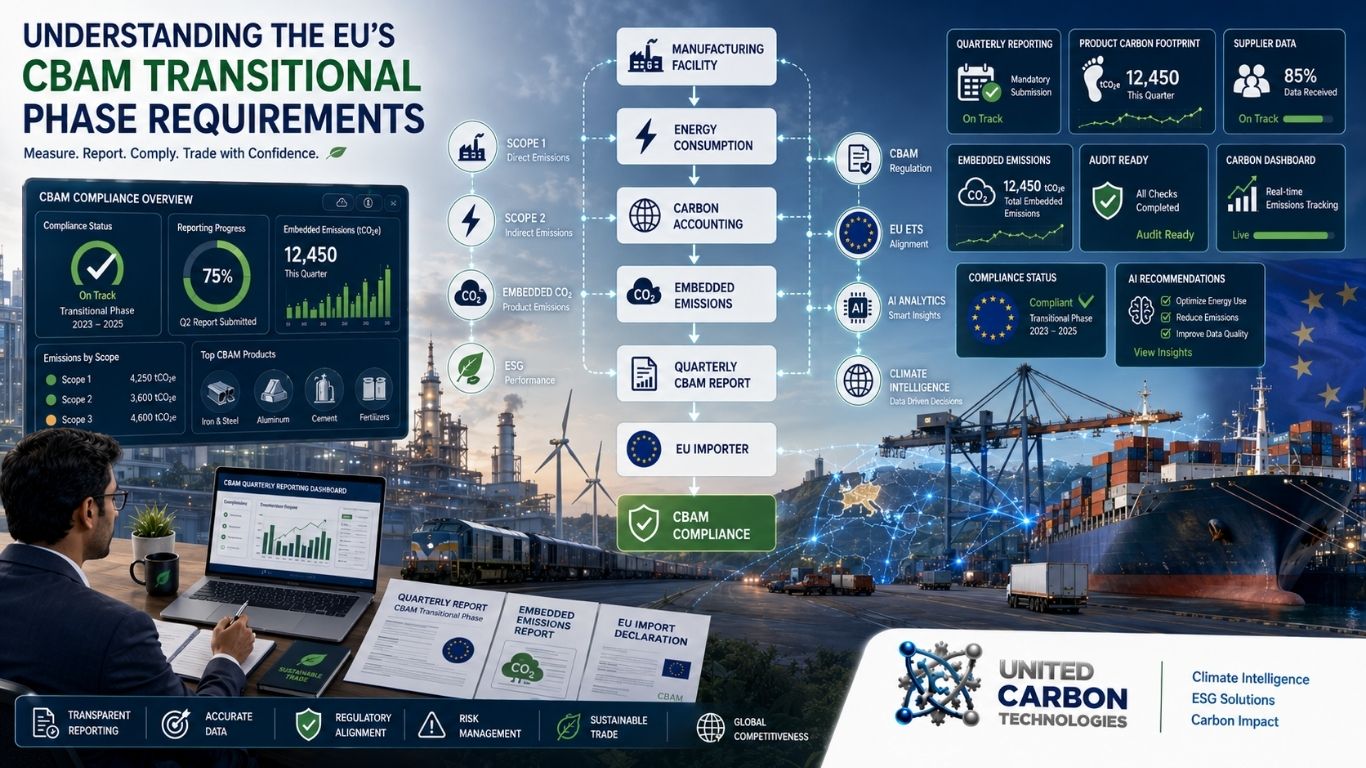
The European Union is reshaping global trade through climate policy. As carbon emissions become an increasingly important factor in international commerce, businesses exporting products into the EU must now account not only for quality and price but also for the carbon emissions embedded in their goods.
The Carbon Border Adjustment Mechanism (CBAM) is one of the world's first large-scale carbon border policies. It aims to create a level playing field between European manufacturers, who already pay for carbon emissions under the EU Emissions Trading System (EU ETS), and overseas producers exporting into the European market.
Although the current transitional phase does not yet require businesses to purchase CBAM certificates, it introduces mandatory reporting obligations that require exporters, manufacturers, suppliers, and EU importers to collect accurate emissions data and establish robust carbon accounting processes. Organizations that begin preparing now will face fewer compliance challenges when the permanent CBAM system takes full effect.
The CBAM transitional phase is often described as the world's largest "learning period" for carbon reporting. During this phase, companies are expected to develop reliable systems for measuring embedded emissions, engaging suppliers, and improving data quality before financial obligations begin under the permanent CBAM regime.
What Is the Carbon Border Adjustment Mechanism (CBAM)?
The Carbon Border Adjustment Mechanism (CBAM) is a European Union climate policy designed to place a carbon price on certain imported goods. It ensures that products manufactured outside the EU face carbon costs comparable to those paid by European manufacturers operating under the EU Emissions Trading System (EU ETS).
The primary objective of CBAM is to reduce the risk of carbon leakage—a situation where production shifts to countries with less stringent climate regulations, resulting in higher global emissions rather than genuine emission reductions.
By requiring importers to report embedded emissions and, eventually, purchase CBAM certificates, the EU aims to encourage cleaner manufacturing practices across global supply chains while maintaining fair competition for European industries.
Why Was CBAM Introduced?
As the European Union strengthens its climate ambitions under the European Green Deal, domestic industries are subject to increasingly stringent carbon pricing through the EU ETS. Without CBAM, manufacturers could relocate production to regions with lower environmental standards or import carbon-intensive products from countries without equivalent climate policies.
CBAM addresses this challenge by encouraging transparency in greenhouse gas emissions and creating incentives for businesses worldwide to improve carbon efficiency. Rather than acting solely as a trade measure, CBAM is intended to accelerate global decarbonization while supporting the EU's goal of achieving climate neutrality by 2050.
What Is the CBAM Transitional Phase?
The CBAM Transitional Phase serves as an implementation and learning period for both businesses and regulators. During this stage, importers of covered products into the European Union must submit detailed quarterly reports on embedded greenhouse gas emissions, but they are not yet required to purchase CBAM certificates.
This reporting-only period allows companies to:
- Develop carbon accounting systems.
- Collect emissions data from production facilities.
- Engage suppliers across global value chains.
- Improve data quality and reporting accuracy.
- Understand embedded emissions methodologies.
- Prepare for future financial obligations under CBAM.
For exporters outside the European Union, the transitional phase is the ideal opportunity to establish reliable emissions measurement processes before compliance requirements become more stringent.
CBAM Implementation Timeline
Key Milestones
- October 2023 – CBAM Transitional Phase begins.
- 2024–2025 – Quarterly reporting of embedded emissions continues.
- 2025 – Businesses strengthen emissions monitoring, supplier engagement, and reporting systems.
- January 2026 – Permanent CBAM system begins with financial obligations and CBAM certificate purchases.
- 2026–2034 – Progressive expansion alongside the gradual phase-out of free EU ETS allowances.
For global exporters, the transition period should not be viewed as a delay but as a strategic preparation window. Companies that invest in carbon accounting, emissions data management, and digital reporting today will be significantly better positioned when the permanent CBAM framework becomes fully operational.
Who Must Comply with CBAM During the Transitional Phase?
One of the most common misconceptions about CBAM is that it only affects European companies. In reality, the regulation impacts businesses across global supply chains because EU importers depend on emissions data from their overseas suppliers to complete mandatory quarterly CBAM reports.
If your organization manufactures products that are exported to customers within the European Union, you will likely be asked to provide detailed information about your production processes, energy consumption, and embedded greenhouse gas emissions.
Even though the legal reporting obligation rests with the EU importer during the transitional phase, exporters that cannot provide accurate emissions data risk losing competitiveness and preferred supplier status.
Which Products Are Currently Covered by CBAM?
During the transitional period, CBAM applies to selected carbon-intensive sectors that are considered at high risk of carbon leakage. These industries represent the first phase of implementation and may expand in the future.
Current CBAM Sectors
- Steel and Iron
- Aluminium
- Cement
- Fertilisers
- Hydrogen
- Electricity
Within these sectors, hundreds of individual product classifications (CN codes) may be covered. Companies should verify whether their exported products fall within the applicable CBAM categories before determining reporting obligations.
Which Exporters Are Most Affected?
Although CBAM is a European Union regulation, its effects extend far beyond Europe. Exporters from many of the world's largest manufacturing economies are already being asked to provide emissions information to their European customers.
United States Exporters
American manufacturers exporting steel, aluminium, hydrogen, or other covered products into the European Union should establish robust greenhouse gas accounting systems to support customer reporting requirements and maintain access to European markets.
Indian Exporters
India is one of the largest exporters of steel, aluminium, engineering products, and industrial materials to Europe. Companies without reliable carbon accounting systems may face increasing pressure from buyers requesting verified emissions information.
Middle East Exporters
Producers of aluminium, fertilisers, petrochemicals, and energy-intensive products across the Middle East are also preparing for increased emissions reporting as European customers seek transparent supply chain data.
Asian Manufacturers
Manufacturers throughout China, Japan, South Korea, Vietnam, Indonesia, Thailand, and other Asian economies supplying carbon-intensive goods to Europe are strengthening emissions monitoring and sustainability reporting capabilities.
Regardless of location, businesses exporting covered products into the EU should treat CBAM reporting as an emerging customer requirement rather than simply a regulatory obligation.
Responsibilities of EU Importers and Non-EU Manufacturers
Understanding the division of responsibilities is essential during the transitional phase.
| EU Importer | Non-EU Manufacturer / Exporter |
|---|---|
| Submit quarterly CBAM reports to EU authorities. | Provide accurate emissions data and production information. |
| Ensure reporting deadlines are met. | Maintain reliable activity and energy records. |
| Request emissions information from suppliers. | Calculate embedded emissions using approved methodologies. |
| Maintain compliance documentation. | Support customers with transparent emissions reporting. |
Strong collaboration between importers and manufacturers is essential for accurate and timely CBAM reporting.
How CBAM Is Changing Global Supply Chains
CBAM is accelerating a major shift in global procurement practices. Instead of evaluating suppliers solely on cost, quality, and delivery performance, European buyers are increasingly considering carbon transparency and emissions performance when selecting suppliers.
Businesses that can demonstrate reliable emissions data and proactive sustainability management are likely to become preferred partners as climate-related procurement requirements continue to expand.
Many multinational organizations are already requesting:
- Corporate carbon footprints.
- Product carbon footprints.
- Supplier ESG information.
- Scope 1, Scope 2, and Scope 3 emissions.
- Energy consumption records.
- Renewable energy usage.
- Third-party sustainability certifications.
- Climate risk disclosures.
CBAM is therefore driving broader improvements in supply chain transparency and climate governance across international trade.
Not Sure Whether Your Exports Fall Under CBAM?
Whether you manufacture steel, aluminium, cement, fertilisers, hydrogen, or other industrial products, understanding your CBAM obligations starts with accurate carbon accounting. United Carbon Technologies helps exporters identify reporting requirements, calculate embedded emissions, prepare supplier data, and build CBAM-ready reporting systems.
CBAM Transitional Phase Reporting Requirements
The transitional phase of the Carbon Border Adjustment Mechanism is designed to familiarize businesses with the new reporting framework before financial obligations begin. Although importers are not yet required to purchase CBAM certificates, they must submit accurate quarterly reports containing detailed information about the carbon emissions embedded in imported goods.
For exporters, this means developing reliable carbon accounting systems, collecting production data, and working closely with EU customers to ensure accurate reporting.
Organizations that establish robust reporting processes during the transitional period will be significantly better prepared for the permanent CBAM system beginning in 2026.
What Information Must Be Reported?
Each quarterly CBAM report requires detailed emissions information for every covered product imported into the European Union. The objective is to provide transparency regarding the greenhouse gas emissions generated during production.
Typical reporting information includes:
- Type of imported product.
- Product classification (CN code).
- Country of origin.
- Manufacturing facility information.
- Quantity imported.
- Production process description.
- Direct greenhouse gas emissions.
- Indirect emissions from electricity consumption.
- Embedded emissions per tonne of product.
- Carbon price already paid in the country of production (where applicable).
Accurate reporting depends on collaboration between manufacturers, suppliers, and EU importers to ensure complete and verifiable emissions data.
Understanding Embedded Emissions
At the heart of CBAM reporting is the concept of embedded emissions. These represent the greenhouse gases emitted during the production of imported goods before they reach the European Union.
Embedded emissions generally include two categories:
Direct Emissions
Direct emissions originate from manufacturing activities within the production facility.
- Fuel combustion
- Industrial processes
- Production equipment
- Company-owned boilers
- Industrial furnaces
- On-site generators
Indirect Emissions
Indirect emissions primarily result from purchased electricity used during manufacturing.
- Grid electricity consumption
- Purchased steam
- Purchased heating
- Purchased cooling (where applicable)
Understanding both direct and indirect emissions is essential because they collectively determine the carbon intensity of exported products.
Default Values vs Actual Emissions
During the early stages of CBAM implementation, the European Commission has allowed the use of default emission values under specific circumstances. However, these are intended only as temporary solutions.
Businesses are strongly encouraged to transition toward reporting actual facility-level emissions as quickly as possible.
| Default Values | Actual Values |
|---|---|
| Estimated using published reference values. | Calculated using actual production data. |
| Useful for limited transitional situations. | Preferred for long-term compliance. |
| Less representative of facility performance. | Reflects real operational emissions. |
| May become unavailable in future reporting periods. | Supports permanent CBAM compliance. |
Organizations that invest in measuring actual emissions now will reduce future compliance risks while demonstrating stronger sustainability performance to customers and regulators.
Collecting accurate emissions data, calculating embedded carbon, and meeting CBAM reporting requirements can be complex—especially across multiple facilities and suppliers. United Carbon Technologies helps organizations build reliable carbon accounting systems, automate emissions calculations, and prepare audit-ready reports for CBAM, ESG, and sustainability compliance.
Monitoring Methodologies and Data Collection
Reliable CBAM reporting begins with systematic data collection from manufacturing operations. Companies should establish standardized procedures for capturing production activity, energy consumption, fuel usage, raw material inputs, and process emissions throughout each reporting period.
Typical sources of emissions data include:
- Electricity bills and utility records.
- Fuel purchase invoices.
- Production logs.
- Manufacturing execution systems (MES).
- Enterprise Resource Planning (ERP) systems.
- Energy monitoring systems.
- Supplier declarations.
- Laboratory measurements where applicable.
Digital data collection significantly improves reporting accuracy while reducing manual effort and the risk of reporting inconsistencies.
Supporting Documentation and Record Keeping
Companies should maintain comprehensive records supporting every reported emissions value. Well-organized documentation simplifies audits, improves transparency, and strengthens confidence among EU customers.
Recommended documentation includes:
- Energy consumption records.
- Fuel invoices.
- Production volumes.
- Equipment operating hours.
- Emission factor references.
- Supplier emissions declarations.
- Calculation methodologies.
- Internal review procedures.
Maintaining organized records today will make future verification and compliance significantly easier.
Common CBAM Reporting Mistakes
Many organizations underestimate the complexity of emissions reporting during the transitional phase. The most common challenges are related to data quality, inconsistent methodologies, and incomplete supplier information.
Businesses should avoid these common mistakes:
- Using incomplete production data.
- Applying incorrect emission factors.
- Ignoring indirect electricity emissions.
- Relying permanently on default values.
- Failing to engage suppliers early.
- Using inconsistent calculation methods across facilities.
- Poor documentation and record keeping.
- Submitting reports after quarterly deadlines.
Investing in strong carbon accounting processes during the transitional phase helps organizations minimize compliance risks and prepares them for the permanent CBAM system, where reporting accuracy will have direct financial implications.
Preparing for Full CBAM Implementation
The CBAM transitional phase is more than a reporting exercise—it is an opportunity for businesses to build the systems, processes, and expertise required for long-term compliance. Beginning in 2026, the Carbon Border Adjustment Mechanism enters its definitive phase, where importers will not only report emissions but also purchase CBAM certificates based on the embedded carbon emissions of imported goods.
Organizations that establish robust carbon accounting practices today will be better positioned to manage future compliance costs, strengthen customer relationships, and remain competitive in international markets.
Preparation should extend beyond regulatory reporting and become part of a broader sustainability and business strategy.
Understanding the Permanent CBAM System
Under the permanent CBAM regime, EU importers will gradually be required to purchase CBAM certificates that reflect the carbon emissions embedded in imported products. The number of certificates required will depend on the verified emissions associated with each product and the prevailing carbon price under the EU Emissions Trading System (EU ETS).
If a carbon price has already been paid in the country where the product was manufactured, businesses may be eligible for adjustments, provided sufficient documentation is available.
This makes accurate emissions measurement, transparent reporting, and reliable documentation essential for minimizing compliance costs.
How Businesses Should Prepare Today
Rather than waiting for financial obligations to begin, exporters should use the transitional period to strengthen their carbon management capabilities. Early preparation reduces compliance risks while improving operational efficiency and supply chain transparency.
Key actions include:
- Establish a corporate carbon accounting program.
- Measure Scope 1 and Scope 2 emissions accurately.
- Begin collecting relevant Scope 3 supplier data.
- Calculate product-level embedded emissions.
- Standardize emissions calculation methodologies.
- Create centralized sustainability data systems.
- Train internal ESG and compliance teams.
- Conduct internal reporting audits.
- Engage suppliers early to improve emissions transparency.
- Monitor updates to EU CBAM regulations.
Businesses that treat CBAM as a strategic transformation rather than simply another reporting requirement will gain a competitive advantage in global markets.
Supplier Engagement Is Becoming a Competitive Advantage
CBAM has significantly increased the importance of supplier collaboration. European importers now require reliable emissions data from manufacturers, while manufacturers increasingly depend on their own suppliers to calculate embedded emissions accurately.
Forward-looking organizations are therefore integrating sustainability into procurement processes by requesting:
- Supplier carbon footprints.
- Product carbon footprints.
- Energy consumption information.
- Renewable electricity data.
- Manufacturing process emissions.
- Environmental certifications.
- Climate commitments and Net Zero targets.
- Verified emissions documentation.
Companies with transparent supply chains will be better positioned to meet growing customer expectations and future regulatory requirements.
CBAM is only the beginning of a broader shift toward carbon transparency in international trade. United Carbon Technologies helps organizations prepare for CBAM, ESG reporting, carbon accounting, product carbon footprints, and Net Zero strategies with expert consulting and technology-driven solutions.
The Role of Digital Carbon Accounting and Climate Intelligence
Managing CBAM compliance through spreadsheets and manual calculations quickly becomes difficult as reporting requirements expand across products, facilities, suppliers, and international markets. Digital carbon accounting platforms provide organizations with a scalable and reliable way to automate emissions measurement and sustainability reporting.
Modern climate technology platforms can support:
- Corporate Carbon Footprint calculations.
- Product Carbon Footprint assessments.
- Scope 1, Scope 2, and Scope 3 accounting.
- Embedded emissions calculations.
- Supplier emissions management.
- Automated ESG reporting.
- BRSR and sustainability disclosures.
- Audit-ready documentation.
- Executive sustainability dashboards.
- Real-time emissions analytics.
By digitizing carbon data, organizations improve reporting accuracy, reduce administrative effort, and gain valuable insights for long-term sustainability planning.
How ACIS Can Simplify CBAM Compliance
At United Carbon Technologies, we are developing the Advanced Carbon Intelligence System (ACIS) to help businesses move beyond manual reporting toward intelligent, AI-powered carbon management.
ACIS is designed to support organizations throughout their sustainability journey—from emissions measurement to executive decision-making—while simplifying compliance with emerging regulations such as CBAM.
Future ACIS capabilities include:
- Corporate Carbon Footprint Calculator.
- Product Carbon Footprint Calculator.
- Scope 1, Scope 2 & Scope 3 Accounting.
- CBAM Reporting Dashboard.
- Embedded Emissions Calculator.
- Supplier Data Collection Portal.
- ESG & Sustainability Reporting.
- AI-powered Compliance Alerts.
- Climate Intelligence Analytics.
- Executive Sustainability Dashboards.
- Net Zero Progress Tracking.
- Audit-ready Reports.
As climate regulations continue to evolve worldwide, organizations that adopt intelligent carbon management platforms will be better equipped to manage compliance, reduce emissions, strengthen customer trust, and compete in the emerging low-carbon economy.
Related Reads
- Carbon Border Adjustment Mechanism (CBAM) Explained for Exporters
- How Companies Calculate Their Corporate Carbon Footprint
- What Is Carbon Accounting? A Complete Guide
- Understanding Scope 1, Scope 2 & Scope 3 Emissions
- ESG Reporting Explained: A Complete Business Guide
- Product Carbon Footprint Explained
- Carbon Reporting Software: What Businesses Should Look For
- How ESG Ratings Are Calculated
- What is Biodiversity Loss And Why Does It Matter
- CBAM's transitional phase focuses on mandatory quarterly emissions reporting rather than carbon payments.
- Exporters supplying covered goods to the EU must provide accurate embedded emissions data to their customers.
- Preparing early helps businesses avoid future compliance risks and maintain market access.
- Reliable carbon accounting is becoming essential for international trade.
- Supplier engagement and emissions transparency are now competitive advantages.
- Digital carbon accounting platforms simplify CBAM reporting and improve data quality.
- AI and climate intelligence will play an increasingly important role in sustainability compliance.
- ACIS is being developed to help organizations automate CBAM reporting, carbon accounting, ESG disclosures, and climate intelligence.
Frequently Asked Questions (FAQs)
1. What is the EU CBAM transitional phase?
The CBAM transitional phase is the initial implementation period of the European Union's Carbon Border Adjustment Mechanism. During this phase, importers of covered goods must submit quarterly reports on embedded greenhouse gas emissions without purchasing CBAM certificates. It allows businesses to build carbon accounting systems before the permanent CBAM regime begins.
2. Which products are covered under CBAM?
The current CBAM scope includes cement, iron and steel, aluminium, fertilisers, hydrogen, and electricity. The European Union may expand the list of covered sectors in the future as the mechanism evolves.
3. Who is responsible for submitting CBAM reports?
EU importers are legally responsible for submitting quarterly CBAM reports. However, non-EU manufacturers and exporters must provide accurate emissions data, production information, and supporting documentation to help importers meet their reporting obligations.
4. What are embedded emissions under CBAM?
Embedded emissions are the greenhouse gas emissions generated during the production of imported goods. They include direct emissions from manufacturing processes and, in many cases, indirect emissions associated with purchased electricity used during production.
5. Does the CBAM transitional phase require businesses to pay a carbon tax?
No. During the transitional phase, businesses are only required to report emissions data. Financial obligations begin when the permanent CBAM system comes into force and importers must purchase CBAM certificates based on verified embedded emissions.
6. Why should exporters prepare for CBAM now?
Preparing early helps businesses establish reliable carbon accounting systems, improve supplier engagement, collect accurate emissions data, and avoid compliance challenges once CBAM financial obligations become mandatory.
7. How does CBAM affect exporters outside Europe?
Exporters in the United States, India, China, the Middle East, and other regions supplying covered products to the European Union must provide emissions information to their EU customers. Businesses with transparent carbon reporting will be better positioned to maintain market access and strengthen customer relationships.
8. What data is needed for CBAM reporting?
CBAM reporting typically requires product details, production quantities, manufacturing information, direct emissions, indirect electricity emissions, embedded carbon calculations, and any carbon price already paid in the country of origin.
9. Can carbon accounting software help with CBAM compliance?
Yes. Carbon accounting platforms automate emissions calculations, supplier data collection, embedded emissions reporting, ESG reporting, audit-ready documentation, and executive dashboards, making CBAM compliance significantly more efficient and accurate.
10. How can United Carbon Technologies help businesses prepare for CBAM?
United Carbon Technologies is developing the Advanced Carbon Intelligence System (ACIS) to help organizations calculate corporate and product carbon footprints, manage Scope 1, Scope 2, and Scope 3 emissions, automate CBAM reporting, improve ESG disclosures, and gain AI-powered climate intelligence for global sustainability compliance.
Start Your Climate Knowledge Journey Today
Global climate regulations like CBAM are changing the future of international trade. Whether you're an exporter, manufacturer, sustainability professional, business leader, student, or policy enthusiast, understanding carbon accounting and climate compliance today will help you stay competitive tomorrow.
Join thousands of learners exploring practical topics such as CBAM, carbon accounting, Scope 1, Scope 2 & Scope 3 emissions, ESG reporting, product carbon footprints, Net Zero strategies, climate technology, AI-powered sustainability, and international climate regulations through India's growing Climate Knowledge Hub with a global perspective.
Organizations that understand and measure their carbon emissions will be better prepared for evolving regulations, supply chain expectations, investor requirements, and the transition toward a low-carbon global economy.
Measure Today. Reduce Tomorrow. Lead the Low-Carbon Economy.
✔ Free Climate Learning Resources | ✔ Weekly ESG & Climate Compliance Insights | ✔ Early Access to ACIS Climate Intelligence Platform | ✔ Join the Global Community Driving the Low-Carbon Economy