

Transition Finance Explained: Funding the Net Zero Economy
Learn what Transition Finance is, why it matters, how it differs from Green Finance, and how businesses can finance their journey toward a Net Zero economy.
By United Carbon Technologies | Climate Knowledge Hub India
Published: July 2026 | Last Updated: July 2026 | 15 min read
Join professionals learning about ESG Reporting, Sustainable Finance, Carbon Accounting, Climate Risk, Net Zero, and Climate Intelligence.
Achieving a Net Zero economy requires trillions of dollars in investment—not only in renewable energy but also in helping existing industries reduce emissions over time. This is where Transition Finance plays a critical role.
Unlike Green Finance, which primarily funds environmentally sustainable projects, Transition Finance supports organizations in carbon-intensive sectors as they implement credible strategies to reduce emissions, improve efficiency, and transition toward low-carbon business models.
As governments, financial institutions, and investors increasingly prioritize climate action, understanding Transition Finance is becoming essential for businesses planning long-term sustainability and climate strategies.
Featured Snippet
Transition Finance refers to financial products and investments that help carbon-intensive businesses reduce greenhouse gas emissions and transition toward a low-carbon or Net Zero economy through credible decarbonization plans and measurable sustainability improvements.
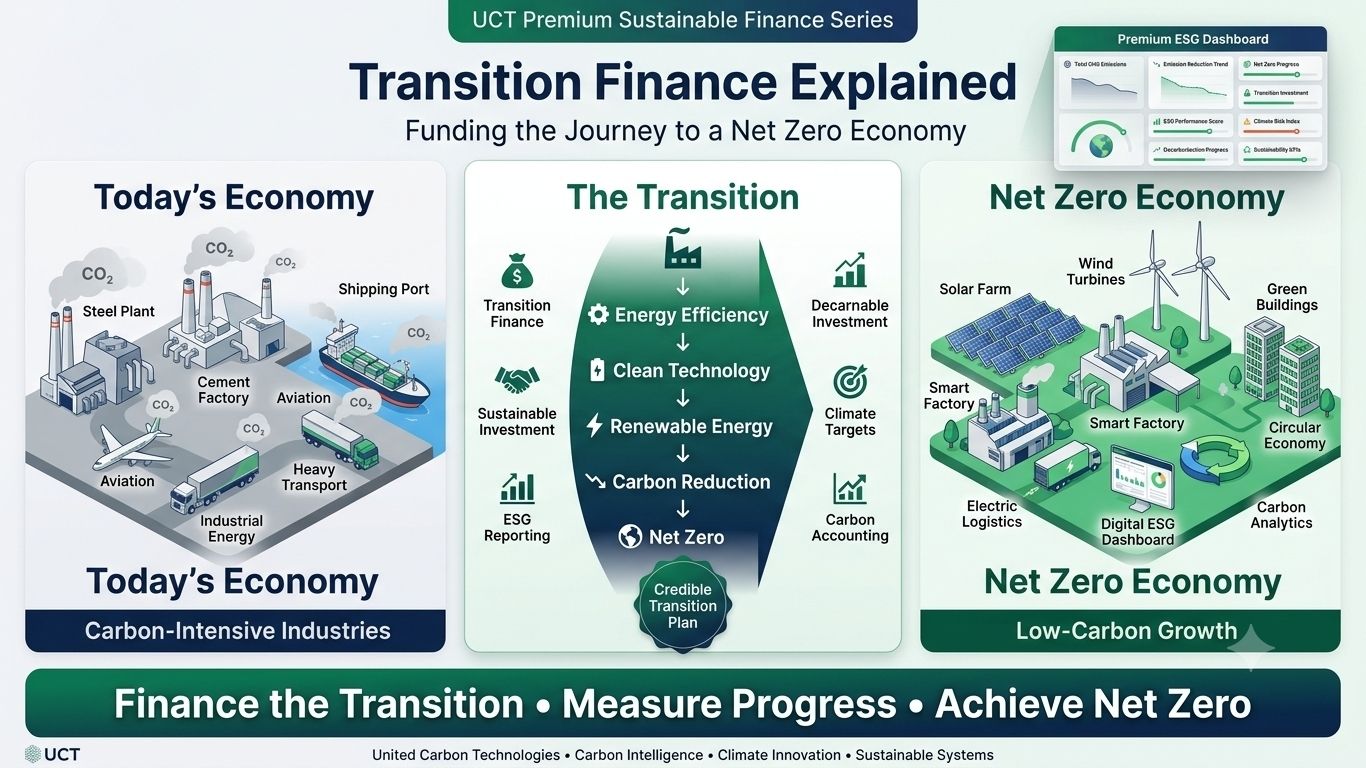
Introduction
Many industries—including steel, cement, aviation, shipping, chemicals, and manufacturing—cannot eliminate emissions overnight. These sectors require significant investment to modernize equipment, adopt cleaner technologies, improve energy efficiency, and reduce carbon emissions over time.
Transition Finance provides the financial support needed for this journey. Rather than expecting immediate zero emissions, it encourages organizations to develop transparent transition plans backed by measurable climate targets and ongoing performance improvements.
For businesses, understanding Transition Finance is increasingly important as investors, lenders, regulators, and customers look for credible pathways toward Net Zero.
💡 Did You Know?
- Many of the world's largest emitters operate in industries that cannot transition to low-carbon operations overnight.
- Transition Finance helps fund gradual decarbonization rather than only financing already "green" projects.
- Investors increasingly evaluate whether companies have credible transition plans alongside current ESG performance.
- Transition Finance is expected to become a major component of global climate investment over the coming decades.
1. What Is Transition Finance?
Transition Finance refers to financial mechanisms that support businesses in reducing greenhouse gas emissions and moving toward a low-carbon economy. Instead of funding only environmentally sustainable projects, it helps organizations transform existing operations through planned and measurable decarbonization.
Transition Finance Supports
- Industrial decarbonization
- Energy efficiency improvements
- Clean technology adoption
- Low-carbon manufacturing
- Carbon reduction projects
- Climate adaptation investments
- Operational modernization
- Net Zero transition strategies
2. Why Transition Finance Matters
Reaching global climate goals requires transforming existing industries—not simply building new green ones. Transition Finance helps bridge this gap by enabling businesses to reduce emissions while maintaining economic productivity and competitiveness.
Key Benefits
- Accelerates decarbonization
- Supports Net Zero commitments
- Encourages technology innovation
- Reduces long-term climate risks
- Improves investor confidence
- Supports responsible economic growth
- Strengthens climate resilience
- Promotes sustainable industrial transformation
Businesses that measure emissions, monitor ESG performance, and build credible transition plans are better positioned to attract future-focused investors and financing.
Build Your Net Zero Transition with Better Data
United Carbon Technologies is developing an ESG & Carbon Intelligence Platform designed to help organizations centralize Carbon Accounting, monitor ESG metrics, visualize transition progress through executive dashboards, and strengthen sustainability reporting. Planned capabilities are intended to support businesses implementing credible decarbonization strategies and preparing for the evolving low-carbon economy.
3. Transition Finance vs Green Finance
Although both Transition Finance and Green Finance contribute to climate action, they serve different purposes. Green Finance primarily supports projects that are already environmentally sustainable, whereas Transition Finance helps carbon-intensive industries move toward lower emissions through structured and measurable transition plans.
| Transition Finance | Green Finance |
|---|---|
| Supports businesses transitioning to lower emissions | Funds projects that are already environmentally sustainable |
| Focuses on gradual decarbonization | Focuses on immediate environmental benefits |
| Often applies to hard-to-abate sectors | Often supports renewable energy and clean technology |
| Requires credible transition plans and measurable targets | Requires projects with clear environmental outcomes |
| Supports long-term Net Zero transformation | Supports green economic development |
Green Finance helps fund green projects, while Transition Finance helps existing industries become greener. Both are essential for achieving global climate goals.
4. Industries That Benefit Most from Transition Finance
Some industries are responsible for significant greenhouse gas emissions but are also critical to economic development. Transition Finance enables these sectors to invest in cleaner technologies while maintaining productivity.
Examples of Transition Sectors
- Steel manufacturing
- Cement production
- Chemical industries
- Mining operations
- Aviation
- Shipping and logistics
- Oil & Gas transition projects
- Heavy manufacturing
5. What Makes a Credible Transition Plan?
Investors increasingly expect organizations seeking Transition Finance to demonstrate clear, measurable, and science-informed plans for reducing emissions over time.
A Strong Transition Plan Includes
- Baseline greenhouse gas emissions
- Short-, medium-, and long-term climate targets
- Energy efficiency initiatives
- Technology adoption roadmap
- Capital investment strategy
- Climate risk assessment
- Executive governance and accountability
- Transparent progress reporting
6. Common Transition Finance Instruments
Financial institutions are developing products that encourage organizations to achieve measurable sustainability improvements while maintaining financial stability.
Examples Include
- Sustainability-Linked Loans
- Transition Bonds
- Sustainability-Linked Bonds
- Green Loans for modernization projects
- Climate-focused investment funds
- Blended finance mechanisms
- Public-private climate financing partnerships
- Industrial decarbonization funds
7. The Importance of ESG Data in Transition Finance
Transition Finance depends on credible, transparent, and measurable sustainability information. Investors and lenders increasingly seek evidence that organizations are making measurable progress toward their climate commitments.
Reliable Carbon Accounting, emissions inventories, ESG metrics, and climate-related KPIs help organizations demonstrate progress, identify improvement opportunities, and communicate performance with confidence.
United Carbon Technologies is developing an ESG & Carbon Intelligence Platform designed to centralize Carbon Accounting, monitor emissions, visualize ESG KPIs, and support executive decision-making through intelligent sustainability dashboards. Planned capabilities aim to help organizations monitor transition progress and strengthen climate reporting.
8. Transition Finance in India
India's journey toward Net Zero will require significant investments across manufacturing, infrastructure, transportation, energy, and industrial sectors. As businesses modernize operations and improve resource efficiency, Transition Finance can help mobilize capital for large-scale decarbonization projects.
Organizations with transparent sustainability strategies and reliable ESG information are likely to be better prepared for future financing opportunities as India's sustainable finance ecosystem continues to evolve.
9. Best Practices for Businesses Seeking Transition Finance
- Measure greenhouse gas emissions regularly.
- Develop a credible Net Zero roadmap.
- Strengthen ESG governance.
- Improve sustainability reporting.
- Set measurable climate targets.
- Invest in cleaner technologies.
- Monitor transition progress continuously.
- Communicate transparently with stakeholders.
10. The Future of Transition Finance
Transition Finance is expected to become one of the most important financial mechanisms supporting the global shift toward a low-carbon economy. As climate policies evolve and investor expectations grow, organizations with credible transition strategies and robust sustainability data will be better positioned to secure financing and remain competitive.
Accelerate Your Net Zero Journey with Better ESG Intelligence
United Carbon Technologies is building an ESG & Carbon Intelligence Platform to help organizations strengthen Carbon Accounting, monitor transition progress, centralize ESG data, and create executive dashboards that support informed sustainability decisions.
India Context
India has committed to ambitious long-term climate objectives while continuing economic growth. Transition Finance can play an important role by helping businesses modernize operations, improve energy efficiency, adopt cleaner technologies, and reduce emissions in sectors that are difficult to decarbonize.
Related Reads
- Green Finance vs Sustainable Finance Explained
- Internal Carbon Pricing Explained
- Building an ESG Dashboard: Metrics Every Company Should Monitor
- How Businesses Improve Carbon Data Quality
- Materiality Assessment Explained for ESG Reporting
- IFRS S1 and IFRS S2 Explained
💡 Expert Insight
The transition to a Net Zero economy will require both innovation and investment. Organizations that combine credible transition strategies with reliable ESG and Carbon Accounting data are generally better positioned to build trust with investors, lenders, customers, and other stakeholders.
Conclusion
Transition Finance recognizes that many industries cannot become carbon neutral overnight. By providing capital for measurable decarbonization efforts, it enables businesses to progressively reduce emissions while maintaining competitiveness and supporting economic growth. As global sustainability expectations continue to evolve, Transition Finance will play an increasingly important role in funding the journey to Net Zero.
Quick Summary
- Transition Finance supports businesses moving toward lower emissions.
- It complements Green Finance rather than replacing it.
- Credible transition plans are essential for attracting investment.
- Reliable ESG data strengthens financing opportunities.
- Carbon Accounting helps demonstrate measurable progress.
- Hard-to-abate industries are key beneficiaries.
- Transition Finance is central to achieving Net Zero.
Frequently Asked Questions (FAQs)
1. What is Transition Finance?
Transition Finance provides funding that helps businesses reduce emissions and transition toward a low-carbon economy.
2. How is it different from Green Finance?
Green Finance funds environmentally sustainable projects, while Transition Finance supports businesses transforming existing operations.
3. Which industries use Transition Finance?
Steel, cement, aviation, shipping, manufacturing, chemicals, mining, and other hard-to-abate sectors.
4. Why is Transition Finance important?
It helps industries reduce emissions while maintaining economic activity and supporting long-term climate goals.
5. What is a transition plan?
A roadmap outlining how an organization intends to reduce emissions over time using measurable targets and actions.
6. What role does ESG play?
ESG data helps investors evaluate whether transition strategies are credible and measurable.
7. What financial products support Transition Finance?
Transition Bonds, Sustainability-Linked Loans, Sustainability-Linked Bonds, climate funds, and blended finance mechanisms.
8. How does Carbon Accounting help?
It measures emissions and demonstrates progress toward climate goals.
9. Is Transition Finance relevant in India?
Yes. It can support industrial modernization and decarbonization as India advances toward its climate objectives.
10. Why should businesses prepare now?
Organizations with credible transition plans and robust sustainability data are better positioned for future financing opportunities.
Key Takeaways
- Transition Finance enables gradual industrial decarbonization.
- Reliable ESG data is becoming increasingly valuable.
- Carbon Accounting supports credible transition strategies.
- Net Zero requires investment across all sectors—not only green industries.
- Technology improves transparency, reporting, and decision-making.
Start Building Your Net Zero Roadmap Today
Explore more expert resources from United Carbon Technologies covering Carbon Accounting, ESG Reporting, Sustainable Finance, Climate Intelligence, and Net Zero strategies. Follow our progress as we develop the UCT ESG & Carbon Intelligence Platform to help organizations measure, monitor, and improve sustainability performance.