

Green Finance vs Sustainable Finance Explained: What's the Difference?
Understand the difference between Green Finance and Sustainable Finance, their importance for businesses, investors, ESG reporting, and India's sustainable economy.
By United Carbon Technologies | Climate Knowledge Hub India
Published: July 2026 | Last Updated: July 2026 | 14 min read
Join professionals learning about ESG Reporting, Sustainable Finance, Climate Risk, Carbon Accounting, Green Investments, and Climate Intelligence.
As climate change, ESG regulations, and responsible investing gain momentum worldwide, the terms Green Finance and Sustainable Finance are becoming increasingly common. Although they are often used interchangeably, they are not the same.
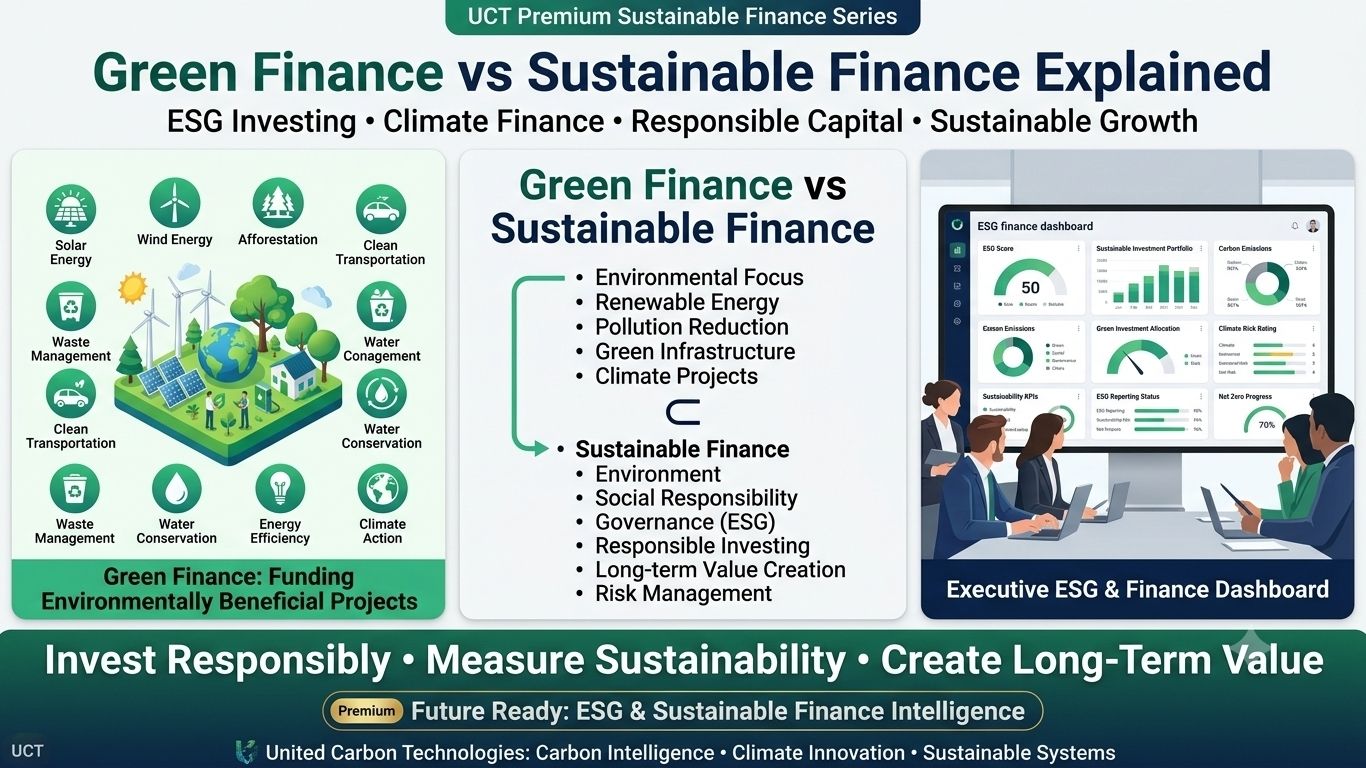
Green Finance focuses primarily on financing projects that deliver positive environmental outcomes, such as renewable energy, energy efficiency, and pollution reduction. Sustainable Finance is broader—it considers environmental, social, and governance (ESG) factors when making financial and investment decisions.
For Indian businesses, understanding the distinction is becoming increasingly important as banks, investors, regulators, and global customers place greater emphasis on sustainable business practices and responsible capital allocation.
Featured Snippet
Green Finance refers to financing activities that directly benefit the environment, while Sustainable Finance incorporates environmental, social, and governance (ESG) considerations into investment and financial decision-making. Green Finance is therefore a subset of Sustainable Finance.
Introduction
Capital is one of the most powerful drivers of sustainable development. Governments, financial institutions, investors, and businesses increasingly recognize that where money is invested today will shape tomorrow's economy.
Green Finance supports projects that generate measurable environmental benefits, while Sustainable Finance evaluates broader ESG impacts alongside financial returns. Together, they help businesses manage risks, create long-term value, and contribute to a more resilient economy.
Whether your organization is seeking funding, attracting investors, strengthening ESG performance, or preparing for future sustainability reporting, understanding these concepts is becoming an important strategic advantage.
💡 Did You Know?
- Green Finance primarily funds environmentally beneficial projects.
- Sustainable Finance includes environmental, social, and governance (ESG) considerations.
- Green Bonds are one of the fastest-growing Green Finance instruments globally.
- Many investors now evaluate ESG performance before making investment decisions.
1. What Is Green Finance?
Green Finance refers to financial products, investments, and funding mechanisms specifically designed to support projects that generate positive environmental outcomes. The primary objective is reducing environmental impact while supporting sustainable economic development.
Examples of Green Finance Projects
- Renewable energy projects
- Solar and wind power
- Energy-efficient buildings
- Electric mobility
- Pollution control initiatives
- Waste management systems
- Water conservation projects
- Climate adaptation infrastructure
2. What Is Sustainable Finance?
Sustainable Finance is a broader concept that integrates Environmental, Social, and Governance (ESG) considerations into financial and investment decisions. Rather than focusing only on environmental outcomes, Sustainable Finance evaluates how organizations manage sustainability risks, governance practices, and social responsibilities alongside financial performance.
Sustainable Finance Includes
- Environmental performance
- Climate risk management
- Social responsibility
- Corporate governance
- Responsible investing
- Long-term value creation
- ESG risk assessment
- Sustainable business strategy
Organizations that measure sustainability performance are better positioned to access responsible finance and build long-term investor confidence.
Turn Sustainability Data into Business Value
United Carbon Technologies is developing an ESG & Carbon Intelligence Platform to help organizations centralize ESG metrics, strengthen Carbon Accounting, monitor sustainability KPIs, and visualize performance through executive dashboards. Reliable sustainability data can support better ESG reporting, investor communication, and informed business decision-making.
3. Green Finance vs Sustainable Finance: Key Differences
Although Green Finance and Sustainable Finance share the common objective of supporting sustainable development, they differ in scope, purpose, and investment approach. Understanding these differences helps businesses communicate more effectively with investors, lenders, and stakeholders.
| Green Finance | Sustainable Finance |
|---|---|
| Focuses on environmental projects | Considers Environmental, Social & Governance (ESG) factors |
| Supports climate and environmental initiatives | Supports long-term sustainable business performance |
| Examples: Solar, wind, clean energy | Includes ESG investing, responsible finance, governance, and social impact |
| Environmental impact is the primary objective | Balances financial returns with ESG performance |
| Subset of Sustainable Finance | Umbrella concept covering Green Finance and ESG investing |
Every Green Finance investment is Sustainable Finance, but not every Sustainable Finance investment is Green Finance.
4. Why Businesses Should Understand Both
Financial institutions increasingly evaluate sustainability performance alongside financial performance. Companies with credible ESG strategies often improve access to capital, strengthen stakeholder trust, and enhance long-term resilience.
Business Benefits
- Improved investor confidence
- Better ESG reporting
- Lower sustainability-related risks
- Enhanced corporate reputation
- Greater financing opportunities
- Improved regulatory readiness
- Stronger stakeholder relationships
- Long-term business resilience
5. Common Green Finance Instruments
Green Finance uses financial products specifically designed to fund environmentally beneficial activities.
Examples
- Green Bonds
- Green Loans
- Sustainability-linked Loans
- Renewable Energy Financing
- Climate Funds
- Energy Efficiency Financing
- Carbon Markets
- Green Infrastructure Investment
6. Sustainable Finance in Practice
Sustainable Finance extends beyond environmental projects by integrating ESG considerations throughout business operations and investment decisions.
Typical Areas Evaluated
- Environmental performance
- Employee well-being
- Human rights
- Board governance
- Business ethics
- Supply chain sustainability
- Climate resilience
- Long-term value creation
This holistic approach helps investors better understand an organization's overall sustainability performance.
7. The Role of ESG Data in Sustainable Finance
Reliable sustainability data is becoming essential for businesses seeking investment, financing, or partnerships. Investors increasingly rely on measurable ESG information rather than broad sustainability claims.
Organizations that measure carbon emissions, governance performance, climate risks, and sustainability KPIs are generally better prepared to communicate with financial institutions and stakeholders.
United Carbon Technologies is developing an ESG & Carbon Intelligence Platform designed to centralize Carbon Accounting, ESG metrics, sustainability dashboards, and executive reporting. Planned capabilities are intended to help organizations improve sustainability data quality and strengthen ESG reporting that supports better business decision-making and investor communication.
8. Green Finance and Sustainable Finance in India
India is accelerating investments in renewable energy, sustainable infrastructure, electric mobility, climate resilience, and responsible business practices. Banks, financial institutions, regulators, and investors increasingly recognize the importance of sustainability-related financial information.
As India's green economy continues to grow, businesses with strong ESG governance and reliable sustainability data may be better positioned to access sustainable financing opportunities and compete in global markets.
9. Best Practices for Businesses
- Measure Carbon Emissions regularly.
- Improve ESG reporting quality.
- Strengthen sustainability governance.
- Develop measurable ESG KPIs.
- Improve climate risk management.
- Increase transparency with stakeholders.
- Invest in sustainability technologies.
- Review sustainability performance annually.
10. The Future of Sustainable Finance
Green Finance and Sustainable Finance will continue to play an increasingly important role in shaping business strategy, investment decisions, and economic development. Organizations that integrate sustainability into decision-making today are better positioned to respond to changing investor expectations, evolving regulations, and emerging market opportunities.
Strong ESG performance supported by reliable data is becoming a competitive advantage rather than simply a reporting exercise.
Strengthen Your Sustainability Journey with Better Data
United Carbon Technologies is building an ESG & Carbon Intelligence Platform to help organizations centralize sustainability information, improve Carbon Accounting, monitor ESG KPIs, and visualize executive dashboards. Our vision is to help businesses make informed sustainability decisions through accurate, data-driven insights.
India Context
India's transition toward a low-carbon economy is creating new opportunities for businesses that embrace sustainability. Companies that strengthen ESG governance, improve sustainability reporting, and measure environmental performance can better position themselves for responsible investment and long-term growth.
What's Next?
After understanding Green Finance and Sustainable Finance, organizations should explore ESG reporting, Carbon Accounting, climate risk assessments, sustainable procurement, and sustainability governance to build a comprehensive sustainability strategy.
Related Reads
- ISSB Standards Explained for Indian Businesses
- IFRS S1 and IFRS S2 Explained
- Materiality Assessment Explained for ESG Reporting
- Building an ESG Dashboard: Metrics Every Company Should Monitor
- What Is Sustainability Governance?
- Internal Carbon Pricing Explained
💡 Expert Insight
Access to sustainable finance increasingly depends on the credibility of an organization's sustainability data. Businesses that measure ESG performance, improve Carbon Accounting, and communicate transparent sustainability information are generally better prepared to engage with investors, lenders, customers, and regulators.
Conclusion
While Green Finance focuses on financing environmentally beneficial projects, Sustainable Finance provides a broader framework that integrates environmental, social, and governance considerations into financial decision-making. Understanding both concepts helps businesses strengthen ESG performance, improve investor confidence, and support long-term value creation.
Organizations that invest in reliable sustainability data and effective ESG governance today will be better positioned to succeed in tomorrow's evolving financial landscape.
Quick Summary
- Green Finance funds environmentally beneficial projects.
- Sustainable Finance integrates ESG into financial decisions.
- Green Finance is a subset of Sustainable Finance.
- Reliable ESG data improves investor confidence.
- Carbon Accounting supports sustainable finance decisions.
- India's sustainable finance ecosystem continues to expand.
- Technology helps businesses manage ESG information efficiently.
Frequently Asked Questions (FAQs)
1. What is Green Finance?
Green Finance funds projects that deliver measurable environmental benefits.
2. What is Sustainable Finance?
Sustainable Finance integrates environmental, social, and governance factors into financial decisions.
3. What is the biggest difference between the two?
Green Finance focuses only on environmental outcomes, while Sustainable Finance covers ESG performance more broadly.
4. Is Green Finance part of Sustainable Finance?
Yes. Green Finance is generally considered a subset of Sustainable Finance.
5. Why is ESG important in finance?
ESG helps investors evaluate long-term business risks and opportunities beyond traditional financial metrics.
6. What are Green Bonds?
Green Bonds are financial instruments used to finance environmentally beneficial projects.
7. Can SMEs benefit from Sustainable Finance?
Yes. Strong ESG practices can improve access to finance, customers, and business opportunities.
8. How does Carbon Accounting support Sustainable Finance?
It provides measurable emissions data that strengthens sustainability reporting and investor confidence.
9. How can technology help businesses?
Digital ESG platforms centralize sustainability information and improve reporting efficiency.
10. Why should Indian businesses understand Sustainable Finance?
It supports better business resilience, ESG readiness, investor communication, and long-term competitiveness.
Key Takeaways
- Green Finance focuses on environmental investments.
- Sustainable Finance considers ESG as a whole.
- Reliable ESG data supports better financing opportunities.
- Carbon Accounting strengthens sustainability reporting.
- Strong ESG governance contributes to long-term business success.
Build a More Sustainable Business with Better Insights
Explore more expert resources from United Carbon Technologies on ESG reporting, Carbon Accounting, Sustainable Finance, Climate Intelligence, and sustainability governance. Stay connected for updates on our upcoming ESG & Carbon Intelligence Platform.