

What Is Biodiversity Loss and Why Does It Matter?
By United Carbon Technologies | Climate Knowledge Hub India
Get practical insights on climate change, biodiversity, carbon footprints, ESG, Net Zero, renewable energy, and sustainable living.
Biodiversity is the foundation of life on Earth, supporting ecosystems, food production, clean water, climate regulation, and human well-being. Yet biodiversity is declining at an unprecedented rate due to human activities. Understanding biodiversity loss is essential for protecting nature, strengthening climate resilience, and building a sustainable future for generations to come.
What is biodiversity loss and why does it matter?
Biodiversity loss is the decline in the variety of plants, animals, fungi, and microorganisms, as well as the ecosystems they form. It matters because biodiversity supports food security, clean air and water, climate regulation, pollination, medicine, and healthy ecosystems that sustain all life on Earth.
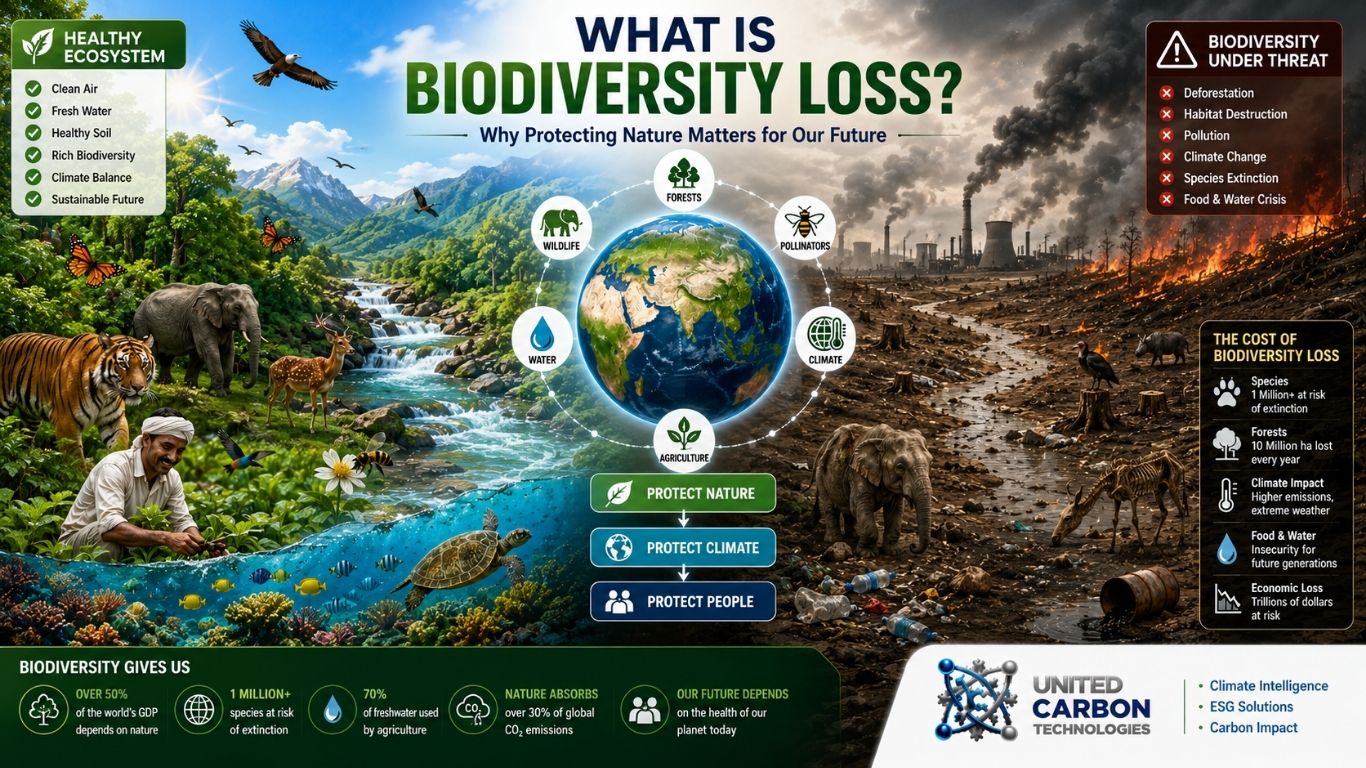
Every forest, river, ocean, grassland, and wetland is home to thousands of interconnected species that depend on one another for survival. Together, these living organisms form Earth's biodiversity—a complex web of life that has evolved over millions of years.
Today, this delicate balance is under increasing pressure. Habitat destruction, pollution, climate change, overexploitation of natural resources, and invasive species are causing plants and animals to disappear faster than at any other time in human history. As biodiversity declines, ecosystems become weaker and less capable of supporting both wildlife and people.
Protecting biodiversity is not only about saving endangered species. It is about securing food, water, health, livelihoods, and climate stability for communities across India and around the world.
More than half of the world's economic output depends directly or indirectly on nature. Healthy forests, wetlands, oceans, pollinators, and fertile soils provide ecosystem services worth trillions of dollars every year, making biodiversity one of the planet's most valuable natural assets.
What Is Biodiversity?
Biodiversity refers to the incredible variety of life found on Earth. It includes every living organism—from tiny bacteria and fungi to towering trees, insects, birds, mammals, and marine life—as well as the ecosystems where they live and interact.
Scientists generally describe biodiversity at three interconnected levels:
- Genetic Diversity – Differences in genes within the same species that help populations adapt to changing environments.
- Species Diversity – The variety of plants, animals, fungi, and microorganisms found in an ecosystem.
- Ecosystem Diversity – Different habitats such as forests, rivers, mountains, wetlands, grasslands, deserts, coral reefs, and oceans.
Together, these three levels create resilient ecosystems capable of supporting life and adapting to environmental changes.
What Is Biodiversity Loss?
Biodiversity loss occurs when species disappear, populations decline, habitats are destroyed, or ecosystems become degraded. It can happen naturally over long periods, but today's biodiversity loss is primarily driven by human activities and is occurring at an unprecedented pace.
Examples of biodiversity loss include:
- Species becoming endangered or extinct.
- Large-scale deforestation.
- Declining pollinator populations such as bees and butterflies.
- Loss of coral reefs and marine habitats.
- Wetlands being converted into urban or agricultural land.
- Reduced genetic diversity in crops and livestock.
When biodiversity declines, ecosystems become less resilient, making them more vulnerable to climate change, natural disasters, invasive species, and disease outbreaks.
Why Biodiversity Matters More Than Ever
Biodiversity is often called Earth's life-support system because it provides essential ecosystem services that humans depend on every day. Without healthy ecosystems, societies would struggle to produce food, secure clean water, regulate the climate, and maintain healthy economies.
Healthy biodiversity supports:
- Food production and agriculture.
- Pollination of crops by insects and birds.
- Clean drinking water through healthy watersheds.
- Natural carbon storage in forests and wetlands.
- Medicines derived from plants and microorganisms.
- Protection against floods and soil erosion.
- Economic livelihoods through forestry, fisheries, and tourism.
- Climate resilience for communities and ecosystems.
Protecting biodiversity is therefore not just an environmental responsibility—it is essential for sustainable development, economic prosperity, and human well-being.
How Healthy Ecosystems Support Climate Action
Climate change and biodiversity are deeply interconnected. Healthy ecosystems absorb carbon dioxide, regulate local temperatures, conserve water, and reduce the impacts of extreme weather events. Forests, mangroves, peatlands, grasslands, and oceans all act as important natural carbon sinks that help slow global warming.
Conversely, when ecosystems are degraded or destroyed, they release stored carbon back into the atmosphere while losing their ability to support wildlife and protect communities from climate-related risks.
Protecting biodiversity is therefore one of the most effective nature-based solutions for addressing climate change while strengthening ecosystem resilience.
What Causes Biodiversity Loss?
Biodiversity loss is primarily driven by human activities that alter natural ecosystems faster than they can recover. While extinction is a natural process over geological time, today's rate of species decline is hundreds of times higher due to increasing pressure from population growth, industrialization, urban expansion, and unsustainable resource use.
The five major drivers of biodiversity loss are recognized globally and often work together, making ecosystems more fragile and less resilient to climate change.
1. Habitat Loss and Deforestation
Forests, wetlands, grasslands, mangroves, and rivers are being cleared or altered for agriculture, urban development, mining, roads, and infrastructure. As habitats disappear, wildlife loses food, shelter, breeding grounds, and migration routes, leading to declining populations and species extinction.
2. Climate Change
Rising temperatures, changing rainfall patterns, heatwaves, floods, droughts, melting glaciers, and rising sea levels are forcing many species to migrate or adapt rapidly. Some species cannot adjust quickly enough, making climate change one of the fastest-growing threats to global biodiversity.
3. Pollution
Air pollution, plastic waste, industrial chemicals, pesticides, untreated sewage, and agricultural runoff contaminate ecosystems and harm plants, animals, and microorganisms. Polluted rivers and oceans reduce aquatic biodiversity, while excessive fertilizer use damages soil health and freshwater ecosystems.
4. Overexploitation of Natural Resources
Unsustainable logging, overfishing, hunting, groundwater extraction, and excessive harvesting of plants reduce natural populations faster than they can regenerate. Responsible resource management is essential to maintain healthy ecosystems.
5. Invasive Alien Species
Species introduced outside their natural habitats can spread rapidly and outcompete native plants and animals for food and space. Many invasive species disrupt ecological balance and contribute to biodiversity decline.
India: One of the World's Most Biodiverse Countries
Although India occupies only about 2.4% of the world's land area, it is home to nearly 8% of the world's recorded species. Its diverse geography—from the Himalayas to tropical rainforests, deserts, grasslands, wetlands, rivers, islands, and long coastlines—supports an extraordinary variety of life.
India is recognized as one of the world's 17 megadiverse countries, making biodiversity conservation a national as well as global priority.
Major Biodiversity Hotspots Connected to India
- Western Ghats
- Eastern Himalayas
- Indo-Burma Region
- Sundaland (Nicobar Islands)
These biodiversity hotspots contain thousands of unique plant and animal species found nowhere else on Earth. Protecting these ecosystems is critical for conserving global biodiversity.
How Biodiversity Loss Affects People
Many people think biodiversity conservation is only about protecting wildlife. In reality, healthy ecosystems directly support human health, economic development, agriculture, water security, and climate resilience.
Biodiversity loss can have serious consequences for society, including:
- Reduced agricultural productivity due to declining pollinators.
- Lower food security and increased crop failures.
- Water shortages caused by degraded forests and watersheds.
- Greater risk of floods, droughts, and soil erosion.
- Loss of medicinal plants used in modern and traditional healthcare.
- Reduced fisheries and marine resources.
- Economic losses in tourism, forestry, and agriculture.
- Higher vulnerability to climate change and natural disasters.
Protecting biodiversity is therefore essential not only for wildlife but also for improving public health, supporting livelihoods, and strengthening long-term economic resilience.
Protecting forests, wetlands, rivers, and biodiversity helps reduce climate risks, improve ecosystem resilience, and create a healthier future for everyone. Every conservation effort—big or small—contributes to a more sustainable planet.
Businesses increasingly recognize that biodiversity, climate action, and ESG performance are closely connected. United Carbon Technologies helps organizations strengthen sustainability strategies through carbon accounting, ESG reporting, climate intelligence, and data-driven decision-making.
The Connection Between Biodiversity and Climate Change
Biodiversity loss and climate change are two of the world's biggest environmental challenges, and they are closely interconnected. Climate change accelerates biodiversity loss, while degraded ecosystems become less effective at storing carbon and regulating the climate.
Healthy ecosystems act as natural climate solutions by absorbing carbon dioxide, regulating temperatures, protecting coastlines, conserving water, and supporting resilient landscapes. When forests are cleared or wetlands destroyed, these natural climate benefits are lost, making global warming even more difficult to address.
Protecting biodiversity is therefore one of the most cost-effective and sustainable ways to strengthen climate action while safeguarding ecosystems for future generations.
How We Can Protect Biodiversity
Although biodiversity loss is a global challenge, individuals, businesses, governments, and communities all have an important role to play in protecting nature. Conservation efforts combined with sustainable development can restore ecosystems while supporting economic growth and improving quality of life.
Some of the most effective ways to protect biodiversity include:
- Protecting forests, wetlands, grasslands, and coastal ecosystems.
- Planting native trees and restoring degraded landscapes.
- Reducing pollution and plastic waste.
- Promoting sustainable agriculture and responsible land use.
- Using water and natural resources efficiently.
- Protecting endangered species and their habitats.
- Supporting wildlife conservation initiatives.
- Encouraging responsible tourism.
- Reducing greenhouse gas emissions.
- Increasing public awareness about biodiversity conservation.
Every positive action—whether planting a tree, reducing waste, conserving water, or supporting conservation programs—helps build healthier ecosystems for future generations.
How Businesses Can Help Protect Biodiversity
Businesses have a significant influence on biodiversity through their operations, supply chains, resource consumption, and investment decisions. As biodiversity becomes an increasingly important part of Environmental, Social, and Governance (ESG) reporting, organizations are expected to assess and reduce their impacts on nature.
Leading companies are taking proactive steps by:
- Reducing deforestation across supply chains.
- Using sustainably sourced raw materials.
- Lowering carbon emissions and energy consumption.
- Reducing water use and protecting watersheds.
- Improving waste management and recycling.
- Minimizing plastic pollution.
- Restoring natural habitats around operations.
- Supporting biodiversity conservation projects.
- Including biodiversity risks in ESG strategies.
- Reporting nature-related impacts transparently.
Protecting biodiversity is increasingly recognized as a business opportunity. Companies that integrate nature into their sustainability strategies can strengthen resilience, reduce environmental risks, enhance brand reputation, and meet growing investor and regulatory expectations.
Technology Is Transforming Biodiversity Conservation
Modern technology is helping scientists, conservationists, governments, and businesses monitor ecosystems more effectively than ever before. Artificial intelligence, satellite imagery, drones, remote sensing, and geographic information systems (GIS) are making biodiversity conservation more accurate, scalable, and data-driven.
Emerging climate technologies can help by:
- Monitoring forest cover using satellite imagery.
- Detecting illegal deforestation in near real time.
- Tracking wildlife populations.
- Assessing ecosystem health.
- Monitoring water quality and wetlands.
- Supporting biodiversity mapping.
- Predicting climate-related ecosystem risks.
- Providing decision-makers with actionable environmental insights.
As climate and biodiversity challenges become increasingly interconnected, digital technologies will play a critical role in protecting natural ecosystems and supporting evidence-based environmental decision-making.
The Future of Biodiversity Conservation
Around the world, governments, businesses, researchers, and communities are recognizing that biodiversity conservation must become a central part of climate action and sustainable development. Global initiatives such as the Kunming-Montreal Global Biodiversity Framework aim to halt and reverse biodiversity loss through stronger conservation efforts, ecosystem restoration, and sustainable resource management.
Future biodiversity strategies are expected to focus on:
- Nature-based climate solutions.
- Large-scale ecosystem restoration.
- AI-powered environmental monitoring.
- Satellite-based biodiversity mapping.
- Sustainable agriculture and forestry.
- Corporate biodiversity reporting.
- Climate risk and nature risk assessments.
- Greater collaboration between governments, businesses, and communities.
Protecting biodiversity is no longer just an environmental priority—it is essential for economic stability, food security, climate resilience, and the well-being of future generations.
How United Carbon Technologies Supports Climate Intelligence
At United Carbon Technologies, we believe that protecting biodiversity and addressing climate change go hand in hand. Healthy ecosystems store carbon, regulate water cycles, improve air quality, and strengthen resilience against climate impacts, making biodiversity an essential component of sustainable development.
Our upcoming Advanced Carbon Intelligence System (ACIS) is being developed to help organizations make better environmental decisions through data-driven climate intelligence. While its primary focus is carbon accounting and ESG reporting, future capabilities can support broader sustainability initiatives by integrating environmental performance with climate insights.
Future ACIS capabilities include:
- Corporate Carbon Footprint Calculator.
- Scope 1, Scope 2 & Scope 3 emissions tracking.
- ESG Reporting Dashboard.
- Climate Intelligence Analytics.
- Energy and emissions monitoring.
- AI-powered sustainability recommendations.
- Environmental performance dashboards.
- Decision-support tools for climate resilience.
As organizations increasingly recognize the link between biodiversity, climate change, and sustainable business, intelligent environmental data will become an important driver of responsible decision-making.
Related Reads
- How Forests Help Fight Climate Change
- How Heatwaves Are Increasing Across the Globe and India
- What Is Sustainable Consumption?
- How Electricity Usage Impacts Your Carbon Footprint in India
- What Is Carbon Footprint? A Complete Beginner's Guide
- How Climate Change Affects Agriculture in India
- Biodiversity is the variety of life on Earth, including species, ecosystems, and genetic diversity.
- Biodiversity loss is primarily caused by habitat destruction, climate change, pollution, overexploitation, and invasive species.
- Healthy ecosystems provide food, clean water, medicines, climate regulation, and economic benefits.
- India is one of the world's 17 megadiverse countries and is home to several global biodiversity hotspots.
- Protecting biodiversity strengthens climate resilience and supports sustainable development.
- Businesses play an important role by adopting sustainable practices and integrating biodiversity into ESG strategies.
- Modern technologies such as AI, satellite imagery, and climate intelligence are transforming biodiversity conservation.
- Every individual can contribute by conserving nature, reducing waste, protecting habitats, and supporting sustainable lifestyles.
Frequently Asked Questions (FAQs)
1. What is biodiversity loss?
Biodiversity loss is the decline in the variety of living organisms, including plants, animals, fungi, microorganisms, and the ecosystems they inhabit. It occurs when species become extinct, habitats are destroyed, or ecosystems are degraded.
2. Why is biodiversity important?
Biodiversity supports healthy ecosystems that provide clean air, fresh water, food, medicines, pollination, fertile soils, climate regulation, and many other ecosystem services essential for human survival and economic development.
3. What are the biggest causes of biodiversity loss?
The primary causes include habitat destruction, deforestation, climate change, pollution, overexploitation of natural resources, and invasive species. Human activities have accelerated biodiversity loss across the world.
4. How does climate change affect biodiversity?
Climate change alters habitats through rising temperatures, changing rainfall patterns, extreme weather events, sea-level rise, and ocean warming. Many species struggle to adapt, leading to declining populations and increased extinction risks.
5. Why is biodiversity important for India?
India is one of the world's 17 megadiverse countries and is home to several biodiversity hotspots. Healthy ecosystems support agriculture, water security, livelihoods, tourism, and climate resilience, making biodiversity conservation vital for the country's sustainable development.
6. How does biodiversity help fight climate change?
Forests, wetlands, mangroves, oceans, and grasslands absorb and store large amounts of carbon dioxide. Healthy ecosystems also regulate temperatures, protect water resources, and reduce the impacts of floods, droughts, and other climate-related disasters.
7. Can businesses contribute to biodiversity conservation?
Yes. Businesses can reduce their environmental impacts by adopting sustainable sourcing, protecting natural habitats, reducing emissions, improving water efficiency, minimizing waste, and integrating biodiversity into ESG and sustainability strategies.
8. What are biodiversity hotspots?
Biodiversity hotspots are regions with exceptionally high numbers of unique plant and animal species that are under significant threat from human activities. India is connected to four globally recognized biodiversity hotspots.
9. How can individuals help protect biodiversity?
Individuals can conserve biodiversity by planting native trees, reducing plastic waste, conserving water, supporting sustainable products, protecting wildlife habitats, reducing carbon emissions, and participating in local conservation initiatives.
10. How does technology support biodiversity conservation?
Modern technologies such as satellite imagery, drones, artificial intelligence, remote sensing, and climate intelligence platforms help monitor ecosystems, detect environmental changes, track wildlife, and support better conservation planning.
Start Your Climate Knowledge Journey Today
Climate change, biodiversity loss, carbon emissions, and sustainability are shaping the future of our planet. Whether you're a student, professional, business leader, policymaker, or simply passionate about protecting nature, understanding these topics empowers you to make informed decisions and drive meaningful change.
Join thousands of learners exploring practical topics such as climate change, biodiversity conservation, carbon footprints, ESG reporting, carbon accounting, renewable energy, sustainable living, Net Zero strategies, climate technology, and environmental innovation through India's growing Climate Knowledge Hub.
Every step toward climate awareness contributes to healthier ecosystems, stronger communities, and a more sustainable future for generations to come.
Learn Today. Protect Nature Tomorrow.
✔ Free Climate Learning Resources | ✔ Weekly Climate & Sustainability Insights | ✔ Early Access to ACIS Climate Intelligence Platform | ✔ Join India's Growing Climate Community