

Why Trees Alone Cannot Solve Climate Change
By United Carbon Technologies | Climate Knowledge Hub India
Practical insights on climate science, carbon accounting, ESG, sustainability, and climate technology.
Planting trees is one of the most effective nature-based climate solutions, but forests alone cannot stop climate change. While trees absorb carbon dioxide, reducing greenhouse gas emissions from energy, transport, industry, and agriculture remains essential for achieving global climate goals.
Can planting more trees solve climate change?
No. Trees play a vital role in absorbing carbon dioxide and protecting ecosystems, but they cannot offset the world's rapidly growing greenhouse gas emissions on their own. Effective climate action requires both protecting forests and significantly reducing emissions across all sectors.
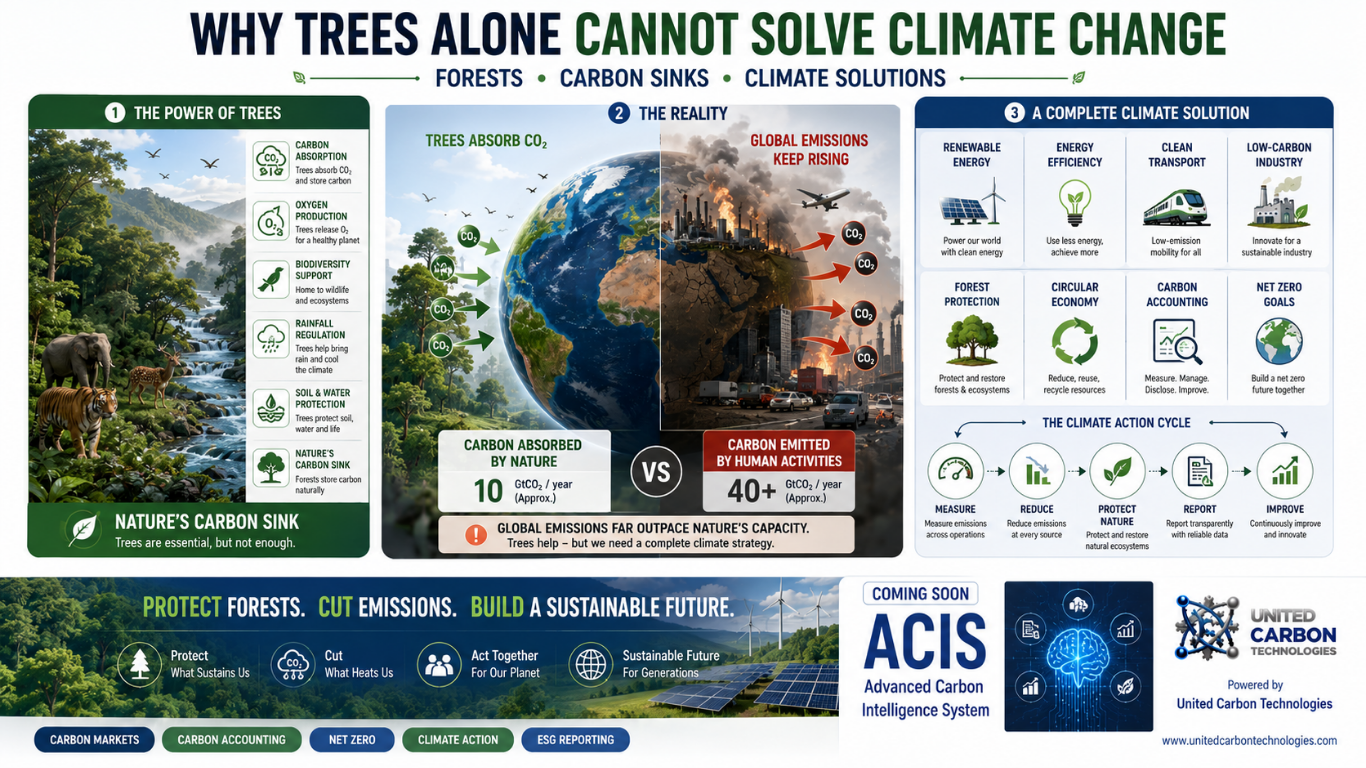
Tree planting campaigns have become one of the most visible symbols of climate action. Governments, businesses, schools, and communities around the world regularly organize plantation drives to restore forests and improve the environment. These initiatives provide valuable ecological benefits and contribute to carbon removal from the atmosphere.
However, a common misconception has emerged that planting enough trees alone can solve climate change. While forests are incredibly important, the climate crisis is driven by massive greenhouse gas emissions from burning fossil fuels, industrial production, transportation, agriculture, and land-use change. These emissions occur at a scale far greater than trees alone can absorb.
Protecting and expanding forests must therefore be combined with reducing carbon emissions, improving energy efficiency, transitioning to renewable energy, and adopting sustainable production and consumption practices. Climate change requires a comprehensive solution—not a single one.
A mature tree can absorb carbon dioxide over its lifetime, but global human activities emit **tens of billions of tonnes of CO₂ every year**. This is why reducing emissions remains just as important as planting trees.
Why Trees Are Important for the Climate
Trees are among nature's most valuable climate allies. Through photosynthesis, they absorb carbon dioxide from the atmosphere and store carbon in their trunks, branches, roots, and surrounding soils. Forests also regulate local climates, support biodiversity, improve water cycles, and protect ecosystems.
Healthy forests contribute by:
- Removing carbon dioxide from the atmosphere.
- Producing oxygen.
- Reducing soil erosion.
- Protecting wildlife habitats.
- Supporting rainfall patterns.
- Cooling urban environments.
- Improving air quality.
- Enhancing ecosystem resilience.
Because of these benefits, forest conservation and restoration remain essential components of global climate action.
Why Trees Alone Are Not Enough
Despite their importance, forests cannot keep pace with today's greenhouse gas emissions if societies continue relying heavily on fossil fuels. Every year, emissions from electricity generation, transportation, manufacturing, construction, agriculture, and industrial activities far exceed the amount of carbon that newly planted trees can absorb.
Several factors limit the ability of trees to solve climate change independently:
- Trees require years or decades to reach maximum carbon storage capacity.
- Young forests absorb less carbon than mature forests.
- Wildfires, droughts, pests, and deforestation can release stored carbon back into the atmosphere.
- Available land for large-scale tree planting is limited.
- Carbon emissions continue every day from human activities.
This means that while forests are an essential part of the solution, they cannot replace the urgent need to reduce greenhouse gas emissions at their source.
Trees Are Carbon Sinks—Not Unlimited Carbon Vacuums
Forests are often described as carbon sinks because they absorb more carbon dioxide than they release. Through photosynthesis, trees capture atmospheric CO₂ and store it in their wood, leaves, roots, and surrounding soil.
However, every forest has a natural limit to how much carbon it can store. As forests mature, the rate of carbon absorption gradually slows, even though they continue to store large amounts of carbon.
Carbon storage also depends on several factors, including:
- Tree species.
- Climate conditions.
- Soil quality.
- Water availability.
- Forest age.
- Biodiversity.
- Protection from fires and deforestation.
Healthy forests remain critical for climate stability, but they cannot absorb unlimited quantities of greenhouse gas emissions while global fossil fuel consumption continues to rise.
The Biggest Driver of Climate Change Is Fossil Fuel Emissions
Climate change is primarily caused by the large-scale release of greenhouse gases from human activities. Burning coal, oil, and natural gas for electricity, transportation, manufacturing, heating, and industrial processes releases enormous quantities of carbon dioxide into the atmosphere every day.
Major sources of emissions include:
- Electricity generation.
- Transportation.
- Heavy industries.
- Cement production.
- Steel manufacturing.
- Aviation and shipping.
- Agriculture.
- Buildings and construction.
Even if billions of new trees were planted, continued growth in fossil fuel emissions would outpace the amount of carbon those trees could realistically absorb.
Reducing emissions at their source is therefore essential for slowing global warming.
Nature-Based Solutions Work Best Alongside Emissions Reductions
Nature-based solutions—including forest restoration, mangrove conservation, wetland protection, and regenerative agriculture—play an important role in climate action. These approaches help remove carbon dioxide while providing valuable environmental and social benefits.
Examples include:
- Protecting existing forests.
- Restoring degraded ecosystems.
- Planting native tree species.
- Conserving mangroves and wetlands.
- Improving soil carbon through sustainable farming.
- Restoring grasslands.
However, international climate experts consistently emphasize that these solutions must complement—not replace—rapid reductions in greenhouse gas emissions from energy, industry, and transportation.
The most effective climate strategy combines both approaches:
- Reduce emissions wherever possible.
- Protect and restore natural ecosystems.
- Transition to renewable energy.
- Improve energy efficiency.
- Adopt sustainable production and consumption.
Why Protecting Existing Forests Is Often Better Than Planting New Ones
While tree planting receives significant public attention, protecting existing forests is often even more valuable for the climate.
Mature forests already contain enormous carbon reserves accumulated over decades or centuries. If these forests are cleared or degraded, much of that stored carbon can be released back into the atmosphere.
Protecting existing forests offers several advantages:
- Immediate carbon storage.
- Rich biodiversity.
- Established ecosystems.
- Healthy soils.
- Stable water cycles.
- Greater resilience to climate impacts.
- Support for indigenous communities and wildlife.
Planting new trees remains important, but preventing deforestation and conserving mature forests often delivers faster and more significant climate benefits.
Tree planting is valuable, but lasting climate impact begins with understanding your carbon footprint. Measuring emissions helps organizations identify where the greatest reductions can be achieved.
United Carbon Technologies helps businesses measure greenhouse gas emissions, strengthen carbon accounting, develop ESG reporting frameworks, and create practical decarbonization strategies that prioritize real emissions reductions alongside nature-based solutions.
The Role of Renewable Energy in Climate Action
Replacing fossil fuels with renewable energy is one of the most effective ways to reduce greenhouse gas emissions. Unlike coal, oil, and natural gas, renewable energy sources generate electricity with significantly lower carbon emissions during operation.
Major renewable energy sources include:
- Solar power.
- Wind energy.
- Hydropower.
- Geothermal energy.
- Sustainable bioenergy.
When combined with energy efficiency, electrification, and cleaner industrial processes, renewable energy can reduce emissions at a scale that tree planting alone cannot achieve.
Protecting forests while transitioning to clean energy creates a stronger and more balanced climate strategy.
How Businesses Can Contribute Beyond Tree Planting
Many organizations include tree plantation initiatives as part of their sustainability programs. While these activities demonstrate environmental commitment, businesses can create a much greater impact by reducing emissions throughout their operations and value chains.
Effective corporate climate actions include:
- Measuring Scope 1, Scope 2, and Scope 3 emissions.
- Improving energy efficiency.
- Increasing renewable electricity use.
- Reducing waste and resource consumption.
- Optimizing transportation and logistics.
- Working with suppliers to lower emissions.
- Investing in low-carbon technologies.
- Supporting credible forest conservation initiatives.
Combining operational improvements with ecosystem restoration enables businesses to deliver measurable environmental benefits while strengthening ESG performance and long-term resilience.
Every Individual Can Make a Difference
Climate action is not limited to governments and corporations. Individual choices, when multiplied across millions of people, contribute to meaningful environmental change.
Simple actions include:
- Plant and care for native trees.
- Reduce household energy consumption.
- Use public transport, cycling, or walking when possible.
- Choose renewable electricity where available.
- Reduce food waste.
- Support sustainable products and businesses.
- Recycle and reuse materials responsibly.
- Spread awareness about climate science.
Tree planting remains a valuable activity, but it should be part of a broader lifestyle focused on reducing carbon emissions and protecting natural ecosystems.
Climate Intelligence Helps Build Better Solutions
Addressing climate change requires informed decisions backed by reliable data. Climate intelligence combines carbon accounting, emissions monitoring, predictive analytics, and sustainability reporting to help organizations identify where the greatest environmental improvements can be achieved.
Rather than relying on a single solution, climate intelligence enables organizations to balance emissions reductions, renewable energy investments, nature-based solutions, and responsible carbon management.
Key capabilities include:
- Corporate carbon footprint measurement.
- Scope 1, Scope 2, and Scope 3 emissions analysis.
- Energy performance monitoring.
- ESG reporting support.
- Climate risk assessment.
- Net Zero planning.
- Carbon reduction opportunity identification.
- Performance tracking through sustainability dashboards.
Looking Ahead: A Balanced Path to Climate Action
Trees are one of Earth's greatest natural defenses against climate change, but they cannot solve the climate crisis alone. Lasting progress depends on protecting forests while simultaneously reducing greenhouse gas emissions from every major sector of the economy.
At United Carbon Technologies, we believe the future of sustainability lies in combining nature-based solutions with science, technology, and climate intelligence. Our upcoming Advanced Carbon Intelligence System (ACIS) is being envisioned to help organizations measure emissions, strengthen carbon accounting, improve ESG reporting, and make data-driven decisions that support meaningful decarbonization.
Protecting forests, transitioning to clean energy, improving operational efficiency, and embracing climate innovation together provide the strongest pathway toward a more sustainable and climate-resilient future.
Related Reads
- How Companies Calculate Their Corporate Carbon Footprint
- What Is Carbon Accounting?
- What Are Carbon Credits?
- Understanding Scope 1, Scope 2 & Scope 3 Emissions
- What Is Net Zero?
- How ESG Software Simplifies Sustainability Reporting
- Trees are essential carbon sinks that absorb and store carbon dioxide.
- Tree planting alone cannot offset today's rapidly growing greenhouse gas emissions.
- Reducing fossil fuel use is critical for slowing climate change.
- Protecting existing forests often delivers greater climate benefits than planting new ones.
- Nature-based solutions work best alongside emissions reductions and renewable energy adoption.
- Businesses should combine carbon accounting, emissions reductions, and ecosystem restoration.
- Individuals can contribute through sustainable lifestyle choices and forest conservation.
- Climate intelligence helps organizations develop balanced, science-based climate strategies.
Frequently Asked Questions (FAQs)
1. Can planting trees stop climate change?
No. Planting trees is an important climate solution, but it cannot stop climate change on its own. Reducing greenhouse gas emissions from fossil fuels, industry, transportation, and agriculture is equally essential.
2. Why are trees important for the environment?
Trees absorb carbon dioxide, produce oxygen, support biodiversity, improve air quality, regulate water cycles, reduce soil erosion, and help moderate local temperatures.
3. What is a carbon sink?
A carbon sink is any natural or artificial system that absorbs and stores more carbon than it releases. Forests, wetlands, oceans, and healthy soils are among Earth's largest natural carbon sinks.
4. Why can't forests absorb all human carbon emissions?
Human activities release billions of tonnes of greenhouse gases every year. Forests have a limited capacity to absorb carbon, and factors such as deforestation, wildfires, droughts, and land availability further limit their ability to offset global emissions.
5. Is protecting existing forests more effective than planting new trees?
In many cases, yes. Mature forests already store vast amounts of carbon and support rich ecosystems. Preventing deforestation often delivers faster climate benefits than planting new trees that require decades to mature.
6. What are nature-based climate solutions?
Nature-based solutions include protecting forests, restoring wetlands, conserving mangroves, improving soil health, and restoring ecosystems to help remove carbon dioxide while supporting biodiversity and climate resilience.
7. What role does renewable energy play in climate action?
Renewable energy replaces fossil fuels with low-carbon electricity sources such as solar, wind, hydro, and geothermal power, significantly reducing greenhouse gas emissions over time.
8. How can businesses contribute beyond tree planting?
Businesses can measure their carbon footprint, improve energy efficiency, transition to renewable energy, reduce waste, engage suppliers, strengthen ESG reporting, and implement science-based emissions reduction strategies.
9. What is climate intelligence?
Climate intelligence combines carbon accounting, sustainability data, predictive analytics, and ESG reporting to help organizations understand emissions, identify reduction opportunities, and make informed climate decisions.
10. How is United Carbon Technologies supporting climate action?
United Carbon Technologies is developing the Advanced Carbon Intelligence System (ACIS) to help organizations measure greenhouse gas emissions, strengthen carbon accounting, improve ESG reporting, and accelerate data-driven sustainability strategies.
Climate Action Needs More Than Tree Planting
Forests are one of our greatest natural allies, but solving climate change requires a balanced approach that combines ecosystem protection, emissions reductions, renewable energy, sustainable innovation, and informed decision-making.
Explore practical insights on climate science, carbon accounting, ESG reporting, biodiversity, renewable energy, Net Zero, and climate technology through the United Carbon Technologies Climate Knowledge Hub.
Whether you're a student, business leader, policymaker, or climate-conscious citizen, every informed decision contributes to a healthier, more sustainable future.
Protect Nature. Reduce Emissions. Build a Climate-Resilient Future.
✔ Climate Science Explained | ✔ Carbon Accounting & ESG Insights | ✔ Early Access to ACIS Climate Intelligence Platform | ✔ Join India's Growing Climate Community