

Workplace Wellness & Climate Action: How ESG Governance Supports Mental Health
Search Description: Learn how ESG governance improves workplace wellness, employee mental health, and sustainable business performance across Indian organizations.
By United Carbon Technologies | Published: August 2026 | Updated: August 2026
Join professionals exploring ESG reporting, sustainability governance, employee wellbeing, climate leadership, corporate responsibility, and Climate Intelligence shaping the future of business in India.
Healthy Employees Build Sustainable Businesses
Environmental sustainability often receives the most attention in ESG discussions, yet successful organizations recognize that sustainability also depends on people. Employees who feel supported, respected, and mentally healthy are more innovative, productive, and resilient. Workplace wellness has therefore become a strategic component of modern ESG governance.
Across India, businesses are expanding their ESG strategies beyond carbon accounting and environmental reporting to include employee wellbeing, occupational health, diversity, inclusion, and responsible corporate governance. Investors, regulators, customers, and employees increasingly expect organizations to create workplaces that prioritize both business performance and human wellbeing.
Integrating mental health into ESG governance enables organizations to strengthen long-term resilience while creating healthier, more engaged teams capable of driving sustainable growth.
How does ESG governance support workplace mental health?
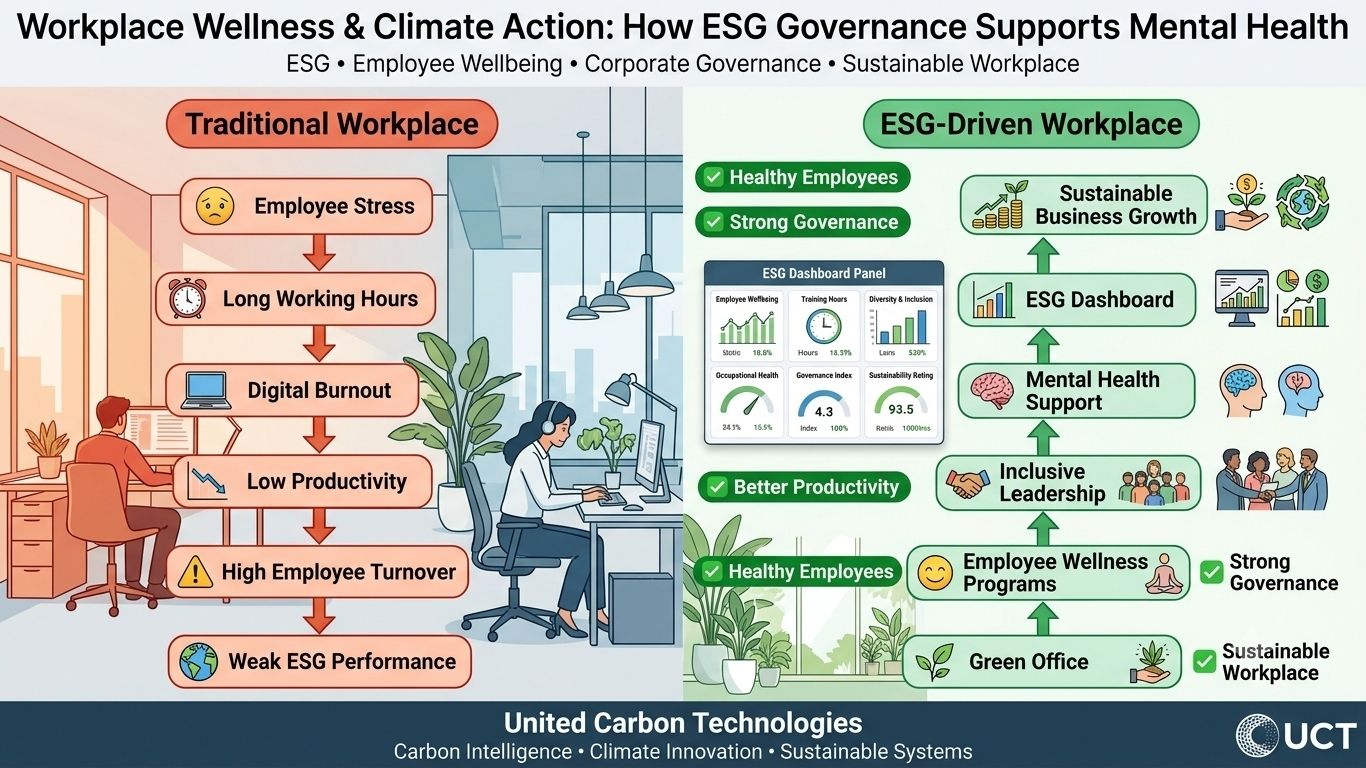
ESG governance promotes workplace mental health by encouraging ethical leadership, employee wellbeing programs, occupational health policies, inclusive work cultures, and transparent governance practices that create healthier and more sustainable organizations.
Introduction
Climate resilience and sustainable business performance depend not only on reducing emissions but also on supporting the people responsible for delivering organizational success. Employees facing chronic stress, burnout, or poor workplace conditions are less likely to contribute effectively to innovation, sustainability initiatives, and long-term organizational growth.
Modern ESG frameworks recognize employee wellbeing as an essential component of sustainable development. Organizations investing in workplace wellness often experience stronger employee engagement, improved retention, enhanced productivity, and better organizational resilience during periods of economic or environmental change.
As India's corporate sector increasingly adopts ESG reporting and Business Responsibility and Sustainability Reporting (BRSR), workplace wellness is becoming an important element of responsible governance and sustainable value creation.
💡 Did You Know?
Organizations with strong employee wellbeing programs often report higher engagement, lower absenteeism, improved retention, and stronger long-term business performance. Workplace wellness is increasingly viewed as a strategic investment rather than simply an employee benefit.
Why Workplace Wellness Is Becoming an ESG Priority
For many years, corporate sustainability focused primarily on environmental protection. Today, organizations understand that sustainability also depends on healthy employees, ethical leadership, safe workplaces, and responsible governance. These factors influence productivity, innovation, risk management, and organizational resilience.
Employees increasingly seek workplaces that value psychological safety, work-life balance, professional development, and inclusive leadership. Investors also recognize that companies supporting employee wellbeing are often better positioned to deliver sustainable long-term performance.
Benefits of Prioritizing Workplace Wellness
- Improves employee engagement and motivation.
- Reduces workplace stress and burnout.
- Strengthens talent attraction and retention.
- Enhances organizational resilience.
- Supports ESG and sustainability objectives.
- Improves innovation and collaboration.
- Builds a positive employer brand.
- Contributes to long-term business growth.
Understanding the Social Pillar of ESG
The Social (S) pillar of ESG focuses on how organizations manage relationships with employees, customers, suppliers, and communities. It encourages businesses to create fair, inclusive, and healthy workplaces while respecting human rights and supporting employee development.
Mental health initiatives, diversity and inclusion programs, workplace safety, employee training, equal opportunities, and occupational health all contribute to stronger ESG performance. These practices demonstrate that organizations value people as much as profits.
| Social ESG Area | Business Impact |
|---|---|
| Employee Wellbeing | Higher productivity and engagement |
| Mental Health Support | Reduced stress and absenteeism |
| Occupational Health & Safety | Safer and healthier workplaces |
| Diversity & Inclusion | Improved innovation and collaboration |
| Learning & Development | Future-ready workforce |
When combined with effective governance and environmental responsibility, these social initiatives help organizations build trust with employees, investors, regulators, customers, and society.
How Good Governance Improves Employee Wellbeing
Strong governance is the foundation of a healthy workplace. While environmental initiatives reduce a company's impact on the planet, governance determines how decisions are made, how employees are treated, and whether an organization builds a culture based on trust, transparency, and accountability.
Companies with effective governance establish clear workplace policies, encourage ethical leadership, provide equal opportunities, and create systems that protect employee wellbeing. These practices reduce workplace conflicts, strengthen organizational culture, and improve long-term business resilience.
Good governance also enables employees to raise concerns without fear, encourages transparent communication between leadership and staff, and supports fair performance evaluations. Together, these practices contribute to better mental health and higher employee satisfaction.
Governance Practices That Support Wellbeing
- Transparent leadership communication.
- Fair recruitment and promotion policies.
- Anti-harassment and ethical conduct frameworks.
- Anonymous employee grievance mechanisms.
- Regular employee engagement surveys.
- Leadership accountability.
- Work-life balance initiatives.
- Continuous professional development.
Organizations that integrate governance with employee wellbeing often build stronger ESG performance because healthy employees contribute to innovation, sustainability, and long-term organizational resilience.
Mental Health and Sustainable Business Performance
Employee mental health directly influences productivity, collaboration, innovation, and decision-making. High stress levels, burnout, and poor workplace culture can reduce organizational performance while increasing absenteeism and employee turnover.
Businesses increasingly recognize mental health as a strategic investment rather than simply a human resources initiative. Organizations that proactively support employee wellbeing often experience stronger engagement, improved customer service, greater innovation, and lower recruitment costs.
Business Benefits of Supporting Mental Health
- Higher employee productivity.
- Improved retention of skilled talent.
- Reduced absenteeism.
- Lower employee turnover.
- Better collaboration across teams.
- Greater workplace innovation.
- Enhanced employer reputation.
- Improved ESG ratings.
Building an ESG-Driven Workplace Culture
Creating a sustainable workplace requires more than policies—it requires culture. Employees are more likely to support ESG initiatives when they understand the organization's purpose, feel included in decision-making, and see leadership demonstrating responsible behavior.
An ESG-driven workplace encourages collaboration, continuous learning, environmental responsibility, diversity, inclusion, and employee wellbeing. Every department, from human resources and finance to operations and sustainability teams, contributes to building a resilient organizational culture.
Characteristics of an ESG-Driven Workplace
- Inclusive leadership.
- Equal opportunities for all employees.
- Flexible work arrangements where appropriate.
- Wellness and counselling programs.
- Continuous ESG awareness training.
- Environmental volunteering initiatives.
- Employee recognition programs.
- Strong ethics and compliance culture.
Measuring Workplace Wellness Through ESG Metrics
What gets measured gets improved. Organizations increasingly use ESG metrics to monitor workplace wellbeing, identify areas for improvement, and demonstrate accountability to investors, regulators, and employees.
By tracking social and governance indicators alongside environmental performance, businesses gain a more complete understanding of sustainability performance and organizational health.
| ESG Workplace Metric | Why It Matters |
|---|---|
| Employee Retention Rate | Measures workforce stability |
| Employee Satisfaction | Reflects workplace experience |
| Training Hours | Supports workforce development |
| Health & Safety Incidents | Evaluates occupational wellbeing |
| Diversity Indicators | Measures inclusive growth |
India's Growing Focus on Workplace Sustainability
Indian businesses are increasingly integrating workplace wellness into broader ESG and sustainability strategies. As investor expectations evolve and BRSR reporting becomes more important, organizations are expanding their focus beyond financial performance to include employee wellbeing, occupational health, governance quality, diversity, and ethical leadership.
Forward-looking organizations understand that sustainable business success depends on healthy employees, responsible governance, and resilient workplace cultures capable of adapting to future environmental, technological, and economic challenges.
India Context: ESG Governance Beyond Environmental Reporting
India's sustainability journey is evolving beyond environmental compliance. Businesses are increasingly recognizing that the Social and Governance pillars of ESG are equally important for attracting investment, retaining talent, improving innovation, and strengthening long-term competitiveness. Organizations that invest in employee wellbeing today are better prepared for tomorrow's sustainable economy.
What's Next?
The future of ESG is human-centered. Companies that integrate workplace wellness, ethical governance, Climate Intelligence, and environmental responsibility into a unified strategy will be better positioned to build resilient organizations capable of thriving in an increasingly sustainability-focused world.
Related Reads
- What Is Carbon Accounting? Complete Guide for Beginners
- The Carbon Footprint of AI: Managing Tech Emissions in Indian Enterprises
- Digital Waste & Enterprise Tech: Auditing Hidden Carbon in Corporate India
- Electronics Manufacturing & Climate: Decarbonizing the Smartphone Supply Chain in India
- Decarbonizing the Supply Chain: Why Buying Local Matters for Indian MSMEs
- Cloud Computing & Data Center Footprints: What Indian IT Hubs Need to Know
- Climate Resilient Cities: How Urban Green Spaces Benefit Indian Real Estate
- Fast Fashion vs. Circular Textiles: The Evolving ESG Landscape for Indian Garment Exporters
Quick Summary
- Workplace wellness is an important component of ESG governance.
- Strong governance supports employee wellbeing and ethical leadership.
- Mental health contributes directly to sustainable business performance.
- Healthy workplace cultures improve productivity and innovation.
- ESG metrics help organizations monitor employee wellbeing.
- India is expanding ESG efforts beyond environmental reporting.
- Responsible governance strengthens long-term organizational resilience.
- Employee wellbeing supports sustainable business growth.
Frequently Asked Questions
1. What is workplace wellness in ESG?
Workplace wellness refers to policies and initiatives that support employees' physical, mental, and emotional wellbeing as part of an organization's ESG strategy.
2. Why is mental health important for ESG?
Mental health improves productivity, employee engagement, retention, innovation, and contributes to stronger social and governance performance.
3. What is the Social pillar of ESG?
The Social pillar focuses on employee wellbeing, diversity, inclusion, occupational health, human rights, community engagement, and workplace safety.
4. How does governance influence workplace wellbeing?
Good governance establishes transparent policies, ethical leadership, employee protections, and accountability that create healthier workplaces.
5. Why are investors interested in employee wellbeing?
Healthy organizations often demonstrate better long-term performance, lower workforce risks, and stronger organizational resilience.
6. How can companies improve workplace wellness?
Organizations can invest in leadership development, mental health support, employee engagement, flexible work policies, training, and occupational health programs.
7. What ESG metrics measure workplace wellbeing?
Common metrics include employee satisfaction, retention, diversity, training hours, safety performance, and absenteeism.
8. Is workplace wellness part of BRSR reporting?
Many workforce-related disclosures align with the Social and Governance principles covered under India's Business Responsibility and Sustainability Reporting framework.
9. How does workplace wellness support sustainability?
Healthy employees contribute to innovation, operational resilience, better decision-making, and long-term sustainable business growth.
10. How can United Carbon Technologies help?
United Carbon Technologies supports organizations through ESG strategy, Climate Intelligence, sustainability reporting, governance advisory, and carbon accounting solutions.
Key Takeaways
- Employee wellbeing is a strategic component of ESG.
- Governance creates healthier and more resilient workplaces.
- Mental health supports sustainable business performance.
- Organizations should measure social ESG indicators alongside environmental metrics.
- India's ESG landscape increasingly recognizes the importance of workplace wellness.