

Digital Waste & Enterprise Tech: Auditing Hidden Carbon in Corporate India
Search Description: Learn how digital waste, enterprise IT, cloud computing, and e-waste contribute to corporate carbon footprints and how Indian businesses can reduce them.
By United Carbon Technologies | Published: August 2026 | Updated: August 2026
Join business leaders, CIOs, ESG professionals, sustainability managers, IT teams, and climate innovators exploring carbon accounting, digital sustainability, enterprise technology, and Climate Intelligence with United Carbon Technologies.
Digital Transformation Has a Hidden Carbon Footprint
As organizations embrace cloud computing, artificial intelligence, enterprise software, and digital transformation, many assume that moving from paper-based systems to digital platforms automatically reduces environmental impacts. While digital technologies can improve efficiency, they also create hidden carbon emissions through data centers, enterprise devices, cloud storage, network infrastructure, and growing electricity consumption.
Digital waste—including unused files, redundant cloud storage, inactive servers, obsolete hardware, and electronic waste—is becoming an overlooked contributor to corporate carbon footprints. Organizations that fail to monitor these impacts may unknowingly increase both operating costs and greenhouse gas emissions.
For Indian enterprises pursuing ESG reporting, carbon accounting, and net-zero commitments, understanding digital emissions is becoming an essential part of sustainable business strategy.
What is digital waste and how does it affect corporate carbon footprints?
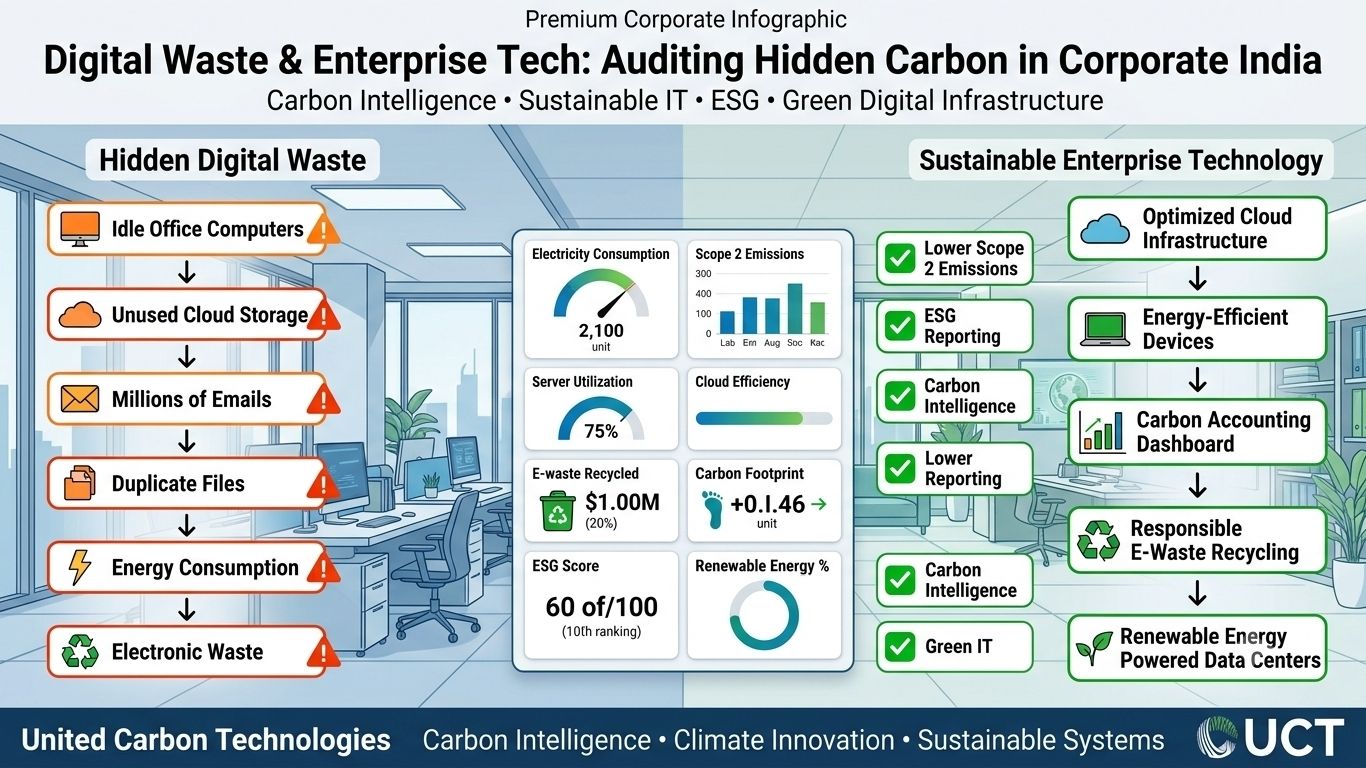
Digital waste includes unnecessary cloud storage, inactive servers, duplicate files, outdated IT equipment, and inefficient digital infrastructure. These hidden activities consume electricity, increase Scope 2 emissions, generate e-waste, and contribute to higher corporate carbon footprints.
Introduction
Every email sent, every file stored in the cloud, every online meeting, and every enterprise application relies on physical infrastructure somewhere in the world. Massive data centers, network equipment, office computers, servers, and cooling systems operate continuously to keep businesses connected.
Although these technologies enable productivity and innovation, they also require electricity, cooling, hardware manufacturing, and regular upgrades. As organizations digitize operations, hidden emissions associated with enterprise technology are becoming increasingly important within ESG reporting and Climate Intelligence.
Forward-looking companies are now treating digital sustainability as a strategic priority. By auditing digital waste and improving IT efficiency, businesses can reduce costs, strengthen ESG performance, and lower their environmental impact while supporting long-term digital transformation.
🌿 Audit Your Enterprise Carbon Footprint with UCT Climate Intelligence
United Carbon Technologies helps organizations identify hidden emissions across enterprise operations, digital infrastructure, electricity consumption, cloud computing, IT assets, and Scope 2 emissions through advanced carbon accounting and Climate Intelligence solutions.
Measure • Optimize • Report • Decarbonize
💡 Did You Know?
Deleting duplicate cloud files, optimizing server utilization, extending device lifecycles, and improving data center efficiency can collectively reduce an organization's electricity consumption and carbon emissions without affecting business productivity.
The Hidden Environmental Cost of Digital Waste
Digital waste refers to unnecessary digital assets and inefficient technology practices that continue consuming energy without delivering business value. Unlike physical waste, digital waste often remains invisible, making it difficult for organizations to recognize its environmental impact.
Unused cloud storage, duplicate databases, abandoned software environments, inactive virtual machines, and obsolete enterprise devices all require computing resources and electricity. Collectively, these activities increase operational costs while contributing to greenhouse gas emissions.
Common Sources of Digital Waste
- Unused cloud storage and archived data.
- Duplicate files and unnecessary backups.
- Inactive virtual machines.
- Idle enterprise servers.
- Outdated office computers.
- Old smartphones and electronic devices.
- Unused enterprise software licenses.
- Poor data lifecycle management.
Understanding Corporate Carbon Footprints in the Digital Era
Digital infrastructure has become one of the fastest-growing contributors to enterprise electricity consumption. Office buildings, cloud services, networking equipment, cybersecurity infrastructure, AI systems, and hybrid work environments all require reliable computing resources operating around the clock.
Many organizations accurately measure emissions from manufacturing or transportation but overlook emissions generated by enterprise technology. As ESG reporting becomes more comprehensive, businesses are expanding carbon accounting efforts to include IT operations, cloud computing, data centers, and digital infrastructure.
| Traditional Carbon Sources | Digital Carbon Sources |
|---|---|
| Manufacturing operations | Cloud computing platforms |
| Transportation fleets | Enterprise data centers |
| Industrial equipment | Office computers and servers |
| Fuel consumption | Electricity powering digital infrastructure |
| Physical waste | Electronic waste and obsolete hardware |
Recognizing these hidden emission sources enables organizations to build more comprehensive carbon inventories and make better decisions regarding digital sustainability investments.
🎓 Learn Carbon Accounting & Digital Sustainability
Discover how carbon accounting, ESG reporting, enterprise sustainability, and Climate Intelligence help organizations measure emissions, improve efficiency, and prepare for future sustainability regulations through UCT Academy.
Build a Low-Carbon Digital Enterprise
United Carbon Technologies supports businesses with enterprise carbon accounting, Scope 2 emissions analysis, digital sustainability assessments, ESG reporting, and Climate Intelligence solutions for modern organizations.
Scope 2 Emissions and Enterprise Electricity Consumption
For many service-based organizations and technology-driven enterprises, electricity consumption is one of the largest contributors to greenhouse gas emissions. These indirect emissions, known as Scope 2 emissions, result from purchased electricity used to power offices, servers, networking equipment, lighting, cooling systems, and digital infrastructure.
As businesses continue adopting cloud computing, hybrid work environments, artificial intelligence, and digital collaboration tools, electricity demand continues to increase. Monitoring Scope 2 emissions helps organizations identify opportunities to improve energy efficiency while strengthening ESG reporting and carbon reduction strategies.
Major Sources of Scope 2 Emissions
- Office electricity consumption.
- Corporate data centers.
- Cloud computing services.
- Enterprise networking equipment.
- Cooling systems for IT infrastructure.
- Lighting and office facilities.
- AI computing workloads.
- Hybrid workplace digital infrastructure.
Reducing electricity consumption through efficient IT infrastructure, renewable energy procurement, and intelligent resource management directly lowers Scope 2 emissions while reducing operating costs.
Why E-Waste Management Matters for ESG Reporting
Electronic waste is one of the world's fastest-growing waste streams. Computers, servers, smartphones, networking equipment, batteries, and office electronics contain valuable materials but also hazardous substances that require responsible disposal.
Improper e-waste management creates environmental pollution while increasing reputational and regulatory risks. Modern ESG reporting increasingly includes electronic waste management, responsible procurement, recycling initiatives, and circular economy practices as indicators of corporate sustainability performance.
Indian businesses can strengthen ESG performance by extending device lifecycles, repairing equipment, partnering with authorized recyclers, and implementing responsible IT asset disposal policies.
Best Practices for Enterprise E-Waste Management
- Maintain an enterprise IT asset inventory.
- Extend equipment lifecycles wherever possible.
- Repair before replacing devices.
- Partner with certified e-waste recyclers.
- Securely erase business data before disposal.
- Purchase energy-efficient certified hardware.
- Promote device refurbishment programs.
- Track recycling performance in ESG reports.
Building Sustainable IT Infrastructure
Green IT is no longer limited to purchasing efficient computers. Modern sustainable IT infrastructure integrates energy-efficient hardware, cloud optimization, renewable electricity, intelligent workload management, virtualization, and responsible technology procurement.
Organizations investing in sustainable IT often experience lower operating costs, improved cybersecurity resilience, longer equipment lifecycles, and stronger environmental performance while supporting corporate decarbonization goals.
| Traditional IT | Sustainable IT |
|---|---|
| Always-on servers | Optimized virtual infrastructure |
| Frequent hardware replacement | Extended equipment lifecycle |
| High energy consumption | Energy-efficient operations |
| Minimal monitoring | Continuous carbon monitoring |
| Reactive maintenance | Predictive and intelligent management |
Climate Intelligence for Enterprise Technology
Climate Intelligence combines sustainability data, carbon accounting, artificial intelligence, and business analytics to help organizations understand their environmental impacts in real time. Instead of relying solely on annual sustainability reports, businesses can continuously monitor emissions and identify opportunities for improvement.
For enterprise technology teams, Climate Intelligence enables better decision-making by combining electricity consumption, cloud utilization, device inventories, facility operations, and carbon accounting into a unified sustainability dashboard.
Technology Supporting Climate Intelligence
- Carbon accounting platforms.
- Enterprise ESG dashboards.
- AI-powered sustainability analytics.
- Cloud optimization software.
- Smart energy monitoring systems.
- IoT-enabled facility management.
- Digital twin technology.
- Automated ESG reporting tools.
The Future of Green Digital Transformation in India
India's digital economy continues expanding rapidly through cloud adoption, AI innovation, fintech, manufacturing digitization, smart cities, and enterprise software modernization. As digital infrastructure grows, sustainability will become an essential component of technology investment decisions.
Organizations that integrate carbon accounting into digital transformation strategies will be better prepared for future ESG regulations, investor expectations, and corporate sustainability commitments. Green technology is evolving from an environmental initiative into a competitive business advantage.
India Context: Building Sustainable Digital Enterprises
India is one of the world's fastest-growing digital economies. Government initiatives such as Digital India, expanding cloud adoption, AI innovation, and enterprise digitization are transforming industries across the country. Alongside this growth comes increased electricity demand, electronic waste, and digital infrastructure expansion. Integrating Climate Intelligence, sustainable IT practices, and responsible carbon accounting will help Indian enterprises balance technological growth with environmental responsibility.
What's Next?
Future enterprise sustainability will extend beyond factories and transportation fleets. Organizations will increasingly evaluate cloud platforms, artificial intelligence, enterprise software, cybersecurity infrastructure, and digital operations through the lens of carbon accounting and Climate Intelligence. Businesses that begin auditing digital emissions today will gain a long-term sustainability advantage.
Related Reads
- Cloud Computing & Data Center Footprints: What Indian IT Hubs Need to Know
- The Carbon Footprint of AI: Managing Tech Emissions in Indian Enterprises
- What Is Carbon Accounting? Complete Guide for Beginners
- The Hidden Carbon Cost of E-Commerce Logistics in India
- Climate Resilient Cities: How Urban Green Spaces Benefit Indian Real Estate
- Beyond Consumer Recycling: Why Indian Industries Must Shift to a Circular Economy
- Fast Fashion vs. Circular Textiles: The Evolving ESG Landscape for Indian Garment Exporters
- Decarbonizing the Supply Chain: Why Buying Local Matters for Indian MSMEs
Quick Summary
- Digital waste contributes to hidden corporate carbon emissions.
- Scope 2 emissions often represent a significant share of enterprise IT impacts.
- Responsible e-waste management strengthens ESG performance.
- Sustainable IT infrastructure reduces operational costs and emissions.
- Climate Intelligence improves carbon accounting and business decision-making.
- Green digital transformation supports long-term competitiveness.
- Indian enterprises can integrate sustainability into digital growth.
- Technology and environmental responsibility must evolve together.
Frequently Asked Questions
1. What is digital waste?
Digital waste includes unnecessary cloud storage, duplicate files, inactive servers, unused software, obsolete devices, and inefficient digital resources that consume energy without providing business value.
2. How does digital waste affect the environment?
It increases electricity consumption, contributes to Scope 2 emissions, creates electronic waste, and raises the overall corporate carbon footprint.
3. What are Scope 2 emissions?
Scope 2 emissions are indirect greenhouse gas emissions resulting from purchased electricity used by an organization.
4. Why is e-waste management important?
Responsible e-waste management reduces pollution, conserves valuable materials, supports ESG reporting, and promotes circular economy practices.
5. What is sustainable IT infrastructure?
Sustainable IT infrastructure uses energy-efficient hardware, optimized cloud services, renewable electricity, virtualization, and responsible device management.
6. How can businesses reduce digital carbon emissions?
Organizations can optimize cloud resources, improve server utilization, extend device lifecycles, adopt renewable energy, and continuously monitor electricity consumption.
7. What is Climate Intelligence?
Climate Intelligence combines sustainability data, carbon accounting, analytics, and AI to help organizations measure, monitor, and reduce environmental impacts.
8. Does cloud computing reduce emissions?
Efficient cloud platforms can reduce emissions when resources are optimized, but poor cloud management may increase electricity use and carbon emissions.
9. How does digital sustainability support ESG reporting?
It improves transparency regarding enterprise technology, electricity consumption, carbon emissions, e-waste management, and operational efficiency.
10. How can United Carbon Technologies help?
UCT provides Climate Intelligence, carbon accounting, enterprise sustainability assessments, ESG reporting, Scope 2 emissions analysis, and digital sustainability solutions.
Key Takeaways
- Digital infrastructure has a measurable environmental footprint.
- Scope 2 emissions are increasingly important in enterprise sustainability.
- E-waste management strengthens ESG performance.
- Green IT reduces costs while lowering emissions.
- Climate Intelligence enables smarter digital transformation.
- Indian enterprises can lead sustainable technology adoption through carbon accounting and ESG reporting.
Transform Your Enterprise with Climate Intelligence
Measure digital emissions, strengthen ESG reporting, optimize Scope 2 performance, and build a sustainable technology strategy with United Carbon Technologies.